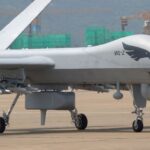
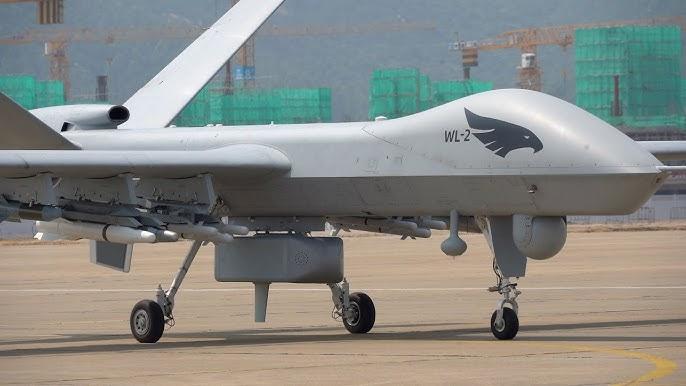

The Chengdu Wing Loong II (GJ-2) is a Chinese medium-altitude, long-endurance (MALE) unmanned combat aerial vehicle (UCAV) designed for persistent ISR and precision strike missions; it is an enlarged, turboprop-powered follow-on to the Wing Loong I and has become one of China’s most exported armed drones.
Development & Purpose
The Wing Loong II was unveiled publicly in 2015 (concept) and progressed to production and PLAAF service as the GJ-2 from 2018. Chengdu Aircraft Industry Group designed it as a more capable, export-oriented MALE UCAV: larger airframe, turboprop powerplant, satellite communications, and explicit provision for multiple guided munitions. The platform targets the niche between light tactical drones and high-end Western MALE systems by offering an affordable strike-capable ISR package for both domestic and export users.
Airframe & Performance (Key figures)
These are open-source consensus figures; block and export variants vary.
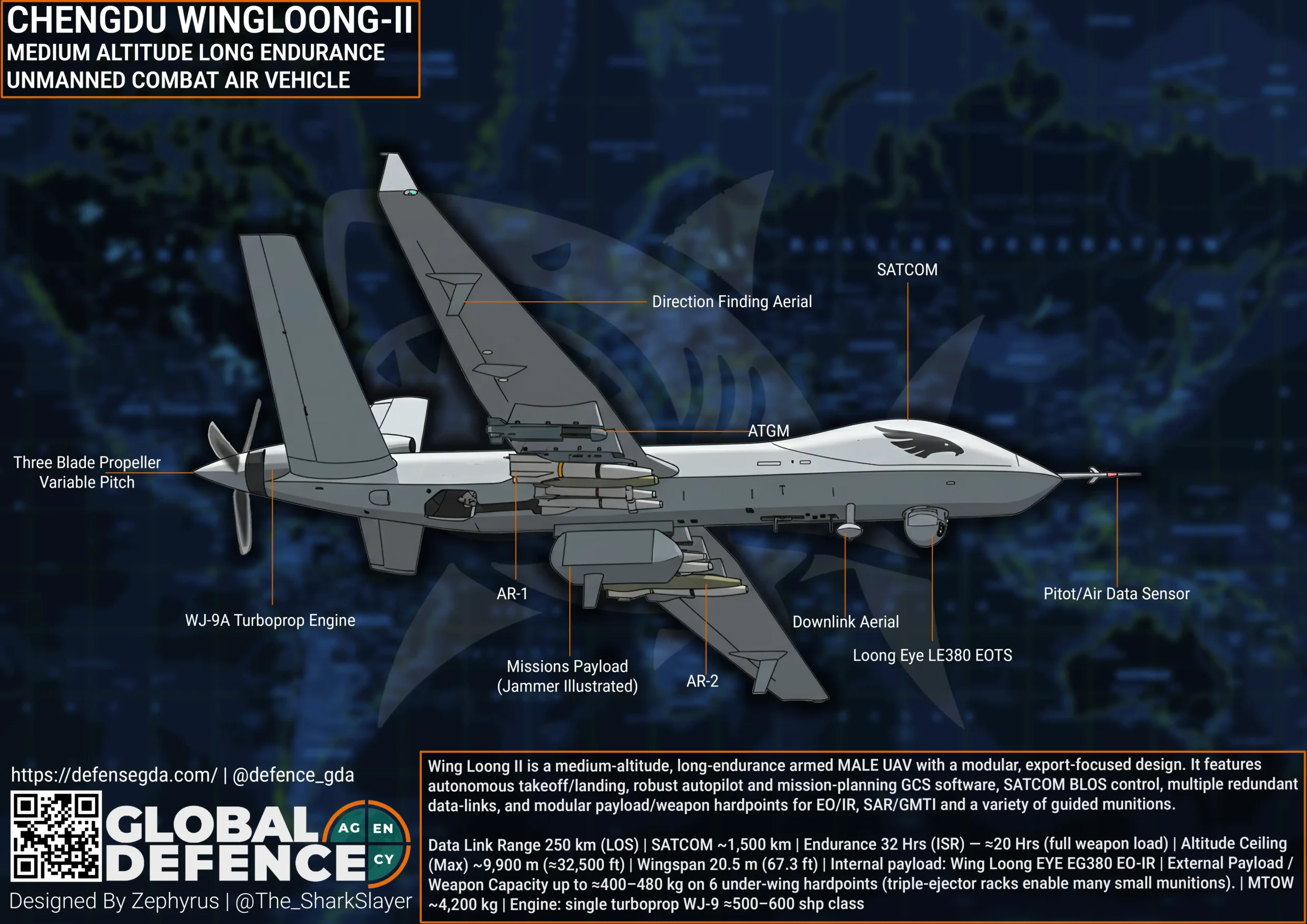
- Length: ~11.0 m.
- Wingspan: ~20.5 m.
- Height: ~4.1 m.
- Max Take-off Weight (MTOW): ~4,200 kg.
- Internal/usable payload: platform is primarily under-wing payload centric (no large internal bomb bay). Total weapon/payload capacity commonly cited ≈ 400–480 kg.
- Powerplant: single turboprop — most reporting points to a WJ-9 family turboprop in the ≈500–600 shp class (sources differ on exact sub-variant).
- Max speed / cruise: top speed ≈ 370 km/h; cruise ≈ 200 km/h.
- Endurance: up to ~32 hours in light ISR configuration; typical armed mission endurance falls (commonly reported ~20 hours depending on load).
- Service ceiling: ≈ 9,900 m (≈32,500 ft).
Subsystems: Sensors, Avionics & Comms
- Electro-Optical / Infra-Red (EO/IR) turret: a stabilized EO/IR turret under the fuselage provides day/night imaging, laser rangefinding and laser designation for laser-guided munitions. This is the primary targeting sensor for precision strike.
- SAR/GMTI (variant dependent): some versions and civil/rescue derivatives have been fitted with synthetic aperture radar and communications relay payloads for all-weather surveillance and comms amplification.
- Flight control & autonomy: mission planning/GCS suite supports autonomous takeoff/landing, waypoint navigation, return-to-base on link loss, and multi-aircraft control in some configurations. Redundant IMUs and multi-mode navigation (GNSS + INS) are reported in public literature.
- Data-links & SATCOM: LOS data-link ranges depend on antenna/terrain (commonly 100–200+ km); SATCOM enables BLOS command & data links out to ~1,000–1,500 km or beyond depending on architecture. The platform’s satcom dome is a visible external feature.
Weapons, Hardpoints and Armament Integration
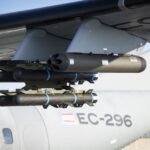
- Hardpoints: typically three pylons per wing (six total). With triple-ejector racks small-munitions capacity can be increased (open-source claims up to a dozen small munitions in maximum small-store racks).
- Common munitions employed / observed:
- AKD-10 / HJ-10 family (export labelled BA-7 / Blue Arrow-7) — laser-guided anti-armor missiles used widely on Wing Loong II variants and observed in combat footage.
- FT / GB series guided glide bombs (small precision glide bombs and GP bombs) — used for point strikes against light fortifications, vehicles and structures.
- Guided rockets / smaller AR-type missiles — some showings/demos include guided rocket pods and modular munitions.
Operational History & Export
- Users / operators: The Wing Loong II / GJ-2 entered PLAAF service in 2018 and has been exported to several states including (public reporting) the UAE, Saudi Arabia, Egypt, Morocco, Algeria, Pakistan (joint production agreements reported), Nigeria and others. It contributed to China’s rapid rise in global UCAV exports.
- Combat usage examples: UAE-operated Wing Loong IIs were used in Libya; visual/forensic evidence links Wing Loong-family UCAV strikes (BA-7 missiles) to civilian casualty incidents documented by NGOs and media. The platform has also been observed in Middle Eastern and African theatres where exported.
Strengths
- Export economics and availability: cheaper and more available internationally than high-end Western MALE systems, enabling governments with smaller defence budgets to field persistent strike-capable UAVs.
- Modularity: hybrid composite/metallic airframe, modular payload bays and multiple hardpoints allow quick re-roling between ISR, strike, and comms/relay variants.
- Endurance and BLOS capability: long endurance in ISR mode (up to ~32 h) plus SATCOM for BLOS employment make it suitable for long patrols and remote area strike missions.
Limitations & Vulnerabilities
- Platform tier: while capable, it does not match the payload, altitude ceilings, avionics and integration of top-tier platforms (e.g., MQ-9 Reaper family) and remains lower in survivability in sophisticated integrated air-defence environments. Open sources show lower payload-to-endurance tradeoffs compared with larger Western MALE UCAVs.
- Export variation & capability downgrades: export customers sometimes receive downgraded sensors, EW suites or weapons compared with PLA domestic variants — complicating open assessments and leading to ambiguity about exact fielded capability for each operator.
- Combat losses: recorded shoot-downs and losses in contested theatres (e.g., Libya) demonstrate survivability limits against capable air defences, electronic attack, or targeted kinetic counter-measures.
Variants & Derivatives
- GJ-2: PLA designation for domestic service.
- Wing Loong 2H / civil comms variant: comms/relay and SAR variants used for civil tasks (flood relief / comms relay).
- Export blocks: multiple export blocks with differing sensor/weapon fitments; some customers reported local assembly or licensed production deals (e.g., Pakistan).
Labelled Diagram