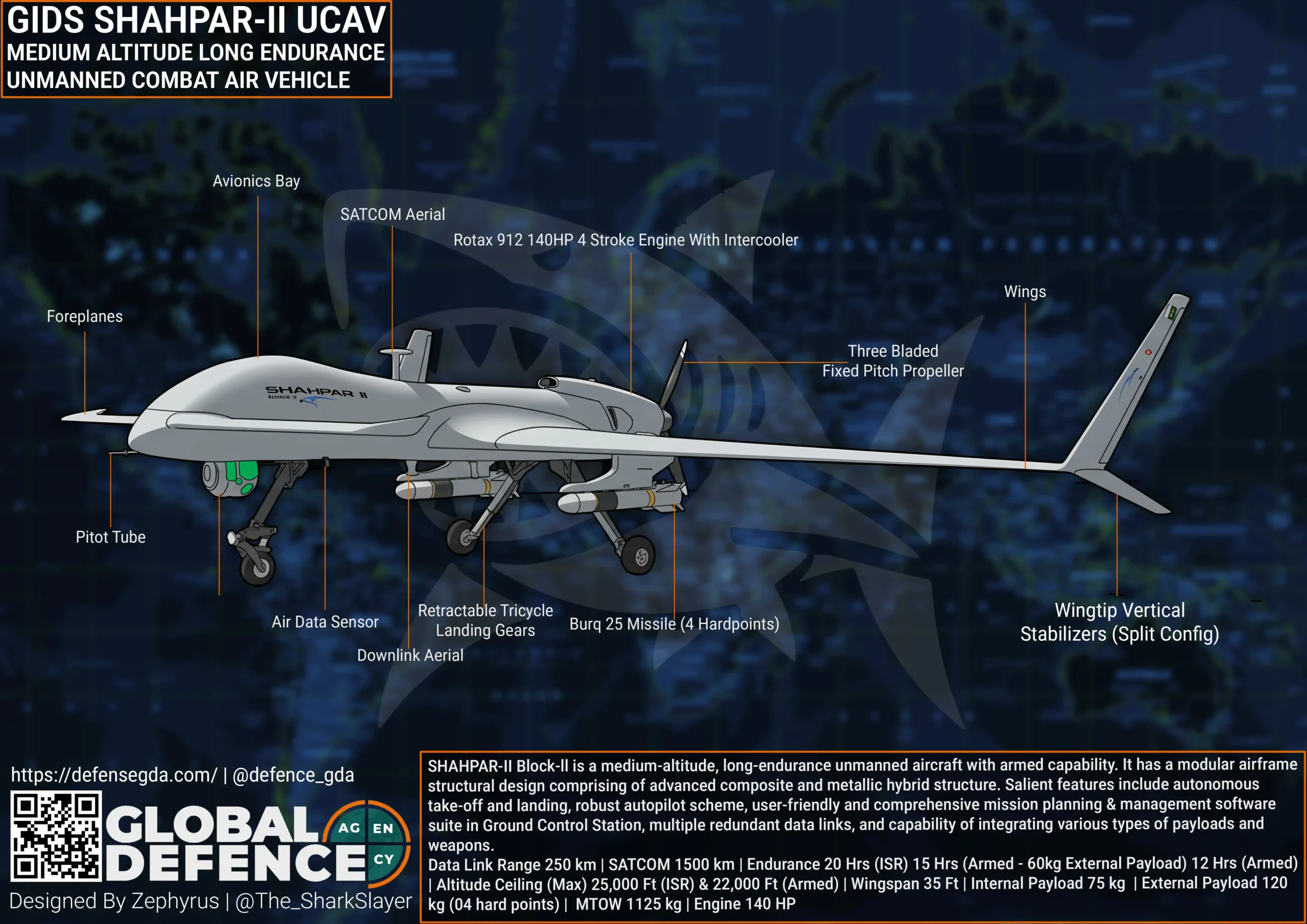
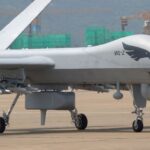
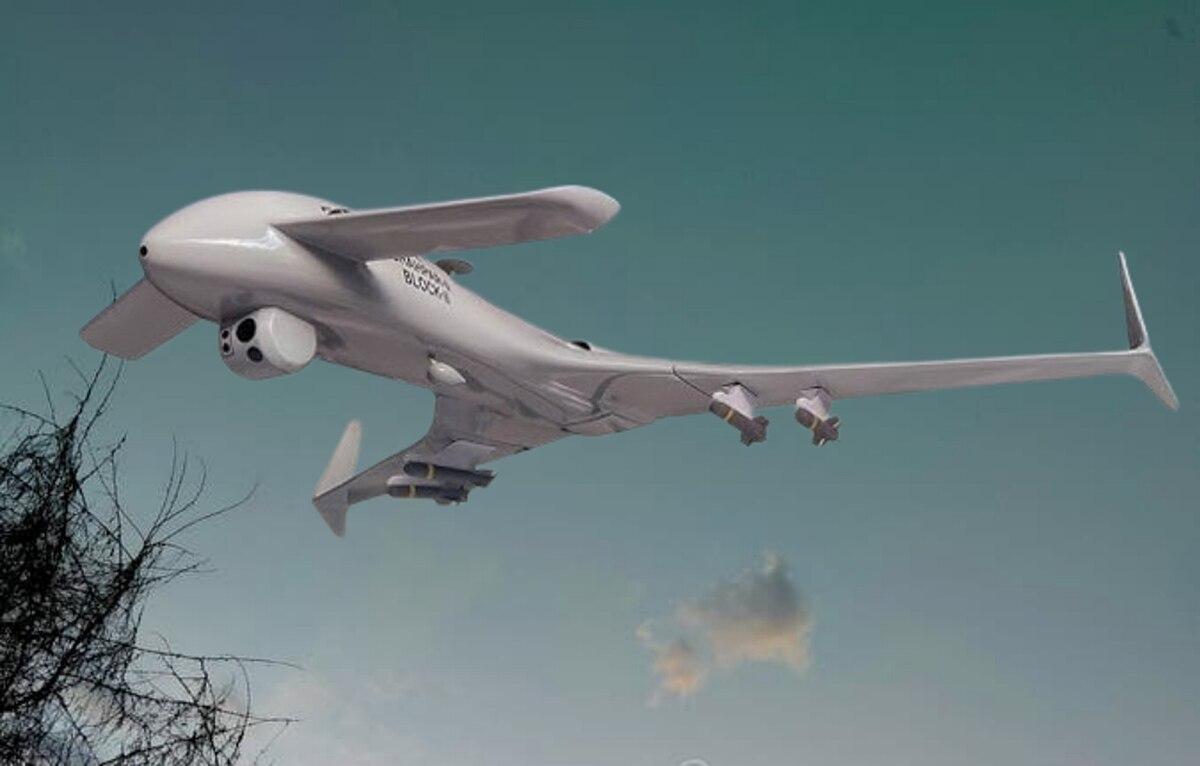

Pakistan’s Shahpar-II Block-II represents the maturing of its indigenous UAV ecosystem — a shift from basic reconnaissance platforms toward autonomous, networked combat drones capable of armed persistence. Developed by GIDS, Shahpar-II sits in the MALE (Medium Altitude, Long Endurance) class — bridging the gap between smaller tactical UAVs and heavier systems like the Chinese Wing Loong-II.
Where the first-generation Shahpar focused on ISR, Block-II adds teeth. A 140-hp turbocharged engine and a composite-metal hybrid airframe push endurance to 20 hours in ISR configuration, or 12–15 hours with up to 120 kg of external payload across four hardpoints. Its modular architecture enables rapid reconfiguration between surveillance, electronic warfare, and strike roles.
Connectivity is its real multiplier. Triple-redundant datalinks offer 250 km LOS and 1,500 km BLOS (SATCOM) control — turning Shahpar-II into a persistent forward sensor node or a precision shooter depending on mission demands. Integrated EO/IR, SAR, COMINT/ELINT payloads, and optional laser-guided munitions (claimed CEP < 1.5 m) make it a credible deep-interdiction asset for time-sensitive strikes with minimal collateral risk.
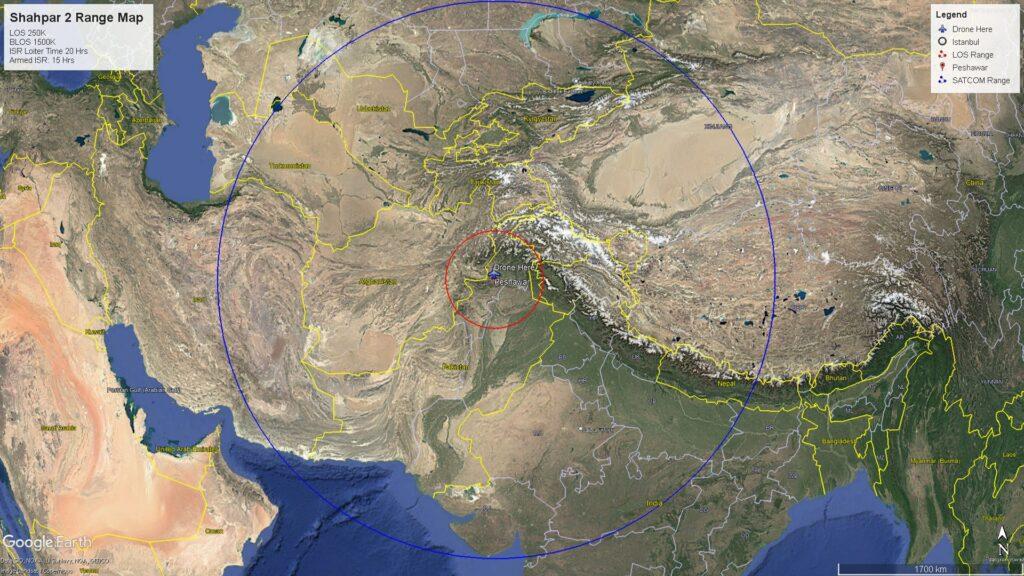
Operationally, Shahpar-II is a “quiet hunter”: mobile, rapidly deployable, and shoot-and-scoot by design. Its low acoustic signature, autonomous take-off and landing, and mid-air engine restart capability allow flexible operations from austere runways. With dual-redundant avionics and advanced GCS supporting two UAVs simultaneously, it scales neatly into networked kill chains — pairing ISR feeds with precision engagement in real-time.
In essence, Shahpar-II marks Pakistan’s steady evolution from drone buyer to drone builder — a platform that fuses indigenous control with modular adaptability. Not the loudest in its class, but certainly one of the most quietly dangerous.
Hi Res Poster