
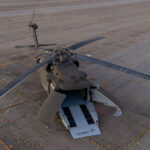
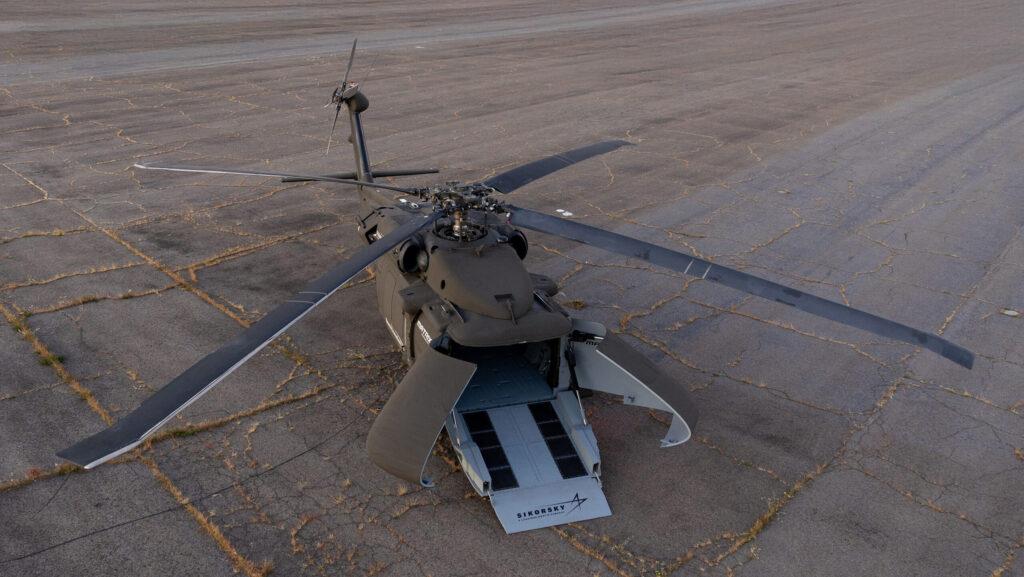

n October 2025, Sikorsky, a Lockheed Martin company, unveiled the S-70UAS “U-Hawk”, a fully autonomous variant of the UH-60L Black Hawk. Developed by Sikorsky Innovations, the project was completed from concept to prototype in just ten months — a rapid turnaround for a platform intended to redefine rotary-wing logistics and utility operations.
Overview
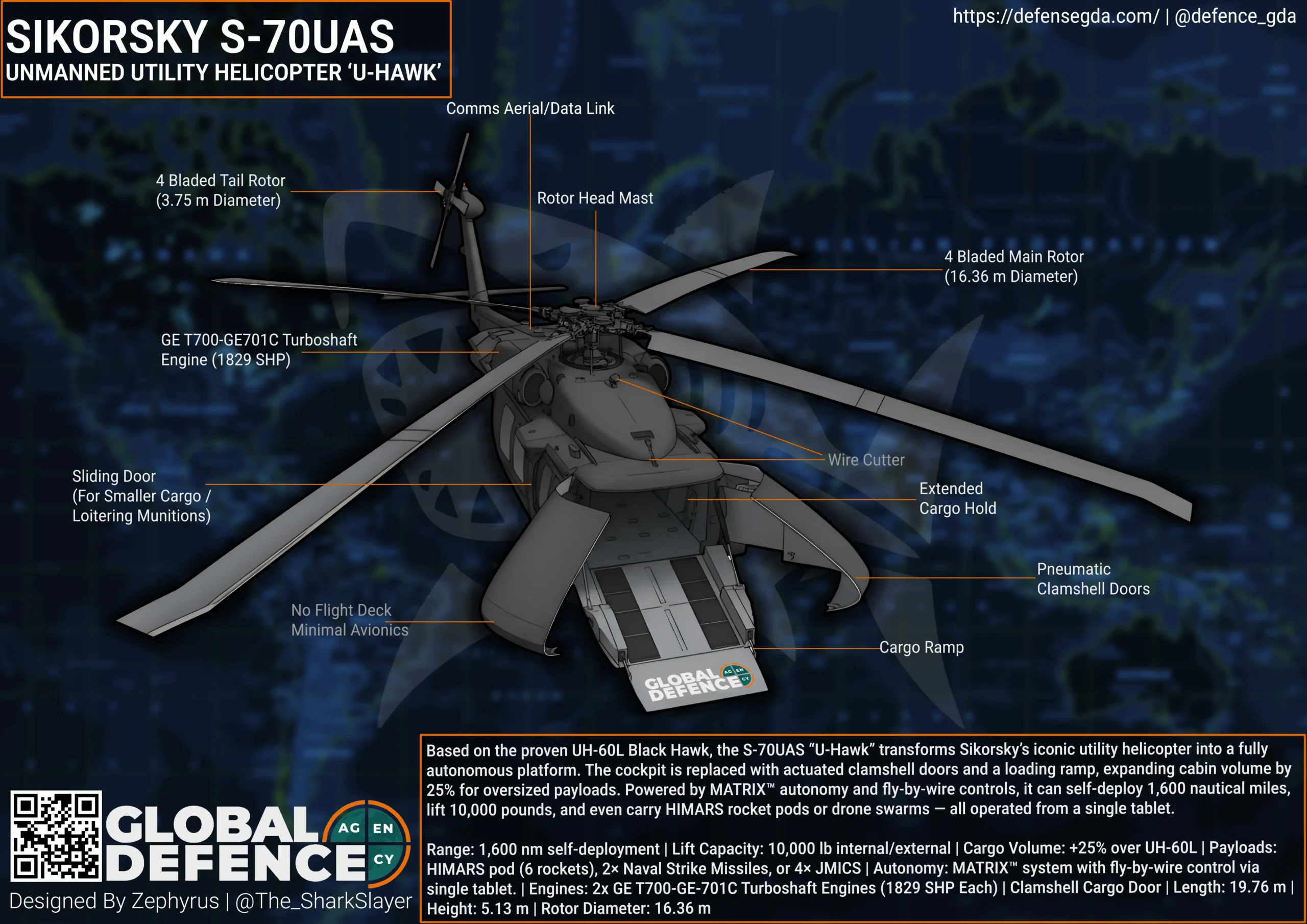
The U-Hawk is not a new airframe but a conversion of existing UH-60L helicopters. Sikorsky removed the cockpit, crew stations, and associated controls, replacing them with actuated clamshell doors and a powered loading ramp, which expand the cabin’s usable space by 25%. Internally, it retains the UH-60L’s twin General Electric T700-GE-701C turboshaft engines (1,890 shp each), main gearbox, and dynamic systems — maintaining roughly 95% parts commonality with the legacy Black Hawk fleet.
Flight control is handled by a third-generation fly-by-wire system integrated with Sikorsky’s MATRIX™ autonomy suite, allowing the helicopter to operate entirely without onboard crew. Command and mission input are handled via a tablet interface, through which an operator can start, load, plan, and execute a flight autonomously.
Capabilities
- Range: 1,600 nautical miles (self-deployment)
- Lift Capacity: 10,000 lb internal/external
- Cargo Volume: 25% greater than UH-60L
- Payload Options: 4× Joint Modular Intermodal Containers (JMICS), 1× HIMARS rocket pod (6 rockets), 2× Naval Strike Missiles
- Endurance: Up to 14 hours loiter time
- External Hook: 9,000 lb (4,080 kg)
- Powerplant: 2× GE T700-GE-701C turboshaft engines (1,890 shp each)
- Autonomy: MATRIX system with fly-by-wire control, single-operator tablet interface
Operational Use Cases
The U-Hawk’s design is focused on autonomous logistics, long-range resupply, and denied-area support. By removing the cockpit, the aircraft can carry bulkier or longer payloads — from missile pods to uncrewed ground vehicles — that would otherwise not fit inside a standard Black Hawk.
Potential roles include:
- Autonomous cargo and resupply missions in high-risk zones
- Missile or drone transport for front-line deployment
- Support for uncrewed ground vehicles (UGVs) such as the Hunter Wolf 6×6
- Launch platform for reconnaissance or strike drones
- Long-endurance surveillance or relay missions using modular payloads
These capabilities allow operators to sustain forward forces or humanitarian efforts without exposing pilots to enemy fire or dangerous conditions.
Advantages
The main advantage of the U-Hawk lies in fleet adaptability and cost efficiency. By using existing UH-60L airframes, militaries can convert legacy platforms into autonomous systems instead of procuring new UAVs. The 95% parts commonality simplifies maintenance, logistics, and training, while the absence of onboard crew reduces operational costs and risk.
Additionally, the autonomous flight control allows for consistent performance in degraded environments, GPS-denied zones, or during extended-duration missions where pilot fatigue would normally be a factor. The expanded internal volume also provides greater flexibility for unconventional payloads, such as drone swarm launchers or fuel tanks for extended range.
Limitations and Considerations
Despite its promise, the U-Hawk remains in prototype form, with its first flight scheduled for 2026. Integration into military logistics chains will depend on software reliability, airspace certification, and mission-specific autonomy performance. While the retrofit approach reduces costs, it also inherits the structural and maintenance limitations of older UH-60L airframes.
Moreover, the autonomy stack — while proven in prior MATRIX demonstrations — must demonstrate reliability under combat conditions before large-scale adoption can occur.
Assessment
The Sikorsky S-70UAS represents a transitional platform — bridging legacy utility helicopters and future unmanned vertical lift systems. Rather than replacing the Black Hawk, it extends its service life into the era of autonomy.
For militaries seeking a cost-effective, attritable unmanned lift solution, the U-Hawk offers a credible pathway: reuse existing assets, reduce risk to personnel, and enable sustained logistics in environments too dangerous or demanding for crewed helicopters.
Labelled Diagram