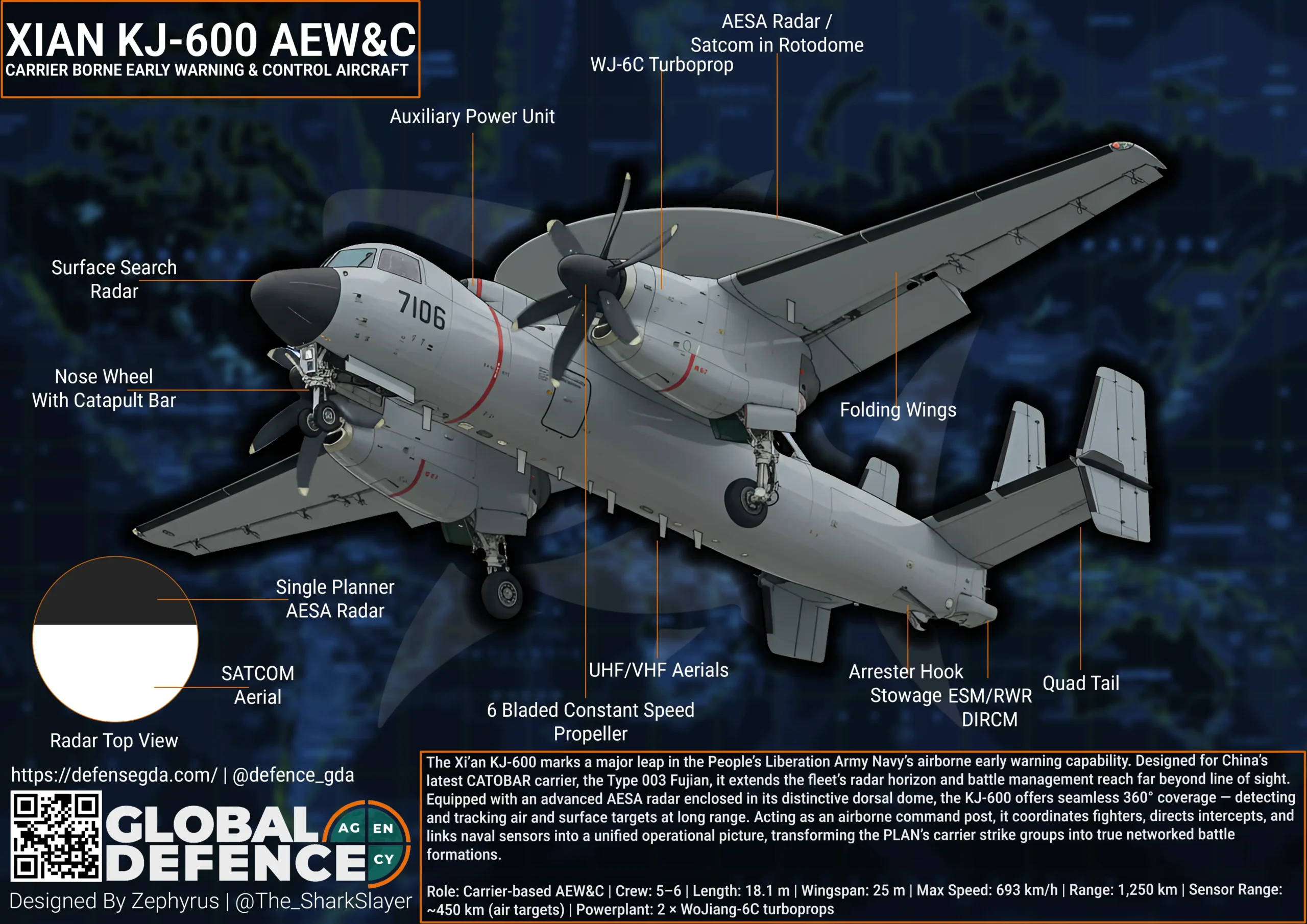
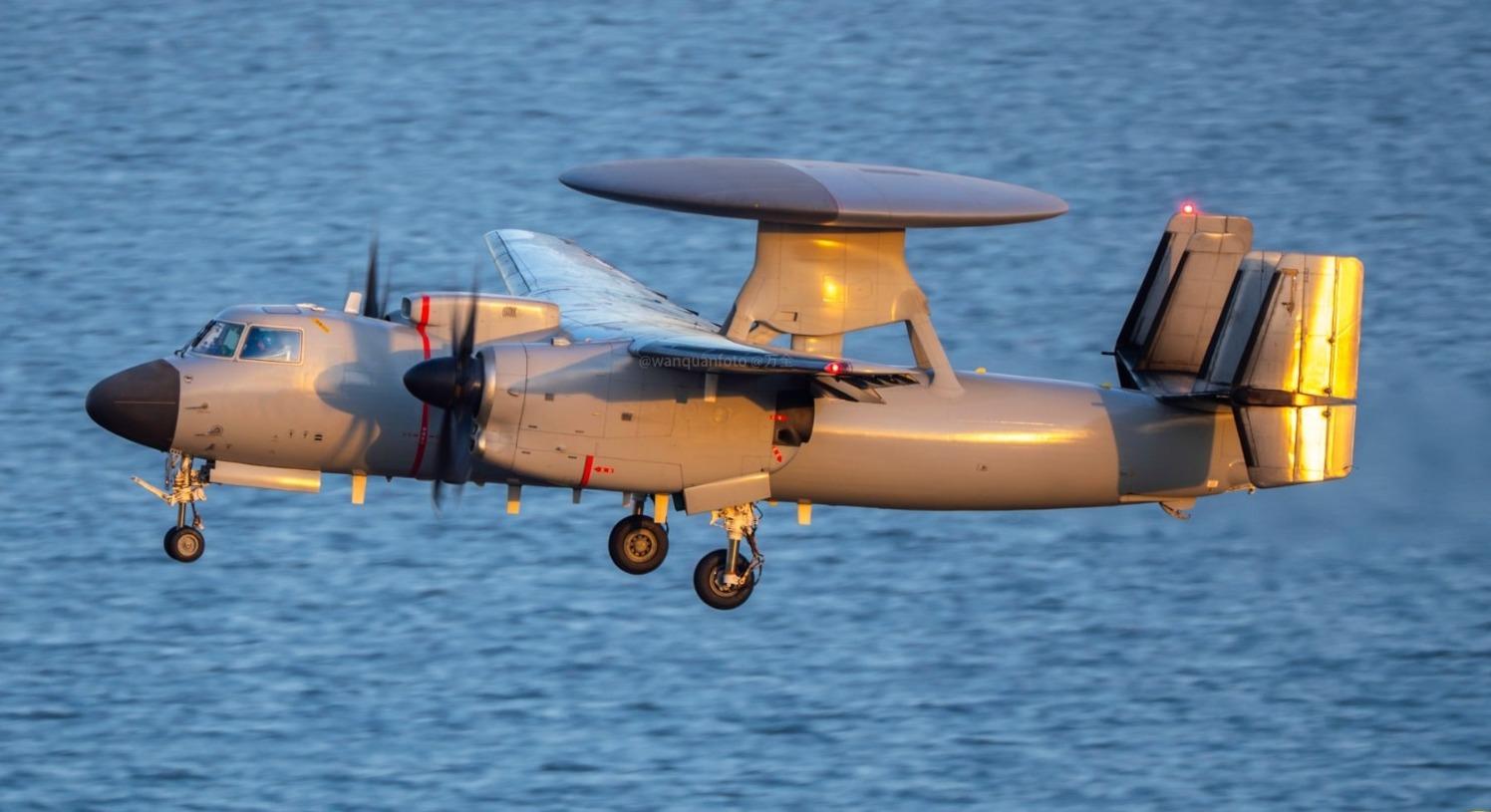

The Xi’an KJ-600 represents one of the most significant leaps in the evolution of Chinese naval aviation. Built for the People’s Liberation Army Navy’s new generation of catapult-equipped carriers, it gives China the airborne early warning capability it has long lacked at sea.
Until now, Chinese carriers depended on helicopter-based AEW platforms like the Z-18J, which offered limited altitude and range. The KJ-600 changes that equation. Operating from the CATOBAR-configured Type 003 Fujian, it provides the fleet with long-range radar coverage, command, and control over the vast spaces of the western Pacific.
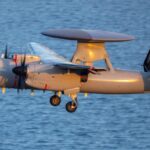
Externally, the KJ-600 resembles the American E-2 Hawkeye, but it is an entirely indigenous design. It is a twin-turboprop, high-wing aircraft featuring a large circular radome above the fuselage and a distinctive four-fin tail configuration. The wings fold for carrier storage, and the aircraft is optimized for catapult launch and arrested recovery operations. Its airframe and control systems have been tested extensively since the first prototype’s flight in August 2020.
At the heart of the platform lies its radar. The large dorsal radome is believed to contain a tri-panel Active Electronically Scanned Array system that provides uninterrupted 360-degree coverage. AESA technology offers faster scanning, resistance to jamming, and the ability to track multiple air and surface targets simultaneously. Analysts assess its effective detection range against aircraft to be around 450 kilometers, depending on altitude and radar cross section.
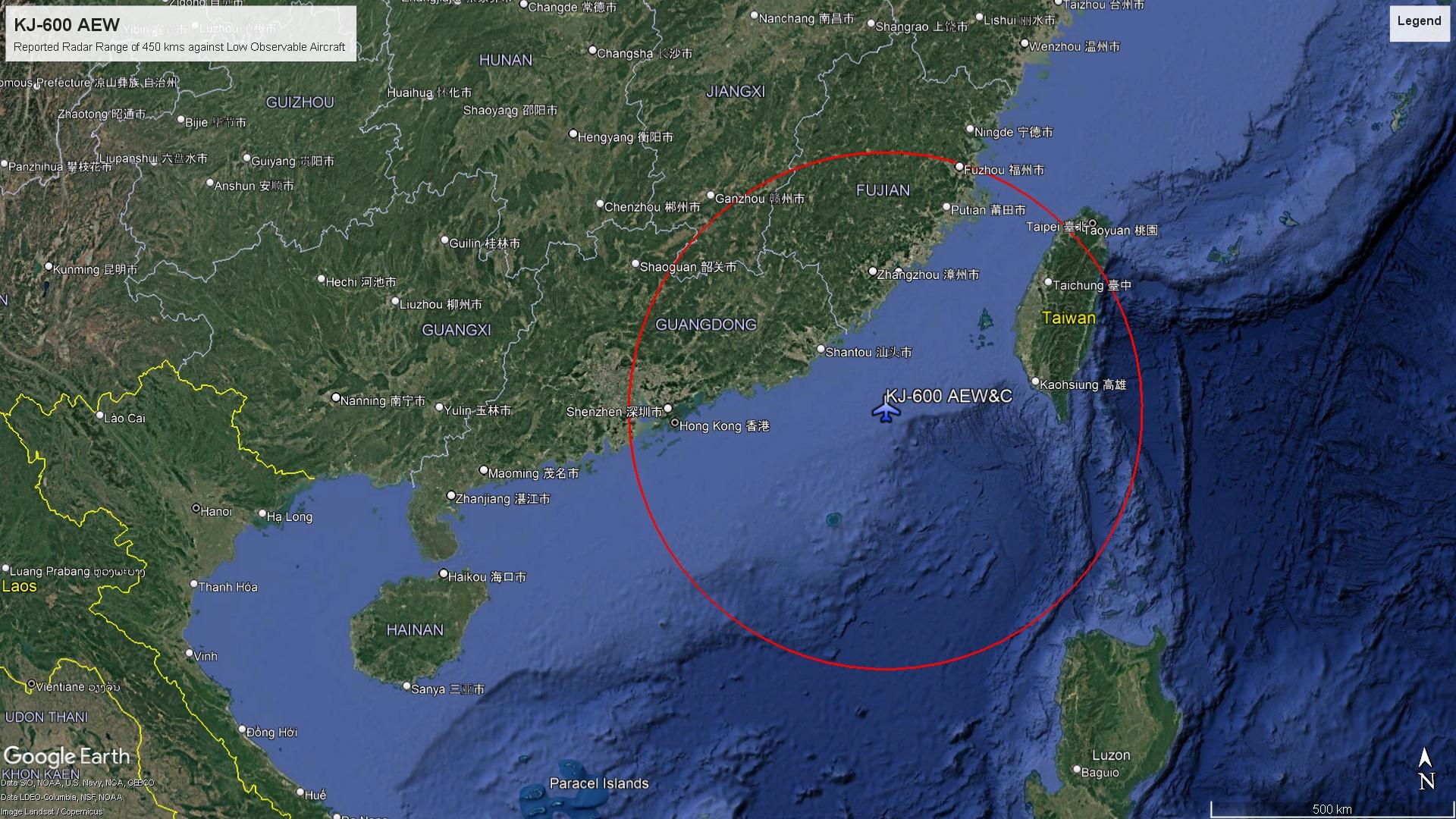
This capability allows the KJ-600 to detect low-observable aircraft, sea-skimming missiles, and distant surface targets well before they appear on shipborne sensors. It can relay data directly to fighters like the J-15T and J-35, cue long-range intercepts, and help synchronize the carrier group’s defensive and offensive actions.
The aircraft is powered by two WoJiang-6C turboprop engines and typically carries a crew of five to six. It measures about 18 meters in length with a wingspan of 25 meters and a top speed close to 700 kilometers per hour. Its operational radius is roughly 1,200 kilometers, giving it substantial endurance for patrol and control missions.
The KJ-600’s induction marks a turning point for the PLAN. With the Type 003 Fujian entering sea trials and catapult certifications completed in 2025, China now possesses the foundation for a true blue-water carrier air wing. Fixed-wing early warning aircraft give the fleet the ability to see first, decide first, and strike first.
It is not just another aircraft. It is the node that completes the Chinese carrier battle network.
Labelled Diagram