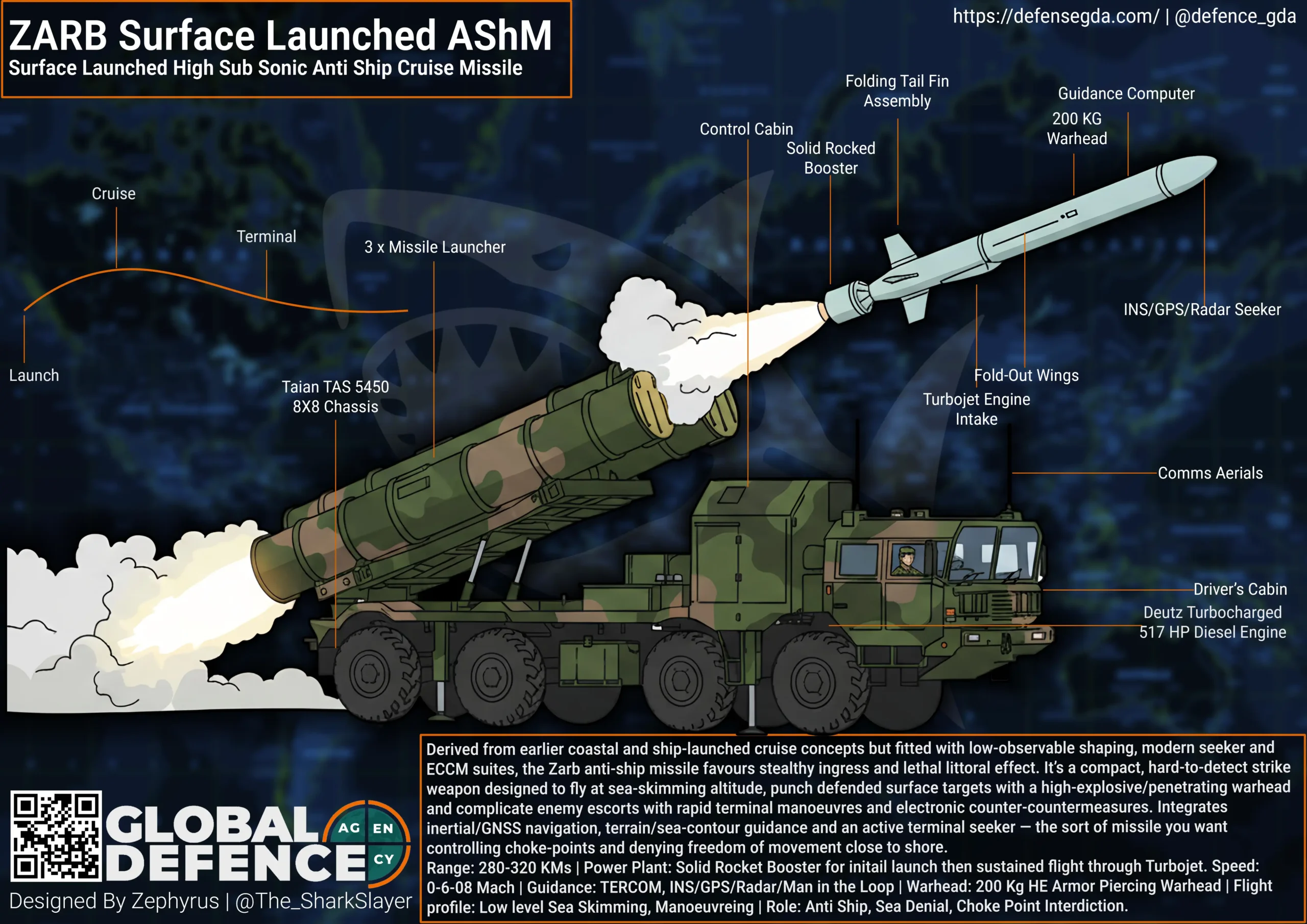


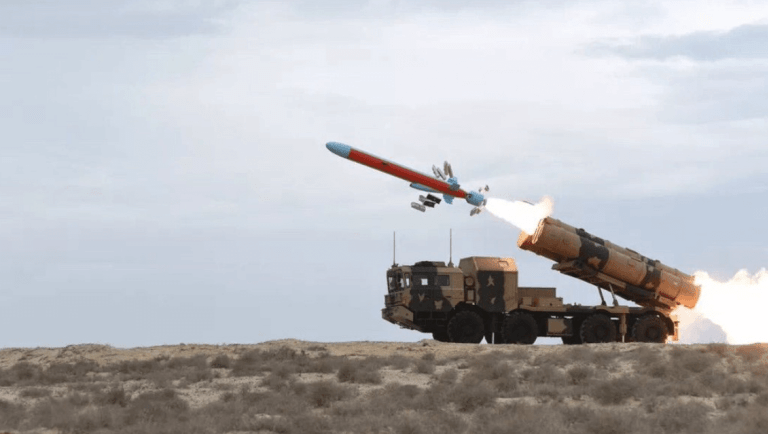

Derived from the Chinese YJ-62 family, the Zarb is a compact but powerful land-launched anti-ship cruise missile designed to give Pakistan flexible and survivable coastal defense. Mounted on a Taian TAS-5450 8×8 all-terrain launcher carrying three missiles, the system replaces fixed coastal batteries with mobility, surprise, and the ability to fire and relocate quickly.
Airframe and Launcher
The Zarb missile is about 6.1 meters long, and around 7 meters with its detachable solid rocket booster. It is built to balance range and survivability in the littoral environment. The missile has foldable control surfaces that deploy after launch: four tail rudders unfold first, followed by the main wings once the booster separates and the onboard turbojet engine starts.
The launcher, a three-round pod mounted on the rugged Taian TAS-5380 8×8 chassis, provides excellent mobility and cross-country performance. This allows launch units to reposition rapidly along Pakistan’s coastline, from Sir Creek in the north to Jiwani in the southwest.
Propulsion and Flight Profile
Zarb uses a two-phase propulsion system. A solid rocket booster provides the initial launch thrust, lifting the missile clear of the vehicle. After separation, a turbojet engine takes over for sustained cruise flight.
The missile flies at low altitude throughout its mission, transitioning to a sea-skimming profile in the terminal phase to minimize radar detection. This flight path, combined with its high terminal speed, makes it very difficult for shipborne air defenses to detect or intercept in time.
Guidance and Control
The guidance system combines GNSS and INS for midcourse navigation, while an active radar seeker guides the missile during the final approach. Zarb also includes a man-in-the-loop control link, which allows operators to monitor or adjust the missile’s path during the terminal phase.
This feature provides real-time control, reduces the risk of striking the wrong target, and allows operators to react to changing battlefield conditions in cluttered littoral zones.
Warhead and Lethality
Zarb carries a 200–280 kg high-explosive armor-piercing warhead, giving it the power to destroy or disable medium to large surface vessels and transport ships. This warhead weight puts Zarb among the heavier coastal cruise missiles in service, capable of causing severe structural damage or mission kills with a single hit.
Mobility and Tactics
The greatest strength of the Zarb system lies in its mobility. Mounted on an 8×8 all-terrain vehicle, launchers can relocate quickly, hide, and fire from unpredictable locations. These shoot-and-scoot tactics make counter-strikes very difficult.
Mobile batteries can:
- Cover the entire coastline without needing fixed infrastructure
- Create overlapping threat zones along Pakistan’s shores
- Avoid detection and preemptive attacks
Its combination of low-level flight, active terminal guidance, and human control makes Zarb hard to detect and even harder to intercept. Each missile can be guided for maximum effectiveness while minimizing collateral damage.
Strategic Importance
Deploying a system like Zarb forces any hostile navy to operate farther from Pakistan’s coast. It raises the risk and cost of approaching key areas or attempting blockades. Zarb acts as a deterrent that helps protect Pakistan’s sea lines of communication and coastal approaches.
For a navy that focuses on defending its waters rather than projecting power globally, the Zarb missile provides a powerful asymmetric advantage. It allows Pakistan to influence the battlespace without directly engaging in large-scale naval warfare.
Limitations and Countermeasures
Like all modern missile systems, Zarb is not invulnerable. It can be challenged by electronic warfare, GNSS jamming, decoys, and layered ship defenses. However, its combination of active radar guidance and man-in-the-loop control helps it remain effective even under hostile conditions.
Defense against such weapons requires strong detection networks, coordinated fleet tactics, and fast decision-making by naval crews.
Conclusion
The Zarb missile reflects modern coastal defense strategy: mobile launchers, long-range cruise capability, low-altitude flight, human-guided precision, and heavy warheads optimized for maritime targets.
Used effectively, it shifts the balance of naval power toward the shore, creating uncertainty for any enemy force planning operations near Pakistan’s coastline. Zarb turns Pakistan’s long coastline into an active, unpredictable threat zone — one that can strike back swiftly and precisely.sing the operational cost for any adversary attempting close coastal operations.
Launcher/Missile Infographic