
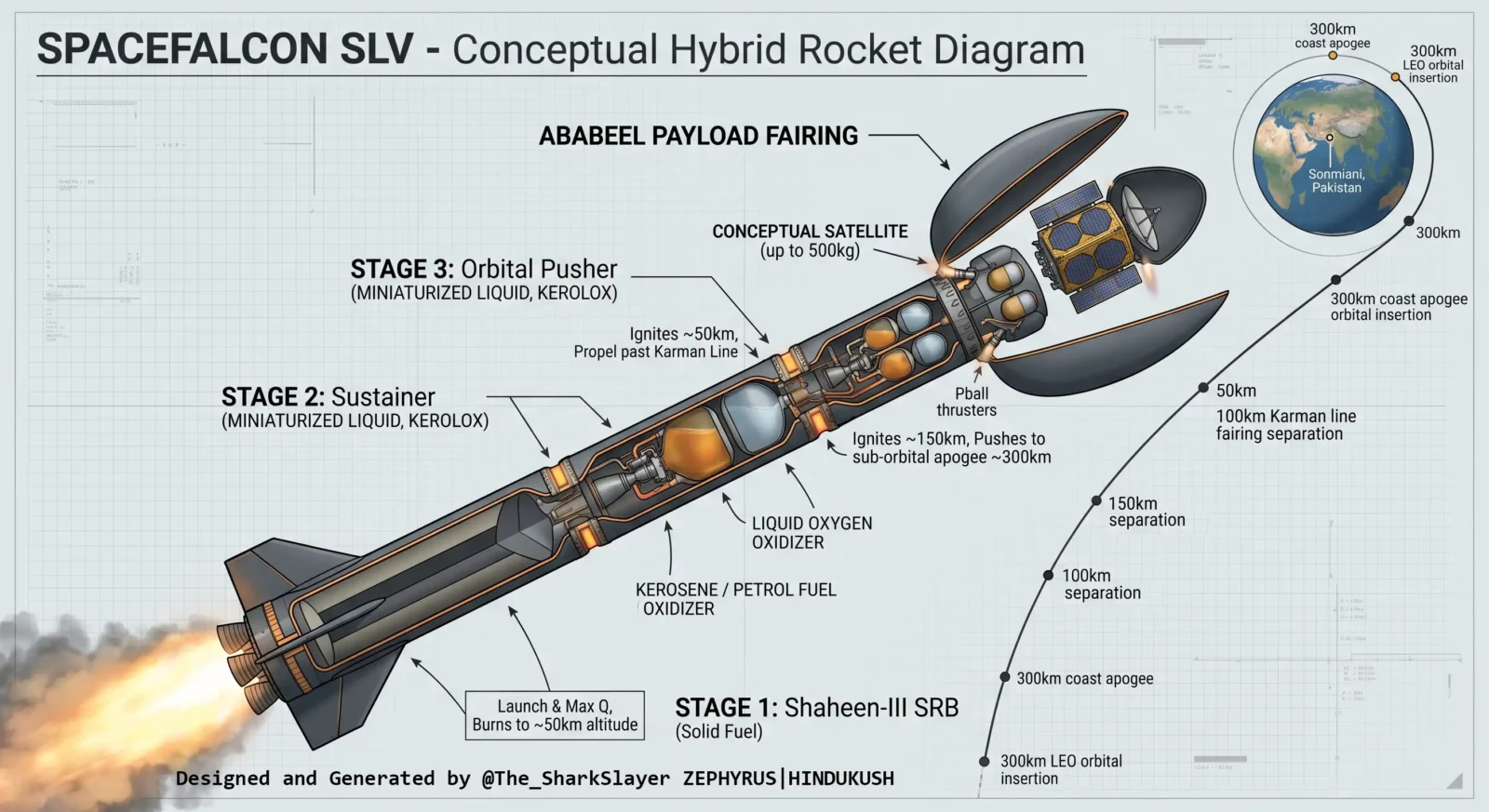

The End goal of this thought experiment will be to design a plausible SLV. lets launch into the design and development for a Space Launch Vehicle from the parts already present in our strategic inventory. Keep in mind that this is going to be a hypothetical experiment and in no way whatsoever am I claiming to be an expert in this.
So what is an SLV?
An SLV is essentially a multi stage ballistic missile but instead of using it to send warheads on the other side of the globe we use it to transport satellites into orbit.
Concept and Thought Process
So technically if we can make ballistic missiles then we can make SLVs as well. So for this thought process we are going to use the tools that are already at our disposal and create an SLV from various rockets and missiles already in service with the Mumlikat e Khudadaad.
Designing the SLV
So our SLV is going to be a three staged hybrid rocket with the capability of transporting a Satellite of up to 500 kgs in Lower Earth Orbit (300 kms). I am going to call it the SpaceFalcon.
Basic design will consist of the Stage 1 of Shaheen 3; the job of this stage will be to get it past the thicker atmosphere.
Stage 2 and 3 will be liquid boosters roughly based on a miniaturized Ghauri 2; for fuel we will be using it with Kerosene and petrol mix and for oxidiser we will go with Liquid Oxygen.
For the final stage we will be using the Post Boost Vehicle and the payload fairing from the Ababeel MIRV, powered by another liquid kick motor whose job will be to orbital insertion.
Launch Pad
Since the goal of the SLV will be to send a hypothetical satellite into Lower Earth Orbit we can’t just launch it from anywhere, I mean we can but that would complicate things a lot more than, since the Earth isn’t completely round, so the closer we launch it from the equator, the lesser distance it would have to travel, now you’ll be thinking we aren’t an equatorial country, and to that I would clap for you because you are correct. So we will have to do the next best thing, launch it from as south as we possibly can and guess what? we already have a launch facility at the southern edge of the country, yes I am talking about Sonmiani.
Lift Off
So at T-0 Minutes the Stage 1 SRB will ignite, it will burn for around ~70s-90s and after it burns out it will separate at a respectable altitude of 50 km, at this altitude we will be above 99% of the Earth’s atmosphere.
2nd Stage
After separation the second stage liquid motor (sustainer) will kick in it will burn for around ~150s and will propel it past the Karman line and officially take it to space, it will separate at the altitude of 150 km.
At the Karman line the Ababeel fairing will split open exposing the the payload to space, The rocket will now be travelling horizontally through space.
Orbital Push
After separation of the sustainer the third stage (orbital pusher) will ignite its job will be to push the payload to the apogee (highest point of the arc) at around 300 kms; after burn out this stage will detach and burn out in atmosphere.
Coast
After the separation the PBV and its kick motor will continue riding the sub orbital arc at 300 kms altitude for around ~7 mins.
Post Boost
After this coast phase the Kick motor will ‘kick’ at the top of the apogee, it will fire its thrusters horizontally and continue burn for around ~40s and add the final delta v (velocity) needed to reach orbital velocity (28,000 km/h) after this the satellite will be freed from the Bus and will open its solar panels.
All of this will take around 15 mins from launch till orbit. Congratulations, we have hypothetically launched a satellite in LEO using the parts from previously tested strategic assets. See? it wasn’t that difficult.