

Technology, Doctrine and the Future Maritime Battlespace of Pakistan Navy
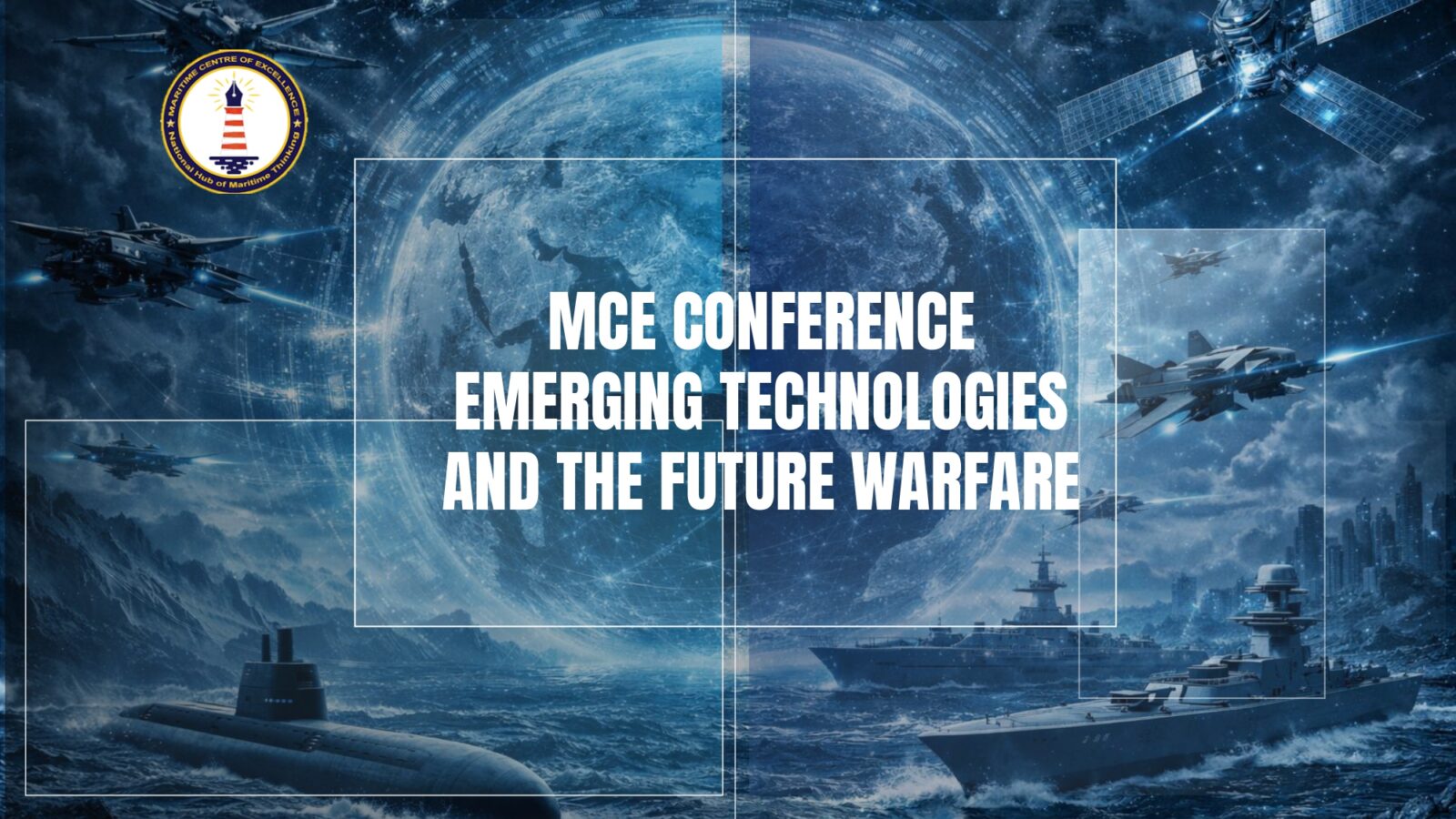
When the Pakistan Navy’s Maritime Centre of Excellence (MCE) convened an international conference on “Emerging Technologies and the Future Warfare” at Karachi, the timing was anything but coincidental. The two-day event, structured deliberately around the OODA (Observe, Orient, Decide, Act) Loop framework, brought together naval leadership, foreign defense academics, industry representatives, and university scholars to grapple with a single pressing question: as warfare undergoes its most fundamental transformation in decades, is Pakistan’s defence ecosystem positioned to respond?
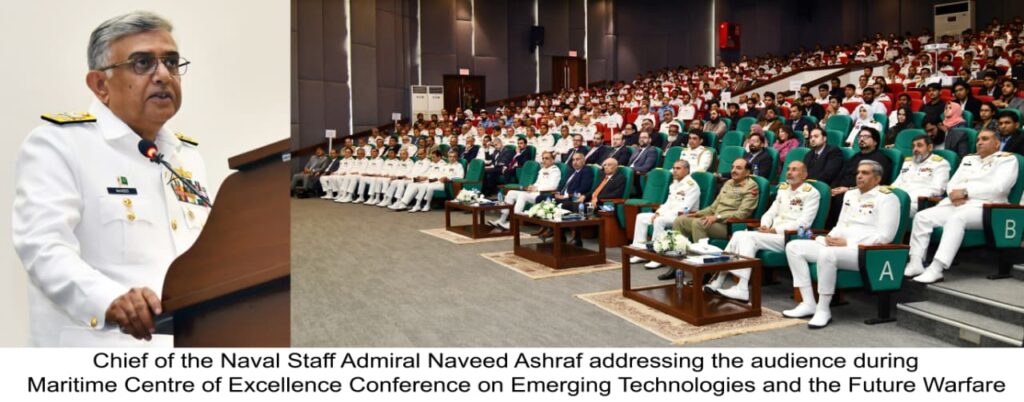
Chief of the Naval Staff, Admiral Naveed Ashraf, graced the occasion as Chief Guest. His address set the tone for the deliberations that followed, underscoring the indispensability of close collaboration between industry, end-users, and academia as the engine of genuine innovation and operational relevance , and identifying the Indian Ocean as a theatre where the future of warfare is already being written.
“Such collaboration would promote indigenization and self-reliance, helping build a cost-effective and globally competitive defence ecosystem for Pakistan with export potential.” — Admiral Naveed Ashraf, Chief of the Naval Staff
Day One: Reading the Battlefield
The conference’s first session established the conceptual scaffolding for everything that followed. Panelists interrogated what “technological determinism” actually means for military planners, the uncomfortable reality that advances in technology are no longer merely enablers of military power but are fundamentally transforming the character, conduct, and outcomes of warfare. Operational concepts, force structures, and doctrinal assumptions are all in play.
A central focus was the lessons drawn from recent conflicts, most notably the Russia–Ukraine war and the Iran–Israel/US exchange. These engagements have demonstrated that the decisive instruments of modern maritime and land warfare are no longer the large, expensive platforms of the Cold War order. Drones, Unmanned Surface Vessels (USVs), loitering munitions, and precision-guided torpedoes, deployed in mass and at relatively low cost, have inflicted disproportionate effects and fundamentally shifted the tactical calculus.
The cost–access–cognitive triad emerged as the new grammar of operational advantage: denying an adversary physical access through low-cost saturation while simultaneously overwhelming their cognitive bandwidth. The US concept of Mosaic Warfare was cited in this context, a strategy that disaggregates traditional large platforms into a distributed network of smaller, cheaper, and more expendable nodes (sensors, shooters, and decision-makers) that can be rapidly reconfigured to impose decision-making costs on the adversary while preserving operational resilience.
Panelists also examined the growing salience of Artificial Intelligence in command and control loops. The concept of an “AI OODA” where machine-speed observation, orientation, and decision are layered over human command authority, was discussed at length. Modern multi-domain ISR capabilities, encompassing satellites, OSINT aggregation, cyber-enabled collection, and advanced radar architectures, are generating intelligence volumes that no human analytical chain can process in operationally relevant timeframes. AI-enabled ISR synthesis and decision-support tools are no longer aspirational; they are operational imperatives.
Additional themes included dual-use technologies, commercial platforms, and AI tools that blur the boundary between civil and military application, and the concept of the hybrid fleet, particularly its relevance for smaller navies seeking to maximize operational effect within constrained budgets.
Day Two: Orienting and Acting, Pakistan’s Technological Roadmap
If Day One was about reading the global battlefield, Day Two was about Pakistan’s own position within it. The session opened with an assessment of contemporary models of technological development for military application, including an in-depth presentation on Türkiye’s ASELSAN model of academia–industry–military collaboration as a replicable framework for Pakistan’s own defence industrial development.
Central to the session was the Pakistan Navy’s technological roadmap for indigenizing niche technologies through industry–academia interface. The roadmap traces a deliberate trajectory: beginning with doctrinal reform, it advances through transformation of naval force structures toward next-generation capabilities. These include:
- Unmanned systems for MPA, reconnaissance, and targeting roles
- AI-enabled target learning and AI OODA integration
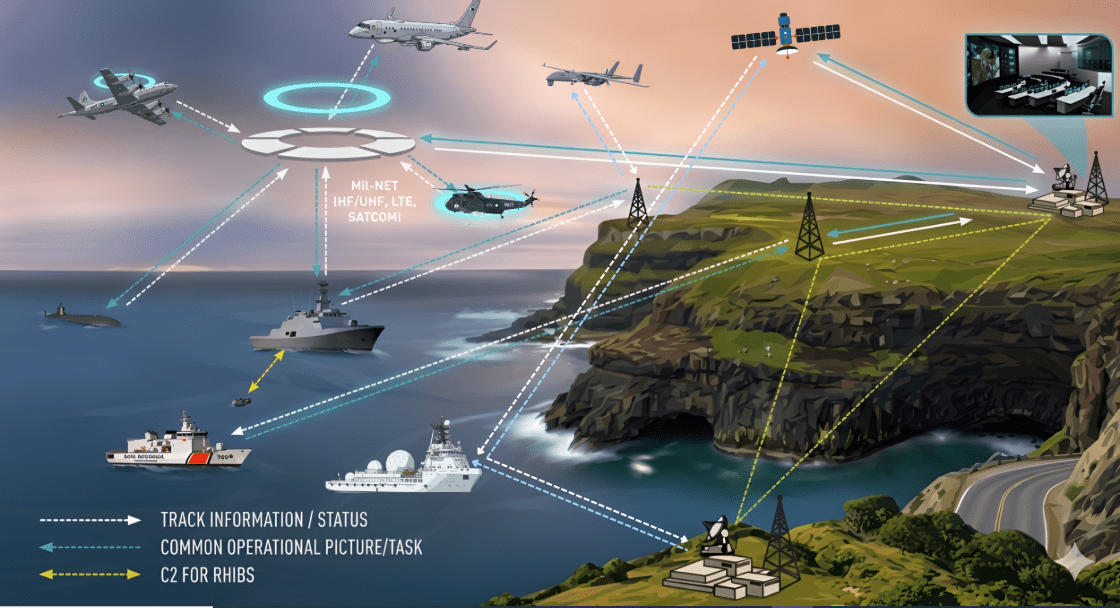
- Network-centric warfare architectures
- USVs and loitering munitions
- Directed energy weapons
- Hypersonic missile integration
- Seabed and sub-seabed warfare capabilities
Panelists drew inspiration from two international reference programmes: Project Maven (US DoD) the foundational American AI integration initiative that applies machine learning to automate ISR data analysis at operational scale and Project Nelson (UK Royal Navy), the Royal Navy’s framework for integrating autonomy, AI, and uncrewed systems to accelerate decision-making in high-threat environments. Both were cited as reference models for the Pakistan Navy’s own transformation pathway.
The Navy’s iterative transformation approach, Define, Scale, Fuse, Harden mirrors the nautical injunction to “lay the keel before the mast”: ensuring foundational capability-building precedes operational deployment.
The panel converged on the Triple Helix model as the organizing framework: a mutually reinforcing triad of government, academia, and private industry. The core argument was that government reliance on centralized, state-owned production, where moving to public-private partnerships is best to go with.
Academia’s role was described in particularly strong terms: its primary contribution is not simply research output but the creation of high-quality, globally competitive human capital. A domestic defense industry can only function if it can recruit engineers, data scientists, and systems analysts whose capabilities are commensurate with global standards. Without a strong academic pipeline, indigenous defense industry becomes structurally impossible.
The conference itself demonstrated the model’s viability, defense industry ventures and academic institutions presented joint R&D initiatives and technology development partnerships already underway, offering proof-of-concept for what coordinated civil-military-industrial collaboration can produce.
The Indian Ocean Dimension
A thread running through both days was the strategic significance of the Indian Ocean Region (IOR). As Admiral Ashraf noted, the IOR is not a passive backdrop, it is a dynamic theatre through which an enormous share of global trade, energy flows, and strategic communications pass. Any disruption carries cascading consequences for global supply chains, energy prices, and connected economies. Advanced technologies, from hypersonic anti-ship missiles to autonomous underwater vehicles — are reshaping maritime competition in the IOR in ways that demand updated doctrinal responses and new physical capabilities. The doctrine of Anti-Access/Area Denial (A2/AD) and countermeasures developed against it were examined as particularly relevant frameworks for naval planners in the region.
Conclusions and the Way Forward
The conference concluded with a reaffirmation of the need for sustained intellectual synergy to navigate technology-driven transformation and harness future trends in warfare. Several themes crystallised from the two days of deliberation:
- Doctrinal adaptation must keep pace with technological change. A force equipped with advanced technology but governed by outdated doctrine will be outmanoeuvred by a more conceptually agile adversary.
- The window for indigenization is open but not unlimited. The global defense technology landscape is moving rapidly, and the cost of delayed capability development compounds over time.
- Public–private partnership is a structural necessity and is essential to manage the complexity of modern defense development and meet the requirement.
- Human capital is Pakistan’s most durable strategic asset. Investing in educational and research institutions that generate and retain top talent is among the highest-return decisions a national defense establishment can make.