

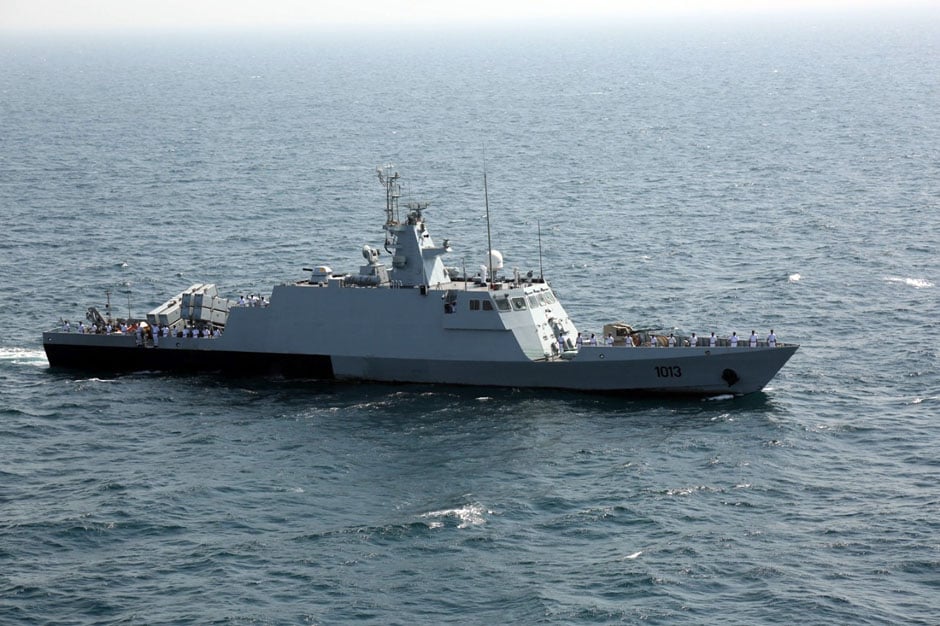

The Azmat-class Fast Attack Craft (Missile) is a purpose-built FAC-M optimized for littoral strike, sea denial and rapid coastal counter-force operations. The class prioritizes short-notice lethality and survivability through mobility, low observability and rapid salvo engagement rather than endurance or blue-water presence.
Design and Propulsion
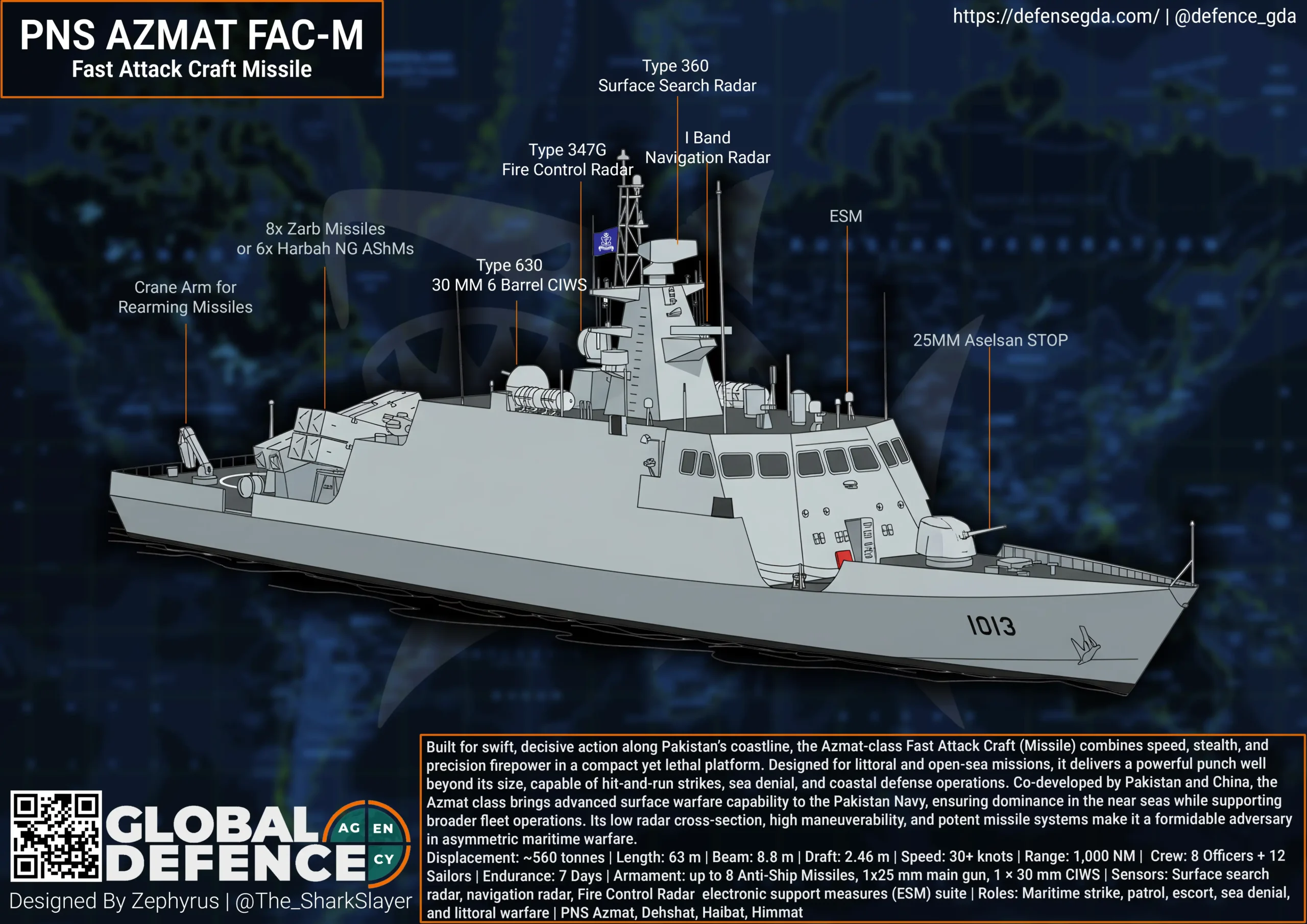
At roughly 560 t displacement and 63 m length, the Azmat employs a steel hull with weight-saved superstructure to preserve structural endurance while limiting signatures. Propulsion is conventionally diesel-driven, arranged for high available shaft horsepower and rapid acceleration. The platform’s design philosophy favors high sprint speeds (30+ kt) and agile maneuvering to enable quick ingress, salvo engagement and immediate egress ;the practical profile of a true shoot-and-scoot FAC-M rather than a sustained-cruise patrol boat.
Weapons & Sensors
The most tactically significant change to later Azmat variants is weapons integration: the platform carries 6 × Harbah-NG cruise missiles in salvo launch capacity, enabling coordinated multi-missile strikes against surface or littoral land targets. Close-in defense is handled by a 30 mm Type 630 CIWS with a smaller calibre gun for secondary engagement and point defense. Sensors are mission-oriented: surface surveillance radar, navigation radar and an ESM/communications suite sufficient for over-the-horizon targeting updates and networked salvo coordination.
Tactics and Employment
The Azmat is doctrinally employed as a short-range strike node within a distributed coastal fires architecture. Typical mission cycle:
- Transit to stand-off within missile engagement envelope at high speed.
- Execute a coordinated salvo (multiple Harbah-NGs) against assigned maritime or littoral targets.
- Immediate egress at sprint speed under cover of coastal radar/air defence and electronic countermeasures.
This operational cycle minimizes exposure to counter-fire and airborne interdiction — a hallmark of FAC-M shoot-and-scoot tactics. The vessel is not intended for long endurance presence; rather, it functions as a high-value, semi-expendable strike asset in distributed anti-access and sea denial schemes.
India–Pakistan Context: Operational Impact
In the northern Arabian Sea and approaches to Pakistan’s principal naval bases, the Azmat class complicates adversary operational calculus. Key effects:
- Targeting burden: The ability to launch multiple Harbah-NG missiles in salvo forces adversaries to allocate high-value air and ASW assets to guard littoral avenues, increasing their operational cost.
- Asymmetric attrition: In contested littorals, Azmat FAC-Ms enable Pakistan to threaten surface task groups and littoral infrastructure without committing larger combatants into shallow, sensor-congested waters.
- Temporal escalation control: Rapid, deniable salvo engagements permit graduated response options below full fleet action but with tangible effect on adversary freedom of maneuver.
While limited sea-keeping and endurance constrain strategic reach, the Azmat’s salvo capability and shoot-and-scoot profile materially increase Pakistan’s distributed lethality along its coastline and in chokepoints adjacent to Karachi and Gwadar.
Technical Summary
- Type: FAC-M (Fast Attack Craft — Missile)
- Displacement: ~560 t
- Length / Beam / Draft: 63 m / 8.8 m / ~2.46 m
- Top/Sprint Speed: 30+ knots (design emphasis on rapid acceleration)
- Operational Transit Speed: tactical transit at higher single-digit tens of knots (designed for rapid movement, not 18 kt patrol speeds)
- Endurance / Range: limited (optimized for short sortie cycles)
- Crew: ~20 (officers + ratings)
- Armament: 6 × Harbah-NG or 8 x Zarb AShMs, 1 × 30 mm Type 630 CIWS, 1 × 23 mm gun
- Sensors: surface search radar, navigation radar, ESM/comm suite
- Primary Roles: Littoral strike (salvo), sea denial, convoy interdiction, coastal defense (shoot-and-scoot)
- anti-ship missile
- Arabian Sea
- Arabian Sea theater
- asymmetric warfare
- Azmat Class FAC(M)
- Azmat class missile boat
- coastal defense
- coastal radar network
- CSOC
- defense industry Pakistan
- distributed lethality
- EEZ defense
- FAC-M
- Fast Attack Craft
- fast attack craft missile
- Gwadar
- H I Sutton
- Harbah NG
- Harbah NG missile
- India Pakistan conflict
- Indian Ocean region
- indigenous missile systems
- Karachi
- land attack capability
- littoral operations
- Littoral warfare
- maritime domain awareness
- maritime security
- maritime strike
- missile boat
- naval armament
- naval assets
- naval deterrence
- naval doctrine
- naval modernization
- naval order of battle
- naval power projection
- naval strategy
- naval strike capability
- naval tactics
- NESCOM
- Pakistan China naval cooperation
- Pakistan Navy
- Pakistan shipbuilding
- Pakistani Navy modernization
- patrol craft
- PN Azmat class
- salvo launch
- sea denial
- Shephard Media style
- shoot and scoot
- small combatant fleet
- South Asia naval balance
- stealth naval design
- surface warfare
- Type 630 CIWS
- warship analysis