


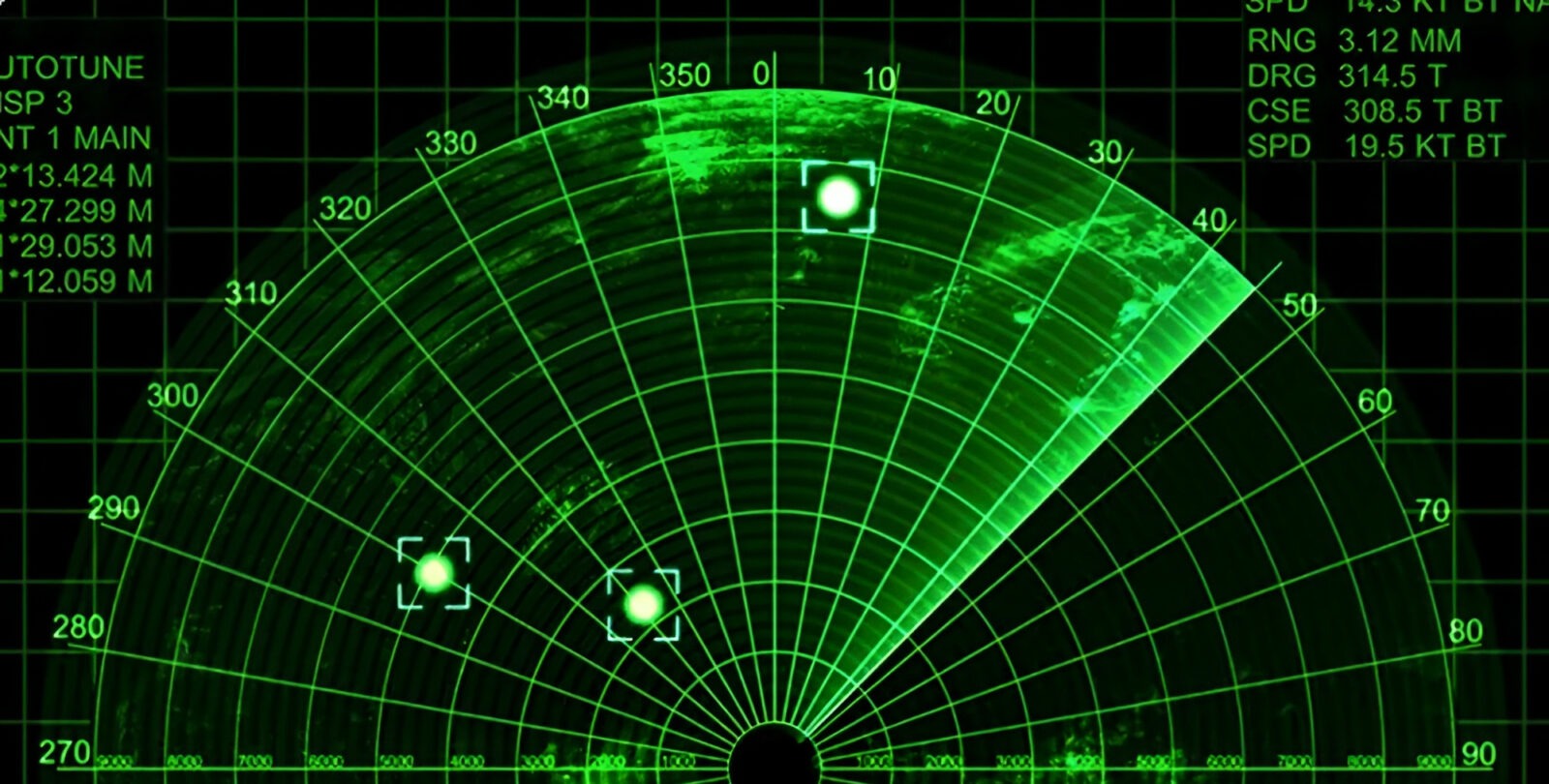

The activation and public unveiling of an indigenous suite of active electronically scanned array (AESA) radar systems marks a fundamental structural shift in South Asia’s electromagnetic battlespace. With the introduction of the AM-350S long-range early-warning radar, the Machaan Ground Radar for Air Defense (GRAD), and the Short-Range 3-Dimensional (SR-3D) radar nested within the broader Short Range Air Defence (SRAD) ecosystem, Pakistan has signaled a doctrinal pivot of immense strategic consequence.1 This pivot moves the national defense architecture away from an over-reliance on imported, static platform numbers, shifting instead toward a paradigm characterized by networked sensor dominance, high mobility, and distributed detection.1
For decades, the architectural backbone of Pakistan’s ground-based air defense heavily integrated foreign-origin systems. The legacy architecture relied upon an assortment of aging Western and Chinese systems, including the Siemens-designed MPDR series (MPDR-45, MPDR-60, and MPDR-90) from the 1980s 5, the United States-supplied Lockheed Martin AN/TPS-77 long-range 3D radars 6, and various Chinese medium-to-long range surveillance radars such as the YLC-2, YLC-6, and the VHF-band JY-27A.5 While these legacy systems provided comprehensive baseline coverage during peacetime and lower-intensity conflicts, the rapidly evolving nature of stand-off precision strikes, low-observable stealth technology, and advanced electronic warfare (EW) has mercilessly exposed the inherent vulnerabilities of static and semi-static surveillance architectures.1 Recent adversarial operations in the region have vividly demonstrated that legacy emitters—whose operating frequencies and precise geographic coordinates are easily cataloged by opposing signals intelligence (SIGINT) over months or years of observation—can be prioritized as primary targets in the initial phases of a Suppression or Destruction of Enemy Air Defenses (SEAD/DEAD) campaign.7
Consequently, the localized production of the AM-350S, the Machaan GRAD, and the SR-3D under the auspices of state-backed entities like the National Aerospace Science and Technology Park (NASTP) and Global Industrial Defence Solutions (GIDS) represents far more than an industrial milestone.1 It constitutes a strategic hardening of the country’s airspace against contemporary and future threats.1 By interlacing indigenous GaN-based (Gallium Nitride) AESA sensors with a China-backed satellite data link architecture 1, military planners have transformed isolated radar arrays into resilient nodes of a network-centric kill chain.1 This report exhaustively analyzes the technological specifications, developmental history, electronic counter-countermeasure (ECCM) capabilities, and the broader geopolitical and doctrinal implications of Pakistan’s new triad of air defense radars.
The Historical Impetus for Indigenous Radar Sovereignty
The transition toward indigenous radar manufacturing was not a spontaneous industrial endeavor, but rather the result of a deliberate, decade-long strategic recalibration catalyzed by both operational necessity and severe geopolitical constraints. Historically, the procurement of high-end defense electronics from foreign suppliers has subjected the importing nation to restrictive end-user agreements, supply chain vulnerabilities, and the perpetual risk of technological embargoes during critical diplomatic standoffs.
The Vulnerability of Legacy Systems
The Pakistan Air Force (PAF) and the Pakistan Army’s Air Defence Command historically relied on an integrated network of imported sensors. Throughout the late 20th and early 21st centuries, the airspace was monitored by American-made Westinghouse AN/TPS-43 radars acquired under the PADS-77 project, complemented by low-level German Siemens SILLACS MPDR-45 and MPDR-90 systems.5 As these systems aged, Pakistan initiated the PADS-2000 and subsequently the PADS-2020 modernization programs, which saw the induction of the Lockheed Martin AN/TPS-77 multi-role radars, alongside a massive influx of Chinese hardware including the YLC-2, YLC-6, YLC-18, and YLC-8E radars.5
However, the operational reality of relying on these imported systems became alarmingly clear during periods of intense regional friction. The static nature of high-power early warning radars makes them highly susceptible to pre-planned kinetic strikes. Reports indicating that the Indian Air Force (IAF) successfully targeted and neutralized multiple Pakistani AN/TPS-77 3D long-range radars (which boast a 450 km range) underscore the fragility of an air defense network anchored to immobile or slow-to-deploy platforms.7 When a sophisticated adversary maps a nation’s high-value sensor nodes, those nodes transition from being strategic assets to critical vulnerabilities.
The Strategic Risks of External Dependence
Simultaneously, Pakistan’s extensive procurement of foreign defense hardware revealed secondary strategic complications. While external suppliers provided a vital lifeline for military modernization, the integration of imported systems was not without operational friction. Relying heavily on foreign vendors creates a profound vulnerability, as importing nations inherently lack total control over the foundational architecture of their defense networks.
During periods of heightened tension, Pakistan’s order of battle was heavily dominated by imported systems, including long-range air surveillance radars and multiple surface-to-air missile (SAM) systems.5 This reliance exposed a deep strategic dependence; by recent estimates, up to 81% of Pakistan’s defense inventory was sourced externally.14 The realization that imported systems could be structurally compromised, spoofed, or rendered ineffective by advanced electronic warfare suites operated by regional adversaries accelerated the imperative for domestic sovereignty in sensor technology. Radar sovereignty underpins independent air defense planning; without domestic control over the source code, hardware architecture, and cryptographic protocols of a radar system, a nation cannot guarantee its airspace integrity.1
The Industrial Incubators: NASTP and GIDS
To achieve sensor sovereignty, Pakistan had to construct an industrial base capable of traversing the immensely complex domain of advanced radio frequency (RF) engineering. The structural foundations for this domestic radar production capability were laid in the mid-2010s.2 The initial strategy deliberately bypassed the immense capital requirement and high failure rate of starting from a clean sheet. Instead, the domestic defense sector focused on mastering the maintenance, upgrade, and life-extension of existing legacy platforms to build institutional knowledge.
From Maintenance to Original Equipment Manufacturing
In 2019, the Pakistan Air Force achieved a critical milestone by executing a local upgrade program for the Siemens MPDR-45 and MPDR-90 low-level radars.2 This modernization effort provided local engineers with crucial hands-on experience in modern digital signal processing, antenna design modernization, and radar data network integration.2 Building upon the empirical success of the MPDR upgrade, local research and development (R&D) pivoted aggressively toward original, clean-sheet radar designs.2
By 2020, defense contractors operating under the National Engineering and Scientific Commission (NESCOM), most notably the Air Weapons Complex (AWC), had successfully prototyped operational transmit/receive modules (TRMs) utilizing Gallium Nitride (GaN) semiconductor technology.2 GaN technology represents the bleeding edge of AESA radar design. Compared to older Gallium Arsenide (GaAs) modules, GaN offers significantly higher electron mobility, superior thermal conductivity, and a much higher breakdown voltage. Operationally, this allows GaN-based radars to emit at much higher power levels, increasing target detection range and spatial resolution while simultaneously shrinking the physical footprint and cooling requirements of the radar array.
The Role of NASTP and International Synergy
To consolidate these disparate R&D efforts, prevent redundant expenditures, and accelerate production timelines, the PAF established the National Aerospace Science & Technology Park (NASTP), formally inaugurated by the Prime Minister and the Chief of Army Staff in August 2023.10 NASTP was designed to serve as a high-technology innovation hub, absorbing all of the PAF’s radar and sensor R&D projects under a dedicated Sensors Division.2
NASTP’s collaborative ecosystem is unique in the region, featuring the unprecedented on-site presence of top-tier Turkish defense conglomerates like Turkish Aerospace Industries (TAI) and Baykar.10 This created an industrial incubator that rapidly brought advanced concepts to fruition. The cross-pollination of engineering expertise within NASTP, which is also responsible for developing the KaGeM V3 cruise missile and the YIHA-III kamikaze drone in collaboration with Turkish firms, provided the Sensor Division with unparalleled access to modern systems engineering practices.10
Simultaneously, Global Industrial Defence Solutions (GIDS), Pakistan’s premier state-owned defense conglomerate, accelerated its own independent tactical sensor programs. GIDS has a long history of developing unmanned aerial vehicles (UAVs), electro-optical targeting pods (like the ZUMR series), and fire-control systems.11 By combining their resources, NASTP, GIDS, and the National Radio Telecommunication Corporation (NRTC) have fielded a multi-tiered, overlapping radar architecture that covers the strategic, tactical, and short-range engagement envelopes.2
Strategic Airspace Surveillance: The AM-350S AESA Radar
Serving as the apex node of this newly minted air defense architecture is the AM-350S, an S-band, active electronically scanned array (AESA) 3-dimensional early-warning and air search radar.12 Formally introduced in November 2024, the AM-350S was jointly developed by the National Radio Telecommunication Corporation (NRTC) and Blue Surge.12 Its deployment represents a critical threshold in national defense autonomy, as it is the first fully indigenous long-range radar of its class to enter service, permanently severing the perpetual dependence on imported replacements for strategic early warning.1


Technical Architecture and Operating Parameters
The AM-350S operates in the S-band (traditionally occupying the electromagnetic spectrum between 2 GHz and 4 GHz), a frequency spectrum highly favored by air defense planners for long-range air surveillance due to its optimal balance between atmospheric attenuation and target resolution.12 While lower frequencies like VHF or UHF (such as those used by the Chinese-supplied JY-27A) provide excellent volumetric search ranges and anti-stealth characteristics due to their long wavelengths, they severely lack the angular precision required to cue interceptors or surface-to-air missiles. Conversely, higher frequencies (like X-band) provide high-fidelity fire-control precision but suffer from severe range limitations and rapid degradation from weather and atmospheric moisture. The S-band strikes the necessary operational compromise, allowing the AM-350S to detect, track, and provide coarse cueing for mid-course missile guidance over vast distances.\
| System Parameter | AM-350S Specification |
| System Designation | AM-350S |
| Developers / Designers | NRTC and Blue Surge |
| Introduction Date | November 2024 |
| Radar Architecture | 3-Dimensional Early-Warning AESA |
| Operating Frequency Band | S-band |
| Maximum Detection Range | 350 km (220 mi) |
| Maximum Altitude Coverage | 60,000 ft (18,000 m) |
| Azimuth Scan Coverage | 360° |
| Elevation Scan Coverage | -6° to 20° |
| Mechanical Scan Rate | 6 RPM (10-second refresh rate) |
| Output Power | > 400 Watts |
| Core Semiconductor Technology | Gallium-Nitride (GaN) Digital Beamforming |
The AM-350S leverages its GaN-based digital beamforming to achieve a confirmed maximum surveillance range of 350 km and an altitude ceiling of 60,000 ft.9 The system utilizes a mechanical rotation speed of 6 RPM, which translates to a 10-second refresh rate across its full 360o azimuth.12 While a 10-second refresh rate is standard for long-range early warning, providing adequate temporal tracking for high-altitude fighters, airborne early warning and control (AEW&C) platforms, and strategic bombers, it inherently necessitates integration with faster-scanning tactical radars for the terminal engagement of highly maneuverable or terrain-hugging threats.
The radar’s elevation coverage from -6o to 20o is a highly specific design choice that ensures the system can monitor threats originating from below the radar horizon.12 If the AM-350S is positioned on elevated mountainous terrain or coastal bluffs, the -6o downward depression angle allows it to look down into valleys or across the ocean’s surface to detect sea-skimming anti-ship cruise missiles or low-flying ingress packages.
Advanced Electronic Counter-Countermeasures (ECCM)
In modern peer or near-peer conflicts, the electromagnetic spectrum is as fiercely contested as the physical airspace. Adversaries employ sophisticated electronic attack (EA) platforms equipped with Digital Radio Frequency Memory (DRFM) jammers. These systems record incoming radar pulses, digitally alter their Doppler and timing signatures in microseconds, and transmit them back to create phantom false targets or obscure actual strike packages behind a wall of electromagnetic noise.
To survive and operate in this hostile environment, the AM-350S incorporates highly resilient anti-jamming capabilities.12 Because it utilizes an AESA architecture with thousands of individual TRMs rather than a single massive transmitter, the system features agile frequency hopping, vector control, and advanced side-lobe suppression.12 In a traditional mechanically steered radar, the emission is concentrated in a primary main lobe, but RF energy inevitably leaks out in unintended “side lobes.” Adversarial SIGINT platforms exploit these side lobes to inject jamming signals directly into the radar’s receiver. The AM-350S’s digital beamforming actively suppresses these side lobes, creating deep algorithmic “nulls” in the specific direction of known jammers, effectively blinding the enemy’s electronic warfare systems to the radar’s internal processing.
Furthermore, the AM-350S capitalizes on its array of GaN TRMs to emit unique or multiple frequencies within a single radar pulse.12 This intra-pulse frequency agility makes it exceptionally difficult for hostile ECM systems to single out a particular frequency for spot-jamming.12 By constantly shifting its frequency parameters faster than an enemy system can analyze and respond, the AM-350S forces the adversary into using barrage jamming. Barrage jamming requires diluting jamming power over a massive spectrum of frequencies, which severely limits its effective range and intensity, allowing the AM-350S to “burn through” the interference and maintain its recognized air picture.12
Tactical Gap-Filling and the Maneuverability Imperative: Machaan GRAD
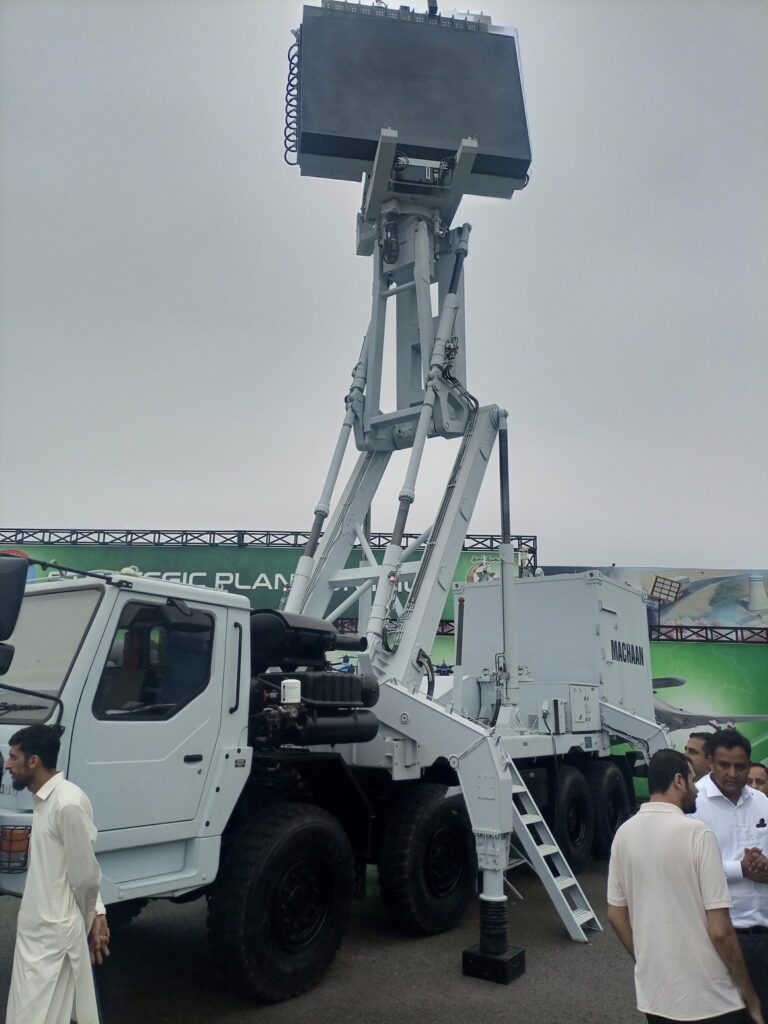
While the AM-350S secures the strategic high-altitude and deep-look surveillance requirements, modern air combat is increasingly defined by threats that operate below the traditional radar horizon. The proliferation of low-radar-cross-section (RCS) cruise missiles, loitering munitions, and terrain-following unmanned aerial vehicles (UAVs) dictates the need for an entirely different class of sensor. To fill this critical tactical gap, Global Industrial Defence Solutions (GIDS) developed the Machaan Ground Radar for Air Defense (GRAD).1
The Doctrine of Rapid Displacement
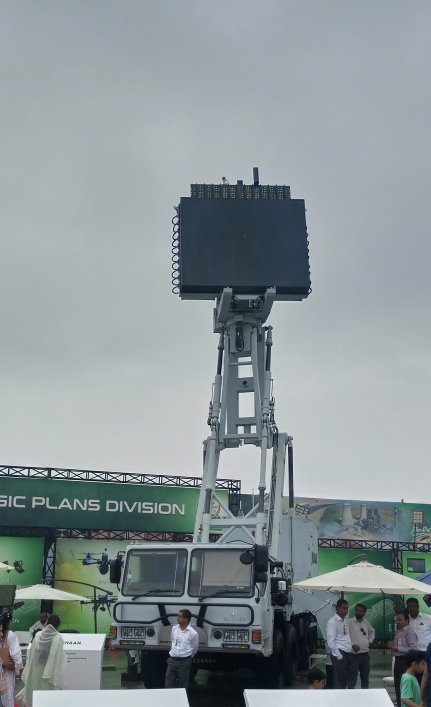
The Machaan GRAD is a mobile, S-band active phased array 3D air surveillance radar explicitly aimed at the point and area defense of critical military installations and civilian infrastructure.3 Its defining operational characteristic is its extreme mobility.1 The system is integrated onto a heavy-duty transporter-erector-launcher (TEL) style vehicle, prominently identified as the Sachman SX2300.1
In a modern theater, static air defense nodes are heavily scrutinized by adversarial satellite reconnaissance. Once hostilities commence, these static nodes are engaged by stand-off precision weapons. The Machaan system counters this by prioritizing rapid displacement, adhering to a “shoot-and-scoot” or “radiate-and-relocate” doctrine.1 Its tactical value is explicitly derived not from raw, over-the-horizon range, but from its persistent, survivable coverage.1 By frequently changing its physical location, the Machaan ensures that the final, innermost defensive rings remain functional, providing contiguous sensor coverage even if the primary strategic surveillance nodes (like the AM-350S or legacy TPS-77s) are degraded, jammed, destroyed, or temporarily taken offline.1
Operational Parameters of the Machaan GRAD
Despite its mobile form factor, the Machaan GRAD boasts formidable technical specifications that are meticulously tailored for the low-to-medium altitude threat environment.
| System Parameter | Machaan GRAD Specification |
| System Designation | Machaan GRAD (Low/Medium Altitude Air Surveillance Radar) |
| Developer | GIDS (Global Industrial Defence Solutions) |
| Radar Architecture | Mobile 3D Active Phased Array |
| Operating Frequency Band | S-band |
| Maximum Detection Range | 100 Km (specifically against a 1m2 target) |
| Maximum Altitude Coverage | Up to 25,000 ft |
| Target Velocity Profile | 25 to 2500 knots (Operating without blind speeds) |
| Deployment Platform | Transporter-Erector-Launcher (e.g., Sachman SX2300) |
| Ancillary Subsystems | Built-in Test Equipment (BITE), IFF, North finding Sensor, Radios |
The radar achieves a detection range of 100 km, a metric specifically mapped against a target with a radar cross-section of 1 m2 (which is roughly equivalent to a medium-sized fighter aircraft or a large, non-stealthy cruise missile).3 Its vertical coverage extends up to 25,000 ft, deliberately ignoring the high-altitude regimes covered by the AM-350S in order to focus all of its RF processing power on the horizon and complex ground clutter.3
Crucially, the Machaan GRAD is engineered to detect moving targets with velocities ranging from a mere 25 knots up to 2500 knots without suffering from the phenomenon known as “blind speeds”.3 In radar theory, moving target indication (MTI) and pulse-Doppler radars can suffer from blind speeds—specific target velocities at which the phase shift of the returning RF signal is an exact multiple of 360o. When this occurs, the radar’s Doppler filters incorrectly interpret the highly mobile target as stationary ground clutter and filter it out of the operator’s display. The Machaan overcomes this limitation, likely through the use of highly staggered pulse repetition frequencies (PRF), ensuring that it can seamlessly track both near-stationary threats like hovering rotary-wing aircraft or slow-moving loitering drones (25 knots), as well as high-mach targets like supersonic anti-radiation missiles approaching Mach 3.7 (2500 knots).3
Furthermore, the integration of a built-in North finding sensor and Identification Friend or Foe (IFF) suite ensures that upon rapid deployment from a moving convoy, the radar can autonomously orient itself within minutes, establish a local recognized air picture (RAP), and instantly differentiate hostile tracks from friendly interceptors returning to base.3
The NASTP SRAD Ecosystem and the SR-3D Radar
As hostile targets penetrate the outer and medium defensive layers monitored by the AM-350S and Machaan GRAD, they enter the terminal engagement zone. This highly volatile zone is the domain of Short Range Air Defence (SRAD) systems.2 The SRAD ecosystem is a critical component of Pakistan’s layered defense network, historically comprising a mix of point-defense systems such as the French Crotale 2000/4000, the Italian Spada-2000, the Chinese FM-90, and an array of man-portable air-defense systems (MANPADS) like the Anza-Mk2/Mk3, FN-6, and RBS-70 NG.5 Moreover, NASTP has recently expanded this SRAD ecosystem to include futuristic directed energy weapons, issuing tenders for 10 kW to 30 kW laser weapon systems (LWS) intended for counter-unmanned aerial system (C-UAS) roles.13
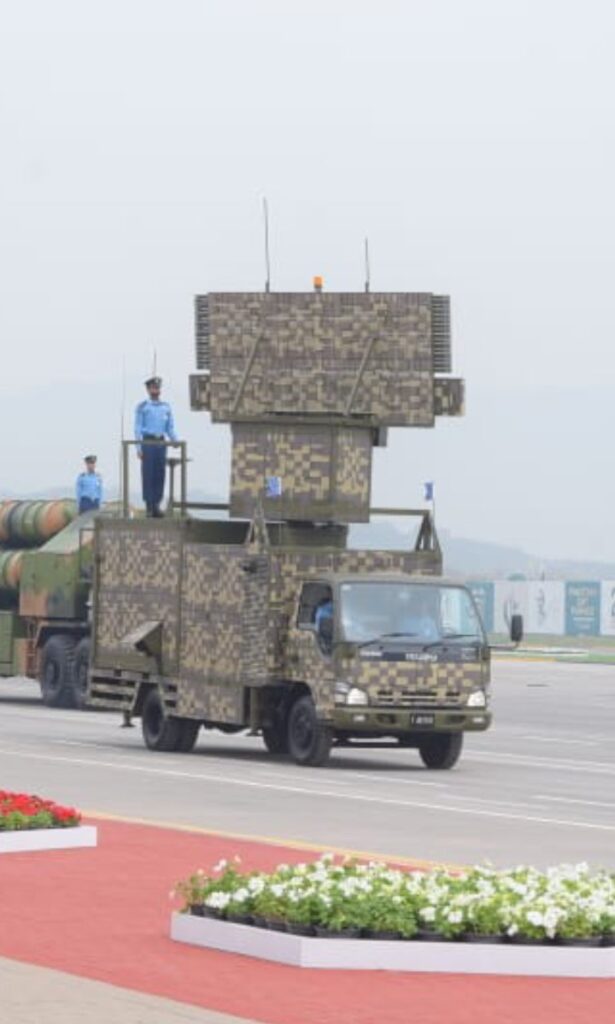
To effectively cue these disparate effectors and bind the SRAD ecosystem together, the NASTP Sensors Division introduced the SR-3D (Search Radar-3 Dimension) in March 2024, debuting it prominently at the IDEAS-2024 defense exhibition in Karachi.2
Dual-Purpose Target Acquisition and High-Fidelity Tracking
The SR-3D is an S-band AESA radar designed specifically as a dual-purpose sensor.2 It operates both as a localized early-warning surveillance net and as a high-fidelity target acquisition system capable of feeding real-time, 3-dimensional target data (including critical elevation metrics necessary for missile intercept geometries) directly to firing batteries, anti-aircraft artillery, and Close-in Weapon Systems (CIWS).2
| System Parameter | SR-3D Specification |
| System Designation | SR-3D (Search Radar-3 Dimension) |
| Developer / Manufacturer | NASTP (Sensors Division) |
| Introduction Date | March 2024 |
| Radar Architecture | 3D Early-warning / Target Acquisition AESA |
| Operating Frequency Band | S-band |
| Maximum Detection Range | 80 km (50 mi) |
| Mechanical Scan Rate | 30 RPM |
| Key Technologies | Advanced digital beamforming, low-RCS tracking |
A critical distinction between the SR-3D and its larger counterparts lies in its rotation speed. Where the strategic AM-350S scans at a deliberate 6 RPM, the SR-3D rotates at a rapid 30 RPM.2 This translates to a 2-second refresh rate, which is an absolute physical necessity in the SRAD environment. When engaging a supersonic target at close range, a radar with a 10-second refresh rate will see the target move several miles between radar sweeps, rendering fire-control solutions obsolete before the surface-to-air missile is even launched. The SR-3D’s rapid update rate ensures that interceptors, CIWS Gatling cannons, or directed energy weapons receive continuous, predictive tracking data.
Furthermore, NASTP engineering explicitly tailored the SR-3D to combat 5th-generation stealth technologies and small UAVs.2 Leveraging advanced digital beamforming, the radar’s processing backend can aggregate faint radar returns from targets with exceptionally low radar cross-sections.2 By synthesizing these minute returns over multiple rapid 2-second sweeps, the SR-3D’s algorithms can differentiate a low-RCS drone or a stealth fighter from ambient background noise.2 Like its larger counterparts, its AESA architecture imbues it with profound resistance to Electronic Counter Measures (ECM), utilizing ECCM-style features to counteract the intense localized jamming often employed by strike packages breaching terminal airspace.2
The SR-3D is not the terminus of NASTP’s development roadmap. It has been officially reported that the current 80 km variant serves merely as the foundational stepping stone for a much larger, more capable radar currently under development.2 This next-generation iteration is projected to possess double the detection range (160 km) and is slated for public reveal by late 2026, indicating a highly aggressive, iterative prototyping cycle within Pakistan’s military-industrial complex.2
The Network-Centric Kill Chain and Chinese Space Architecture
The isolated, individual capabilities of the AM-350S, Machaan GRAD, and SR-3D are formidable, but their true strategic value is only fully unlocked through their systemic integration. A modern air defense network is only as robust as its communications architecture. Pakistan has fundamentally reshaped its air defense balance by integrating these indigenous AESA radars with a China-backed satellite data link.1
Compressing Reaction Timelines via Machine-to-Machine Data
Traditionally, air defense networks relied on ground-based microwave relays, troposcatter communications (like the TS-504 systems used with older Chinese radars) 5, or vulnerable fiber-optic landlines to share the recognized air picture between command centers and firing batteries. These physical links are inherently vulnerable to terrain masking (where mountains block the signal), sabotage by special operations forces, and localized electronic attack.
By routing the sensor fusion data through a secure, China-backed satellite data link architecture, Pakistan has transformed its radars from isolated surveillance assets into interconnected nodes of a highly resilient, network-centric kill chain.1 Consider a tactical scenario: if an autonomously deployed Machaan GRAD detects a low-flying cruise missile navigating through a remote valley, it does not need a local SAM battery in that specific valley to engage it. The Machaan can instantly uplink that 3D tracking data to the satellite network, which then downlinks it to a combat aircraft on combat air patrol (CAP) or an SR-3D-cued GBADS battery hundreds of kilometers away. This machine-to-machine data exchange bypasses traditional, slow voice-cued Ground-Controlled Interception (GCI), compressing the reaction timeline from minutes down to a matter of seconds.1
The Paradox of Strategic Autonomy
While Pakistani defense analysts correctly describe the domestic manufacturing of the AM-350S and Machaan as a milestone in strategic autonomy, freeing Islamabad from the diplomatic and financial constraints of importing finished Western or Chinese hardware, the operational reality contains a profound paradox.1 The very network that empowers these indigenous sensors is built upon Chinese orbital infrastructure.1
Historically, Beijing has provided Pakistan with extensive strategic support, including satellite reconnaissance, real-time targeting data, and secure satellite-based communications, most notably observed during clashes like Operation Sindoor.14 By anchoring its newly indigenous radar network to a foreign power’s space architecture, Pakistan maintains a level of external dependency. Should the satellite link face degradation, cyber-attack, or political withholding during a conflict, the network-centric kill chain would fragment, forcing the radars to revert to localized, autonomous operations. Nevertheless, this hybrid approach—domestic sensor production married to allied space architecture, signals a clear strategic calculation: deterrence against stealth aircraft, drones, and saturation attacks will rely heavily on resilient sensor fusion rather than traditional force-on-force platform attrition.1
Doctrinal Shifts and the South Asian Electromagnetic Battlespace
The activation of this layered, AESA-driven radar architecture forces a profound recalibration of offensive air campaign planning in the region, particularly for adversarial planners in India and other regional actors.
Complicating Stand-off Precision Strikes
In previous eras, achieving strategic surprise against Pakistan involved mapping the known, static locations of legacy radars (such as the Siemens MPDRs or the TPS-77s) and either flying through known gaps in their coverage or executing preemptive SEAD strikes to blind the network.4 The introduction of the AM-350S and Machaan GRAD fundamentally disrupts this doctrinal assumption.1
Offensive planning must now account for a distributed detection grid characterized by highly mobile, unpredictable emitters.1 A strike package can no longer assume vulnerability based solely on legacy radar baselines.1 If an incoming strike relies on terrain masking to avoid the 350 km gaze of the AM-350S, it runs the immediate, unquantifiable risk of blundering into the 100 km envelope of an unmapped, displaced Machaan GRAD system waiting silently in passive mode.1 Once the Machaan detects the intrusion and breaks emission control (EMCON), the satellite link instantly alerts the entire grid, stripping away the element of surprise and allowing for rapid vectoring of interception assets.1
The Cost of Achieving Sensor Dominance
As noted by regional defense analysts, this new radar architecture does not entirely eliminate the broader asymmetry in raw combat aircraft numbers or overall airpower that exists between India and Pakistan.1 However, it dramatically raises the operational cost of conducting a successful campaign.1 By ensuring that the electromagnetic battlespace is heavily contested and deeply layered, Pakistan forces adversaries to expend significantly more resources on electronic warfare, escort jamming, and DEAD missions before kinetic strikes against primary strategic targets can even be attempted. The deployment signals that survivability and victory in South Asia now depend just as much on sensor dominance, algorithm superiority, and EW resilience as they do on the raw number of fighter platforms.1
Conclusion
The simultaneous fielding of the AM-350S early-warning radar, the Machaan GRAD tactical surveillance system, and the SR-3D target acquisition radar constitutes a comprehensive and highly sophisticated overhaul of Pakistan’s ground-based air defense network. Driven by the critical vulnerabilities of static legacy systems and the strategic necessity for sovereign technological control following the vulnerabilities of heavy reliance on imported hardware, Pakistan has successfully navigated the exceptionally complex transition into domestic Gallium-Nitride AESA manufacturing.
Through the AM-350S, military planners have secured a strategic, jam-resistant, deep-look capability that penetrates 350 km into surrounding airspace, utilizing intra-pulse frequency agility and digital beamforming to frustrate adversarial electronic warfare. Through the Machaan GRAD, the defense network gains a highly mobile, low-to-medium altitude shield designed specifically to survive SEAD/DEAD campaigns via rapid displacement, effectively neutralizing the threat of terrain-hugging cruise missiles and stealthy UAVs without suffering from traditional blind speed limitations. Finally, the SR-3D provides the rapid, high-fidelity, 3-dimensional tracking required to feed firing solutions to terminal interceptors within the NASTP SRAD ecosystem, with an expanded range variant already on the horizon for 2026.
Crucially, the lethality of these systems is magnified exponentially by their integration into a China-backed satellite data link. This infrastructure fuses disparate sensors into a singular, decentralized kill chain, compressing reaction times and ensuring that detection by a single node immediately translates to threat awareness across the entire national airspace. While this architecture relies on external orbital infrastructure, highlighting the complex, paradoxical realities of modern strategic autonomy, its deployment fundamentally alters the South Asian balance of power. It dictates that future conflicts in the region will not be decided solely by kinetic platform attrition, but by supremacy in the electromagnetic spectrum. By rendering stand-off precision strikes infinitely more complex and costly, Pakistan’s new AESA radar triad establishes a formidable, resilient deterrent that redefines the parameters of modern air defense in a highly volatile geopolitical theater.
Works cited
- Pakistan Activates AM-350S and Machaan AESA Radars with China-Backed Satellite Link, Reshaping South Asia’s Air Defense Balance, accessed May 17, 2026, https://defencesecurityasia.com/en/pakistan-am350s-machaan-aesa-radars-china-satellite-link-air-defense-india-balance/
- SR-3D Radar – Wikipedia, accessed May 17, 2026, https://en.wikipedia.org/wiki/SR-3D_Radar
- Road-to-Future – GIDS, accessed May 17, 2026, https://www.gids.com.pk/road-to-future
- Pakistan Aktifkan Radar AM-350S dan Machaan Radar AESA Dengan Satelit China, Ubah Keseimbangan Pertahanan Udara Asia Selatan – Defence Security Asia, accessed May 17, 2026, https://defencesecurityasia.com/pakistan-radar-am350s-machaan-satelit-china-pertahanan-udara-asia-selatan/
- Updates On Pakistan’s Air-Defence Artillery Force Modernisation Efforts – TRISHUL, accessed May 17, 2026, http://trishul-trident.blogspot.com/2017/03/updates-on-pakistans-air-defence.html
- List of equipment of the Pakistan Air Force – Wikipedia, accessed May 17, 2026, https://en.wikipedia.org/wiki/List_of_equipment_of_the_Pakistan_Air_Force
- After Badin, Pakistan is Developing another TPS-77 Radar Site (400+ KM range) just 58 Kms from IB – Reddit, accessed May 17, 2026, https://www.reddit.com/r/IndianDefense/comments/11un4hz/after_badin_pakistan_is_developing_another_tps77/
- SR‑3D Radar – Full Specifications | TheDefenseWatch.com, accessed May 17, 2026, https://thedefensewatch.com/product/sr-3d-air-defense-radar/
- Where does the radar technology stand? – Engineering Stack Exchange, accessed May 17, 2026, https://engineering.stackexchange.com/questions/62040/where-does-the-radar-technology-stand
- National Aerospace Science & Technology Park – Wikipedia, accessed May 17, 2026, https://en.wikipedia.org/wiki/National_Aerospace_Science_%26_Technology_Park
- Template:GIDS – Wikipedia, accessed May 17, 2026, https://en.wikipedia.org/wiki/Template:GIDS
- AM-350S – Wikipedia, accessed May 17, 2026, https://en.wikipedia.org/wiki/AM-350S
- Pakistan Air Defence – Quwa, accessed May 17, 2026, https://quwa.org/pakistan/air-defence-pk/
Chinese credibility deficit – Observer Research Foundation, accessed May 17, 2026, https://www.orfonline.org/research/chinese-credibility-deficit