

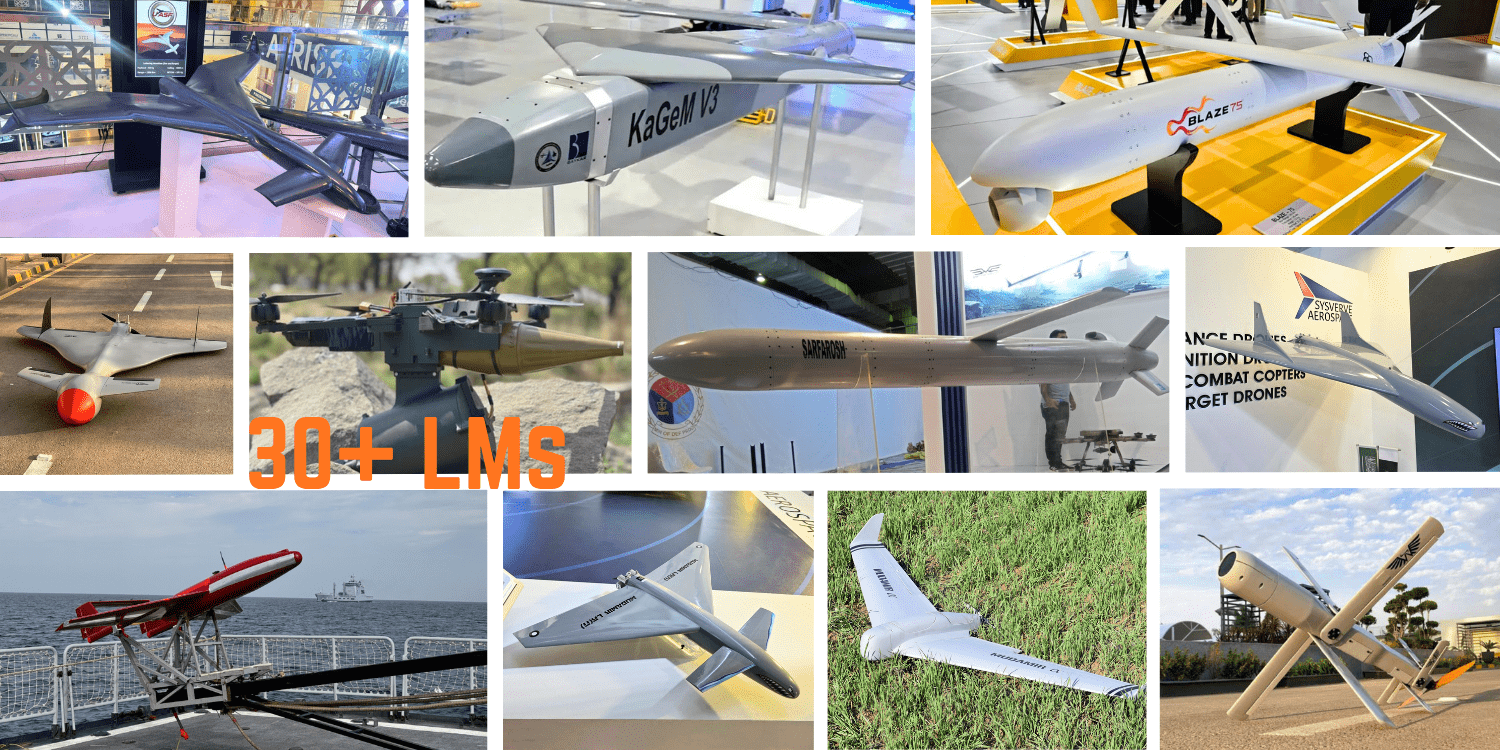

Over the past decade, Pakistan has steadily advanced its indigenous capabilities in unmanned and precision-strike technologies. Among the most notable recent developments is the emergence of locally designed loitering munitions (LMs) offering flexibility, affordability and precision on the modern battlefield. Pakistan’s growing interest in LMs reflects a broader national effort to achieve self-reliance in advanced defence technologies.
During India–Pakistan conflict in May 2025, both sides extensively used loitering munitions for precision strikes, surveillance and air-defence suppression. The conflict highlighted the growing prominence of loitering munitions as decisive tools of modern warfarea.
Loitering munitions have now become a key element of Pakistan’s strike doctrine acting as sensor-to-shooter platforms, decoys or saturation weapons in coordinated attacks and force-multipliers used alongside cruise missiles, glide-bombs and tactical ballistic missiles to probe and overwhelm enemy’s layered air-defence networks
Pakistan’s public and private sectors are now jointly driving an emergent domestic defence-industrial base for UAVs and loitering munitions. State bodies (NASTP, Wah Industries etc) and a growing number of private firms (Sysverve Aerospace, Woot-Tech Aerospace, Integrated Dynamics and others) are contributing in design innovation, rapid prototyping and small-batch manufacturing.
Through a blend of in-house R&D, transfer-of-technology agreements and local supply-chain development, these actors are narrowing capability gaps and shifting Pakistan from a net importer to a manufacturer. Collectively, These efforts signal a strategic shift toward strengthening the local defence industry through the development of scalable and multi-role weapon systems designed to meet both tactical and strategic needs.
With this foundation in place, Pakistan’s indigenous loitering munitions portfolio is expanding rapidly. Let’s take a closer look at some of the key LMs shaping this evolution in Pakistan’s Defence Industry.
NASTP YiHa-III & KaGeM V3
YiHa-III
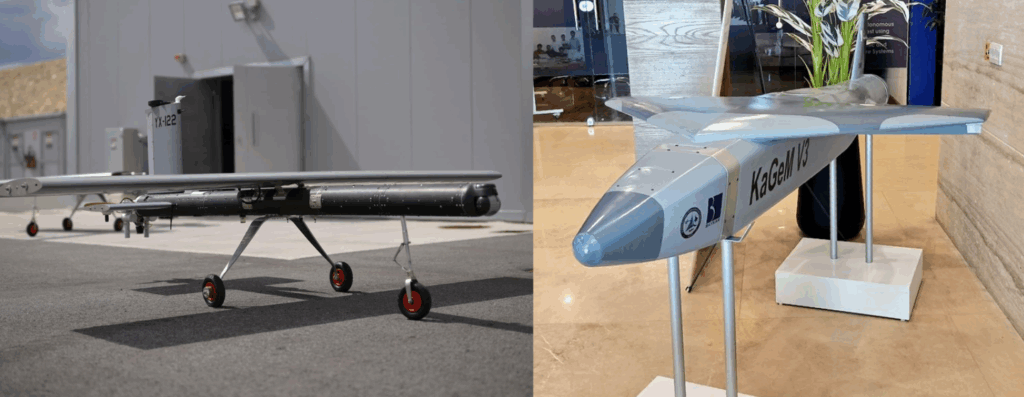
YiHa-II is a combat proven loitering strike platform codeveloped by Turkey’s Baykar and Pakistan’s National Aerospace Science and Technology Park (NASTP). The design adapts a tubular fuselage fitted with square wings, tail surfaces and a propeller engine (reportedly Chinese DLE-170) plus a fixed tricycle landing gear that allows runway launch.
It is capable of both single-shot precision engagements and massed swarm employment against enemy air-defence nodes, radar sites and forward operating bases, posing a direct threat to adversary’s overall warfighting apparatus. Operational employment and unit tactics remain the primary indicators of its capability envelope, as technical performance details (range, endurance, payload, avionics) remain undisclosed.
Combat Use
In January 2024, Pakistan employed the system to carry out precision strikes against terrorist hideouts inside Iran. Open-source reports also noted its use by Ukrainian forces in operations against Russian positions in the Belgorod region during 2024.
In May 2025, the YiHA-III played a pivotal role in the India–Pakistan conflict, where it was employed in coordinated swarm attacks against a range of Indian military targets. Turkish forces have also fielded the platform in counter-terror and interdiction missions in northern Syria, primarily targeting high-value targets.
As of 2025, reports indicate that YiHA‑III has been in service with five countries including Pakistan, Turkey, Azerbaijan, Albania and Ukraine.
KaGeM V3
Jointly developed by Turkish Baykar and Pakistan’s National Aerospace and Technology Park (NASTP), KaGem V3 is a medium range precision strike plateform designed to engage high-value targets with high accuracy. Powered by a air-breathing jet engine, the airframe is 2.47 m long with a 1.34 m wingspan, designed to operate at an altitude of approximately 6,000ft with a cruising speed of 215 km/h. With an operational range of around 150 km, the KaGeM V3 provides stand‑off strike reach capable of delivering a 20 kg warhead against designated targets.
KaGeM V3 is equipped with electro-optical sensors, anti-jam navigation, fully autonomous flight modes and terminal guidance via GPS and fly-by-camera, supported by a 35 km telemetry link. Its rocket‑assisted take‑off (RATO) and catapult launch capability makes it a runway-independent stand‑off precision‑strike weapon capable of complicating opponent’s force‑projection and defensive planning by posing a serious threat to key air‑defence sites, command‑and‑control nodes, logistics hubs and other critical infrastructure.
Its integration onto Pakistan’s existing fleet of Bayraktar TB2 and Akinci UAVs will provide a true sensor‑to‑shooter capability, enabling persistent ISR and precision strike at extended ranges for cross‑border operations. In short, KaGeM V3 fills a unique strategic role within Pakistan’s loitering-munition inventory, delivering stand-off lethality and operational flexibility, filling the gap between small tactical LMs and larger, costlier cruise missiles while delivering affordable, scalable strike options for cross-border and deep-strike missions.
NASTP Dark Angle II
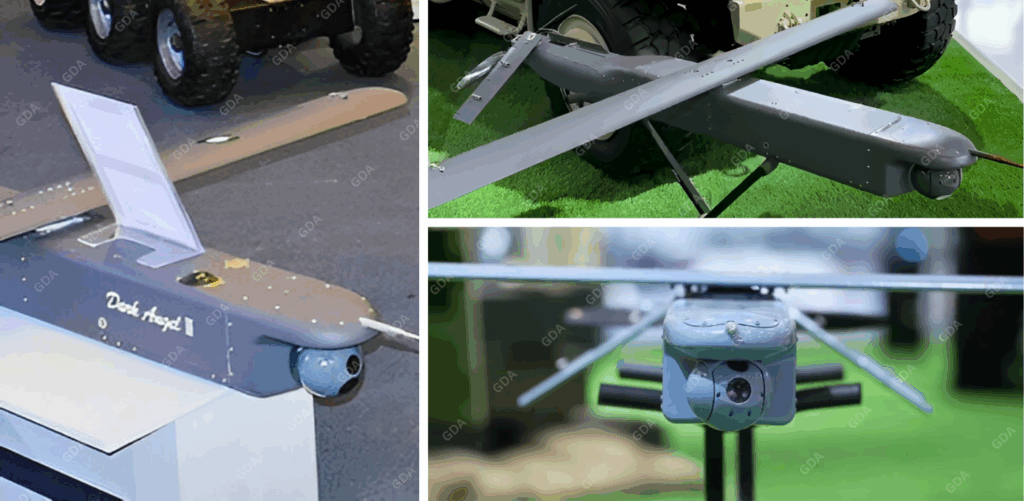
Dark Angle II is a Chinese tube launched loitering munition being locally manufactured at NASTP under a transfer-of-technology (ToT) agreement. Visually, the airframe presents a slender, rectangular fuselage with a rounded nose section optimized to house an electro-optical/infrared (EO/IR) sensor suite for day-and-night target acquisition and terminal homing. A rectangular wing with an estimated span of 1.5–2.0 m and an inverted-V tail provide the platform’s aerodynamic control, while propulsion is provided by an electric motor driving a pusher propeller.
These characteristics indicate a short-to-medium-range tube-launched loitering munition intended for swarm employment. The compact airframe, modest wingspan and electric propulsion make it easy to store, transport and load into multi‑tube launchers.
This enables rapid coordinated salvo launches from ground vehicles or fixed emplacements to saturate enemy’s localized air-defence nodes, soft-skinned logistics hubs and other tactical targets. When emplyed alongside ISR assets, EW packages and other tactical munitions it can create windows for follow-on strikes to complicate adversary’s engagement calculus.
HIT UASF Strategic Loitering Munition
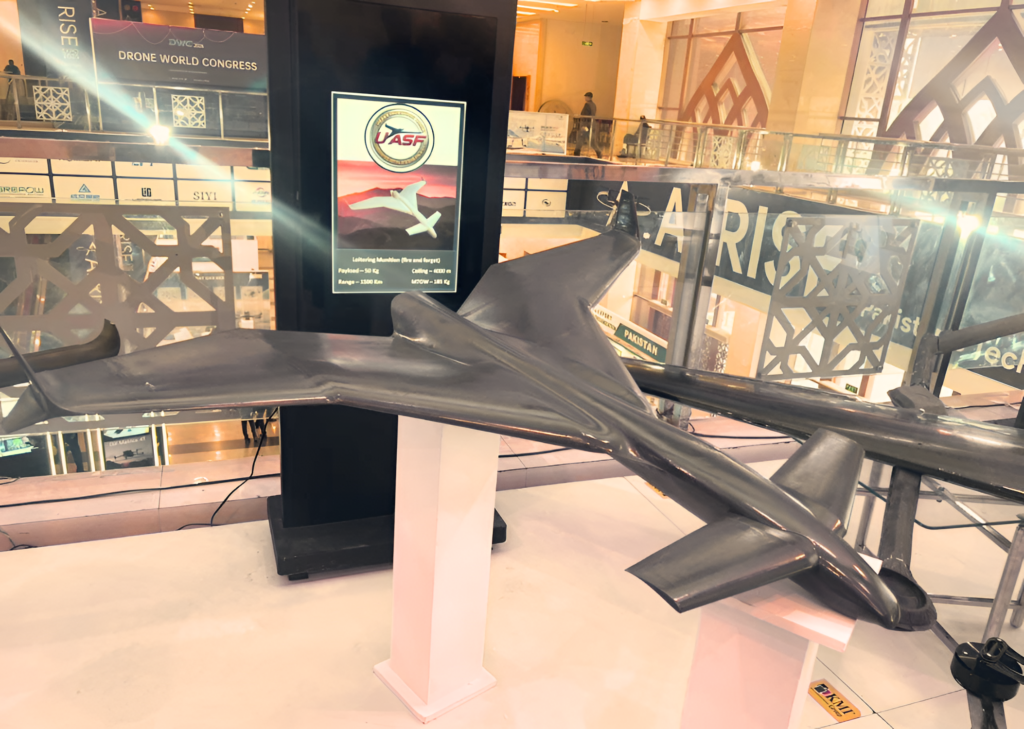
Developed by Heavy Industries Taxila (HIT) under its Unmanned Aerial Systems Facility (UASF), this strategic one way fire-and-forget loitering munition represents a major evolution in deep-strike capabilities of Pakistan armed forces. The drone features a swept-wing sleek, stealth-focused design with a blended wing-body (BWB) architecture, distinctive swept wings and integrated aerodynamic winglets for optimized high-subsonic cruise efficiency.
Technical Specifications & Performance
- Operational Range: Engineered for long-range interdiction missions spanning up to 1,500 km.
- Flight Dynamics: Operates at a maximum service ceiling of 4,000 meters.
- Mass Profiles: Features a Maximum Take-Off Weight (MTOW) of 185 kg, optimized for structural efficiency and extended flight profiles.
Payload & Strategic Impact
The munition accommodates a massive 50 kg payload capacity, enabling the integration of heavy high-explosive, penetration, or fragmentation warheads. By combining a 1,500 km strategic reach with an autonomous fire-and-forget guidance suite, the platform can bypass traditional ground-based air defenses to strike static infrastructure, radar systems, command-and-control centers and logistics nodes. This weapon system effectively elevates HIT’s portfolio into the strategic long-range precision effector market, offering a cost-effective mass-producible alternative to conventional cruise missiles.
Al-Murtajiz
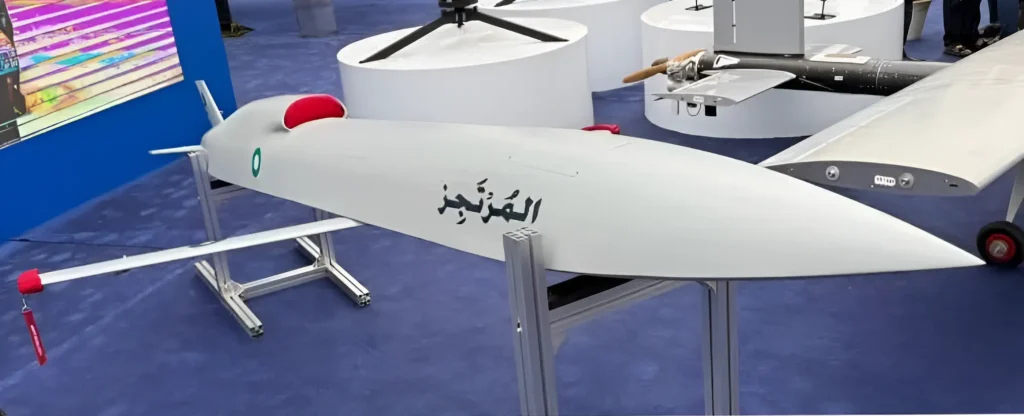
Unveiled on Independence Day, Al-Murtajiz is an under-development ground launched multi-purpose sucide drone designed for deep-strike and interception roles. The mock-up featured low-observable airframe design, high-aspect ratio wings and an air inlet suggesting a jet-powered propulsion system capable of sustaining high subsonic speeds (Mach 0.7–0.9) and extended ranges.
A preliminary look at the displayed mock-up indicates that the plateform remains in early stage of development but its reported characteristics point toward an ambitious, high-end capability under Pakistan’s evolving UAV and loitering-munitions ecosystem.
Al-Murtajiz represents Pakistan Air Force’s broader initiative aimed at fielding an integrated ecosystem of unmanned strike and support platforms from loitering munitions and long-range cruise missiles to decoy and jamming drones and eventually a loyal-wingman UCAV under its manned-unmanned teaming (MUM-T) program.
Mudamir Series LMs

Mudamir is a family of short, medium and long-range loitering munitions designed and developed by Sysverve Aerospace, one of Pakistan’s largest private UAV manufacturers. Equipped with advanced AI algorithm for target identification and engagement with minimal operator input it offer precise and pinpoint strikes against high-value targets. It uses a catapult-launch system which give it rapid runway-independent deployment suitable for frontline units.
Mudamir’s low cost compared to traditional guided missiles and manned strike systems makes it affordable to produce in large numbers and deploy widely. This cost advantage creates operational room for swarm-based employment where large numbers of expendable munitions can saturate enemy air defenses, distribute sensing tasks and execute multi-axis attack profiles.
The combination of affordability, autonomy and coordinated swarm behavior of Mudamir Family LMs significantly enhance battlefield efficiency while reducing risk to high-value platforms.
Technical Specifications:
| Loiterers | Mudamir LR | Mudamir MR | Mudamir SR |
|---|---|---|---|
| Wingspan | 9.0 FT | 5.6 FT | 3.0M |
| Length | 10.0 FT | 5.4 FT | 0.8M |
| Warhead | 10 KG | 5.0 KG | 2.0 KG |
| Speed | 180 Km/h | 180 Km/h | 108 Km/h |
| Range | 600 KMs | 300 KMs | 10 KMs |
| Endurance | 120 MIN | 60 MIN | 25 MIN |
| Altitude | 3000 M | 3000 M | 1000 M |
| Propulsion | Gasoline Propeller | Gasoline Propeller | Electric Propeller |
| Flight Phase | GPS Guided | GPS Guided | GPS Guided |
WIL Sarfirosh
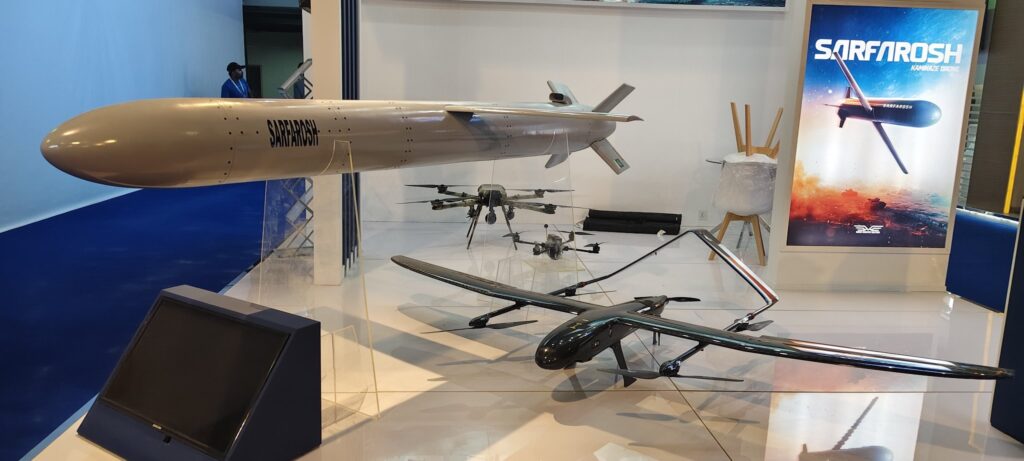
SARFIROSH is a long‑range canister‑launched loitering‑strike munition designed to deliver precision strikes against high‑value. Its 175 kg class weight, turbojet propulsion and 700 to 1000 km range place it in the category of long range deep strike stand-off weapons aimed at penetrating well-defended airspace from safe launch distances.
With a 25 to 50 kg payload capacity, SARFIROSH can carry a range of warhead types, from conventional blast-fragmentation charges to specialised munitions designed for radar sites, command nodes and hardened structures positioning it as a cost‑effective long‑range option for pre‑emptive suppression of enemy air defenses.
The use of a canister launch system indicates a focus on mobility and survivability, allowing deployment from light armored/logistic vehicles and naval platforms while reducing exposure to counter‑fire. Its long-range precision targeting capability make SARFIROSH a highly adaptable and strategically valuable loitering-strike asset, enabling operators to conduct complex missions with minimal workload while maintaining high levels of accuracy against priority targets.
Woot-Tech HiMark-25 T
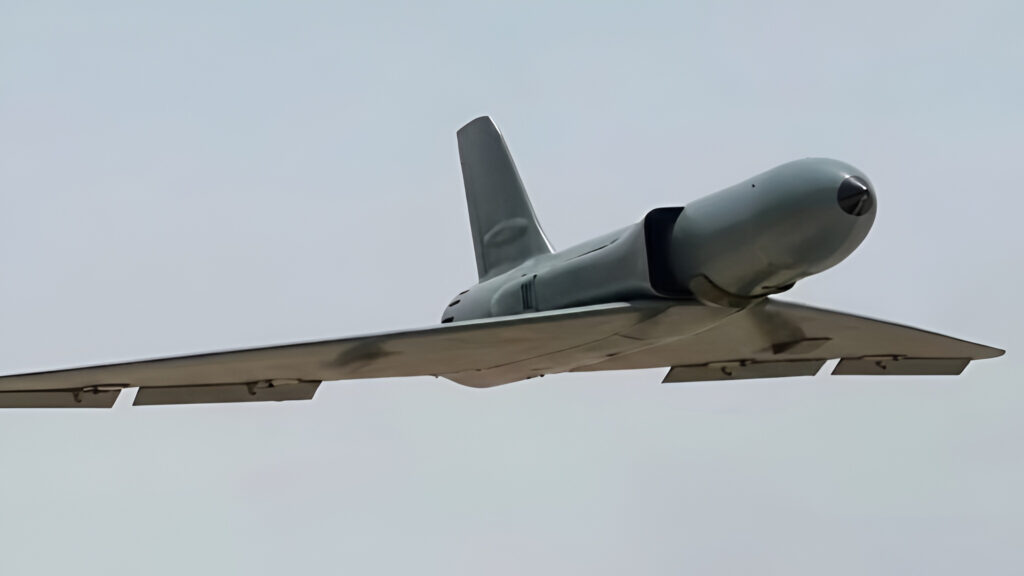
Revealed in April 2026 by Woot Tech Aerospace, the HiMark-25 TJ is a turbojet-powered, one-way attack drone designed for deep-strike missions against soft, semi-hardened and mobile targets. Representing Pakistan’s structural shift toward high-speed expendable strike munitions, this platform swaps the piston/propeller propulsion of the legacy HiMark-25 for a 25 kg thrust-class turbojet engine. This transition reflects the broader global shift toward turbojet-powered expendable strike systems designed to reduce interception timelines and increase penetration capability against modern integrated air defense systems (IADS).
Technical Specifications & Performance
- Dimensions: 3.0 m length, 2.5 m wingspan, and a maximum take-off weight (MTOW) of 70 kg (15 kg empty).
- Speed & Range: Features a cruising speed of 240 km/h, a dash speed of 320 km/h, and an operational range of 250 km.
- Flight Profiles: Maintains a 60-minute endurance with a service ceiling of 4,500 meters and a 35-knot wind tolerance.
- Deployment: Optimized for vehicle-integrated “shoot-and-scoot” rail launchers, with rocket-assisted take-off (RATO) available to preserve internal fuel.
Guidance, Swarming, and Lethality
The HiMark-25 TJ carries a substantial 25 kg warhead, customizable in high-explosive (HE) fragmentation, blast, or shaped-charge configurations.
Its guidance architecture integrates GPS/INS with autonomous waypoint routing and an electro-optical (EO) terminal seeker for real-time target confirmation. To thrive in contested electronic warfare (EW) environments, the drone utilizes secure mesh networking to execute coordinated, multi-axis swarm saturation attacks. Furthermore, the platform integrates Starshield- or Starlink-based satellite communications (SATCOM) to achieve robust beyond-line-of-sight (BLoS) capability, providing a resilient command alternative when terrestrial data links are heavily degraded by adversarial jamming.
GIDS Blaze Sereis
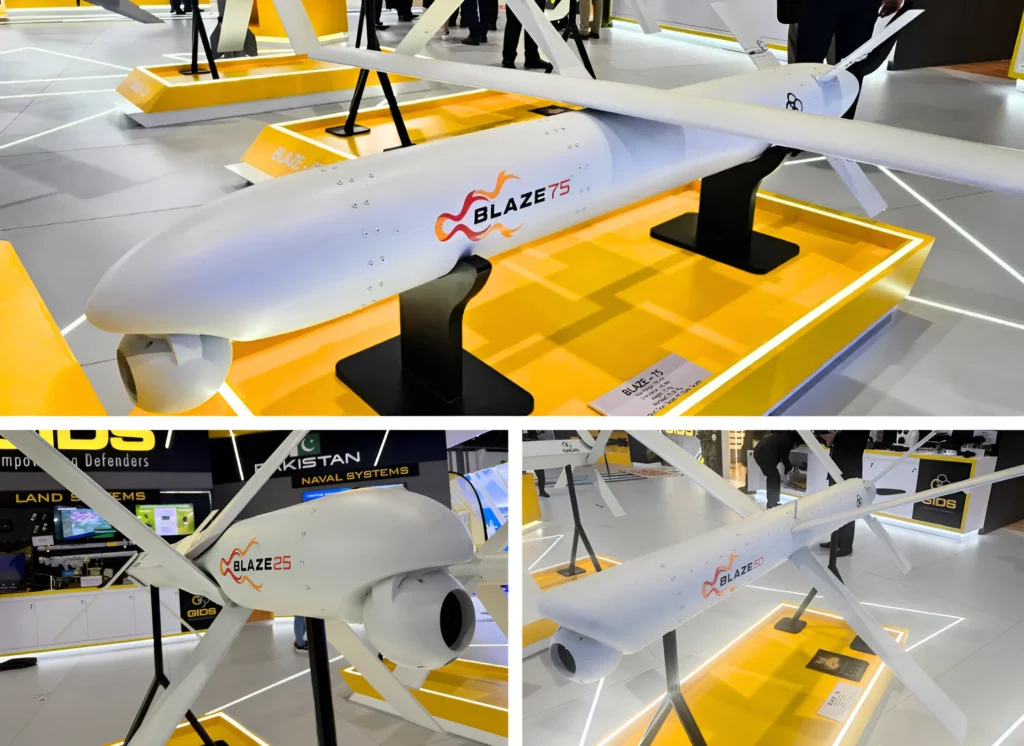
The GIDS Blaze family of loitering munitions reflects a tiered, mission-adaptable design philosophy aimed at providing Pakistan with flexible strike options across tactical and operational ranges. The smaller electric-powered variants offer low acoustic and thermal signatures, rapid deployment and high precision in anti-tank and anti-personnel roles, making them suitable for frontline saturation and ambush missions.
The larger gasoline-powered models deliver significantly extended endurance, higher payload capacity and longer engagement ranges, allowing engagement of high-value targets deep inside contested territory. With support for multiple warhead types, AI-enabled target identification, real-time surveillance sensors and secure datalinks, the Blaze series provides a cost-effective and scalable alternative to conventional guided munitions while enabling both individual strikes and coordinated swarm tactics.
While AI‑enabled target recognition and onboard decision‑support, these munitions can prosecute objectives far beyond their communication range, reducing operator workload and ensuring mission continuity in EW‑contested environments. This modularity positions the Blaze family as a versatile component within Pakistan’s expanding autonomous unmanned strike ecosystem.
Technical Specifications:
| Parameters | Blaze 25 | Blaze 50 | Blaze 75 |
|---|---|---|---|
| Weight | 25 kg | 50 kg | 75 kg |
| Datalink Range | 40 km | 75 km | 150 km |
| Max Range | 75 km | 150 km | 400 km |
| Endurance | 45–60 mins | 60–90 mins | 360–480 mins |
| Air Launch | Yes | Yes | Yes |
| Warhead | 8–10 kg | 15–20 kg | 25–30 kg |
| Warhead Type / Targets | PF, Anti-personnel, Top-attack anti-tank | PF, Anti-tank (Top Attack) | PF, Static targets |
| Propulsion | Electric | Gasoline / Electric | Gasoline |
SKYDOG Kamikaze E-VTOL

GIDS SkyDog represents a new class of ultra‑mobile, hand‑launched loitering munitions combining precision strike, interception capability and scalable swarm employment. Its AI-enabled electro-optical (EO) targeting allows it to automatically recognize and track targets, while the GPS/INS terminal guidance ensures accuracy even if external signals are jammed on small, high‑value ground targets resulting in a 1-meter CEP for highly precise strikes.
Its standout feature is its dual-role capability. When cued by radar, SkyDog can function as a low‑altitude guided anti‑air munition (GAM), engaging flying targets up to 3,000 m a rare capability for a hand‑launched LM. This creates a low-cost, attritable layer of air denial around infantry or forward operating bases.
A single Ground Control Station (GCS) can operate 1–64 SkyDog drones simultaneously, enabling true swarm employment. This allows SkyDog units to divide roles across the formation, with some performing ISR, others designating targets, and the rest executing precision strikes or interceptions to create an adaptive, multi-layered kill web. This role-splitting drastically reduces sensor-to-shooter latency, enabling near-instantaneous engagements against mobile or time-sensitive targets.
In offensive roles, a SkyDog swarm can saturate enemy positions from multiple axes, overwhelming short-range air defence (SHORAD) systems with low-signature, low-altitude profiles. The swarm’s autonomous routing and collision-avoidance allow it to disperse, maneuver and reconverge as required, making it hard to counter through jamming or point defence alone.
Critically, swarm‑operated SkyDog provides a high degree of continuity and robustness, ensuring that even if an individual drone is jammed or lost, others in the formation maintain situational awareness and continue the mission. This resilience, combined with hand-launch mobility and rapid assembly, allows frontline units to deploy swarms with minimal logistics, making SkyDog not just a standalone loitering munition but a scalable, networked force-multiplier for both offence and point defence.
Murtajiz MP-300
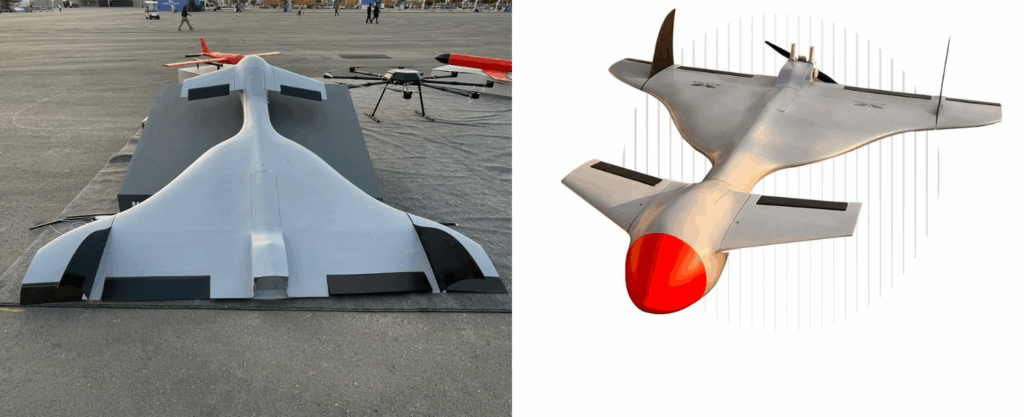
Murtajiz MP-300 is a heavy-class loitering munition system developed by Woot-Tech Aerospace, engineered for precision deep-strike missions against strategically important objectives. It employs a flying-wing configuration spanning 3 meters, offering increased aerodynamic efficiency, stability and lift during
A defining strength of the MP-300 is its ability to carry up to 30 kg of payload, placing it in the heavy-loitering-munition category. It supports a wide variety of warheads including anti-radiation, anti-bunker, pre-fragmentation and high-explosive (HE) charges, enabling it to perform suppression-of-enemy-air-defence (SEAD), hardened-target penetration and area-effect strike missions. This high payload capacity significantly increases its lethality compared to lighter tactical LMs.
With an endurance of up to 3.5 hours and an operational reach of 500 km, the MP-300 is designed to carry out deep-strike missions far beyond forward areas. Its 100 km communication link allows the operator to directly control the system during medium-range engagements, while autonomous mode enables fully autonomous mission execution even after exceeding datalink limits. Its autonomous mode allows navigation, target approach and terminal engagement without continuous human oversight.
The platform cruises at 150 km/h and accelerates to 250 km/h during the attack phase, providing the speed and responsiveness needed to engage moving or time-critical targets. A maximum service ceiling of 5,000 m above ground level (AGL) enhances survivability by allowing it to approach from higher-altitude flight profiles.
Mission Roles and Operational Use-Cases
The MP-300’s combination of long endurance, heavy payload, multi-warhead compatibility and autonomous engagement makes it suitable for:
- Anti-armor and area-denial operations using pre-fragmentation or HE payloads
- SEAD/DEAD missions using anti-radiation payloads
- Strikes on hardened bunkers and critical infrastructure
- High-value target elimination at long ranges
- Deep reconnaissance-strike missions where long endurance is required
The Murtajiz MP-300 represents a significant evolution in Pakistan’s long-range loitering munition capability, combining extended reach, heavy payload capacity and advanced autonomous operation into a single platform. Its dual-mode control architecture provides operational flexibility across tactical, operational and deep-strike tiers. these features make the MP-300 not merely a loitering munition but a multi-domain strike asset capable of penetrating defended airspace, conducting SEAD/DEAD missions, neutralizing fortified sites and delivering precision effects across vast distances.
Woo-tech MP-170 & XM-150
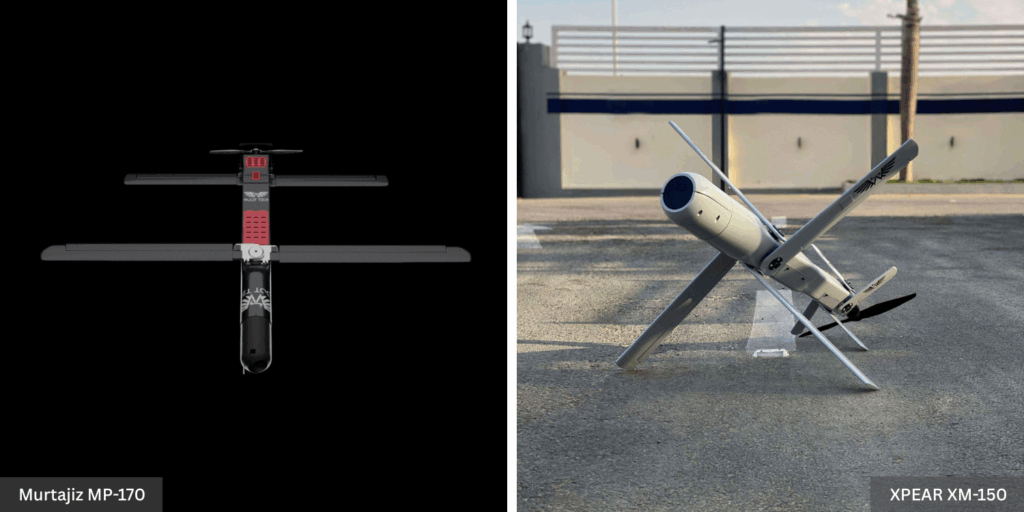
Murtajiz MP-170
The MP‑170 is a compact, tube‑launched loitering munition designed for rapid deployment, high mobility and precision engagement. Its folding‑wing architecture allows it to be fired from single‑tube launchers or employed in coordinated swarms of up to twelve drones using a multi‑barrel launcher system. This configuration enables simultaneous launches, staggered salvos or sequential waves depending on mission requirements, greatly enhancing flexibility.
Beyond ground‑based launch, the MP‑170 is engineered for air‑droppable deployment from heavier multi-rotor motherships . This airborne dispersal capability extends the drone’s operational envelope far beyond its normal communication radius by delivering it deep inside contested areas before activation.
When released mid‑air, the MP‑170’s folding wings deploy automatically, stabilising the platform and transitioning it seamlessly into controlled flight. This mechanism allows mothership UAVs to act as force multipliers, carrying multiple MP‑170 units and releasing them in staggered patterns or simultaneous volleys. Air‑droppable integration effectively transforms the MP‑170 into part of a multi‑layered aerial ecosystem, enabling long‑range reconnaissance‑strike missions and coordinated swarm operations far beyond the reach of ground‑based launchers.
Xpear MX-150
The XPEAR MX-150 is a lightweight, quickly deployable loitering munition designed for fast-reaction precision strikes at the tactical edge. Its tube-launch system enables near-instant deployment and rapid reloads. With an 8 kg maximum take‑off weight and a 2 kg multifunctional warhead, it delivers a strong balance of lightweight mobility and lethal performance.
Its advanced thermal-IR and HD day-camera suite, enhanced by AI-driven computer vision, delivers reliable target detection and accurate terminal guidance in all conditions. With a 30 km communication range, 30-minute endurance and multiple warhead options, the MX-150 provides infantry and mobile units with a flexible, sensor-rich strike asset capable of engaging threats swiftly and with minimal logistical demand.
Like other members of the Woot-Tech loitering munitions family, it also comes with multiple warhead options including anti‑radiation, anti‑armor, pre‑fragmentation, HE and FA explosives enabling it to engage both soft and hard targets, disrupt troops in open areas, penetrate armored or lightly armored vehicles and in the case of anti-radiation payloads, target tactical air-defence radars or other radiation emitters to open corridors for follow-on strikes.
The XPEAR MX‑150 is a compact yet highly capable loitering munition system engineered to deliver rapid, precise and adaptable strike capability in fast‑moving tactical scenarios. Its sensor‑rich guidance suite, quick‑launch format and multi‑warhead compatibility create a versatile, infantry‑portable precision weapon that strengthens frontline lethality while maintaining operational agility.
Technical Specifications:
| Parameters | XM-150 | MP-170 |
|---|---|---|
| Wingspan | 1.5 m | 1.7 m |
| Fuselage | 2.0 m | 1.3 m |
| Weight | 08 kg | 06 kg |
| Datalink Range | 30 km | 30 km |
| Max Range | >30 km | >30 km |
| Endurance | 30 mins | 150 mins |
| Service Ceiling | 3000m | 1500 |
| Warhead | 2 kg | 1.5 kg |
| Air Launch | TBD | Yes |
| Propulsion | BLDC Motor | BLDC Motor |
| Warhead Type / Targets | Anti-radiation, Anti-bunker, Pre-frag, HE, FA Explosives | Anti-radiation, Anti-bunker, Pre-frag, HE, FA Explosives |
Nimbus 2k

Nimbus 2K is an under-development jet-powered high-speed loitering munition engineered for deep‑strike missions. Powered by a 55 kg‑thrust turbojet engine, the Nimbus‑2K can achieve cruise speeds of up to 650 km/h and operates at altitudes reaching 10,000m enabling high‑altitude long range penetrations.
With a maximum take‑off weight of 75 kg, it can carry a 10 kg warhead and supports multiple payload configurations including anti-radiation and anti-armor configurations. A 100 km communication range and up to 150 minutes of endurance enable extended autonomous operations deep behind enemy lines.
Optimized for behind‑enemy‑lines operations, it can home-in on hostile radar emissions, allowing it to autonomously engage radar systems and battlefield surveillance arrays. While the exact development status remains unclear, the system’s design trajectory suggests a transition toward an AIenabled long-range SEAD/DEAD asset potentially positioning Nimbus-2K as a cost-effective, high-speed alternative to conventional cruise missiles once matured.
Integrated Dynamics Nishan MK-II
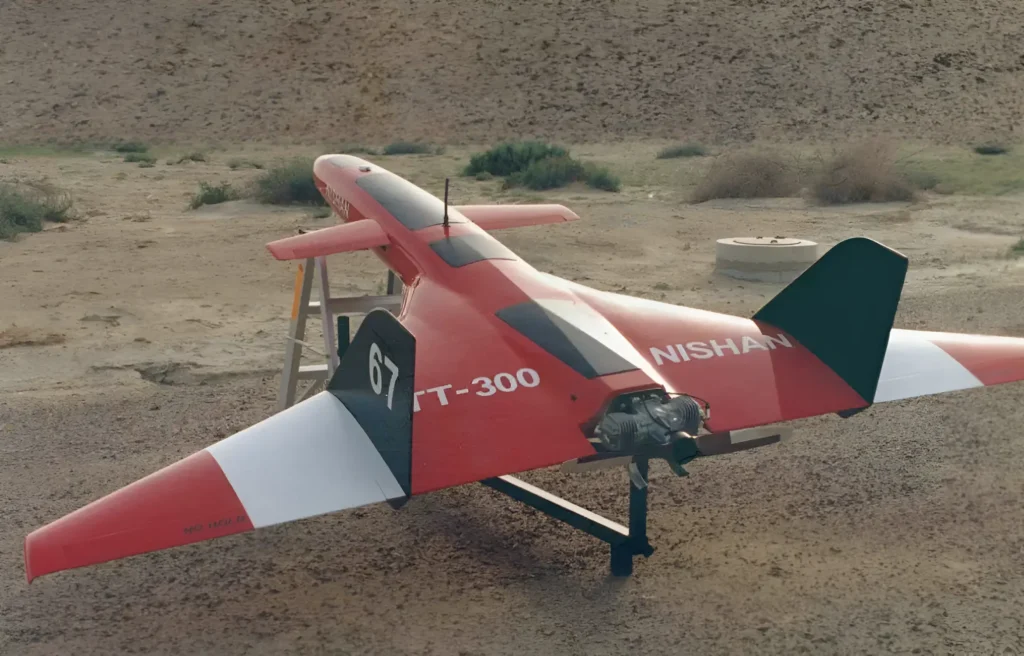
Originally designed for advanced air-defence training and simulation, Integrated Dynamics’ Nishan MK-II is a high speed target drone that has been repurposed to serve as a kamikaze-style strike asset.
In its loitering-munition role, the Nishan MK-II features a Max Take off weight of 65kg, a 15 kg warhead payload and a strike range of up to 100 km. Powered by a 240 cc piston engine, it reaches speeds of up to 400 km/h and offers up to 4 hours of endurance which allows it to conduct long-duration surveillance and strike missions. It uses a catapult launch system and leverages its high-speed target-drone heritage to deliver rapid ingress and effective terminal impact against designated targets.
Proven over extensive operational use by Pakistani forces, the Nishan MK-II has demonstrated reliability, adaptability and low-maintenance sustainment in real field conditions. Its ability to fly low and perform sea-skimming profiles makes it suitable not only for land-based roles but also for naval employment, including shipborne training, deception and precision-strike tasks.
Rover LM
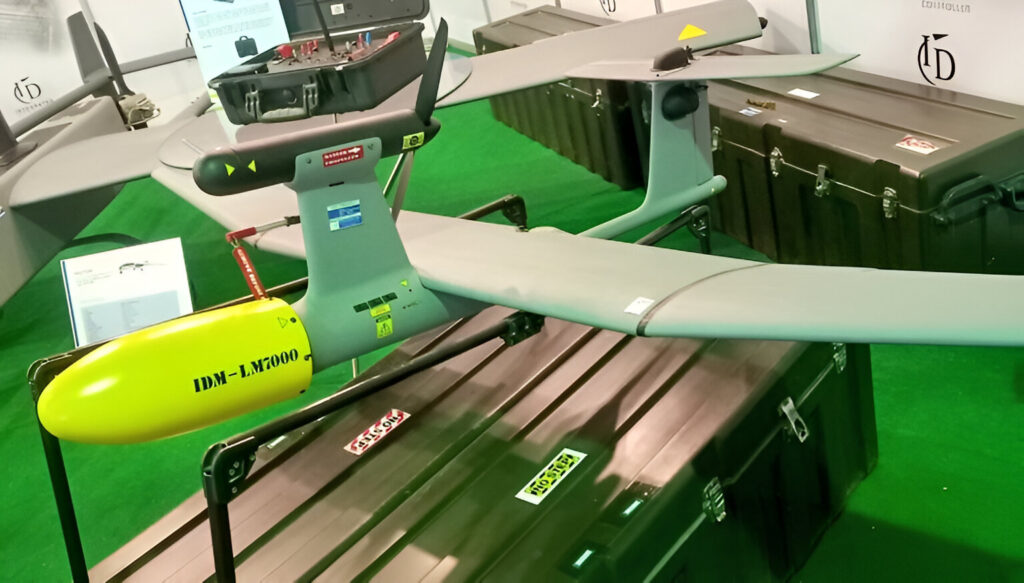
The ROVER LM is a hand launched loitering-munition variant of the Intergrated Dynamics’ ROVER surviellinace UAV. It operates at speeds between 30–100 km/h and provides up to 1.5 hours of endurance, enabling persistent battlefield observation, target tracking and precise last‑moment engagement. The system supports both GPS and autonomous navigation with an operational reach of up to 40 km.
With a maximum take‑off weight of 4.5 kg and a 1.5 kg thermobaric HE warhead, it delivers a lightweight yet potent strike capability for frontline units. Its portability and low acoustic signature make it well-suited for engaging enemy infantry columns, soft-skinned vehicles, firing points and other light targets at the platoon or company level.
WIL FLY Series
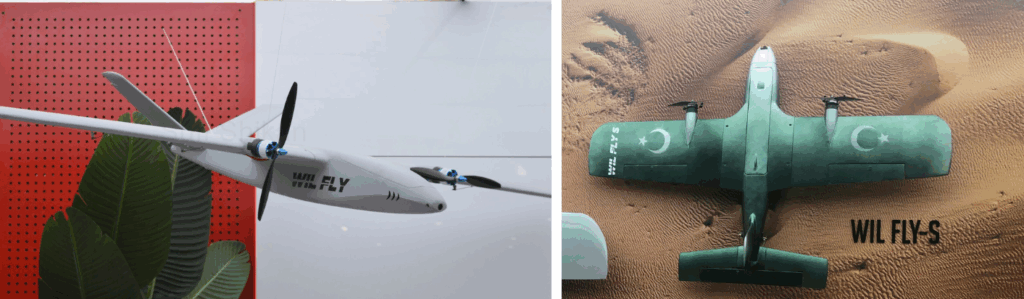
Developed by Wah Industries Limited (WIL), WIL‑Fly seriesre presents a new generation of Pakistan’s first‑person‑view (FPV) loitering and strike‑optimised unmanned aerial vehicles. The family integrates compact airframes built from lightweight composite materials and uses electric propulsion that provides a low acoustic signature and minimal thermal visibility. It relies on FPV guidance which support precise terminal engagement against moving targets.
Designed as low‑cost, modular, and rapidly deployable munitions, the series addresses Pakistan’s growing requirement for attritable drones capable of precision attacks in contested environments. Both platforms in the family share a common design philosophy that prioritises portability, hand‑launch capability, high‑accuracy navigation and operational flexibility.
Technical Specifications:
| Parameters | WIL FLY | WIL FLY-S |
|---|---|---|
| Wingspan | 200 cm | 96 cm |
| Fuselage | 97 cm | 58 cm |
| MTOW | 5.5 kg | 1.4 kg |
| Warhead | 2000g | 400 g |
| Speed | 120 km/h | 60-90 km/h |
| Range | 10-15 km | 8-10 km |
| Endurance | 60 mins | 30 mins |
| Service Ceiling | 2000m | 2000m |
| Launch Mechanism | Hand Launched | Hand Launched |
| Propulsion | BLDC Motor | BLDC Motor |
WIL Guardian S4 & S6
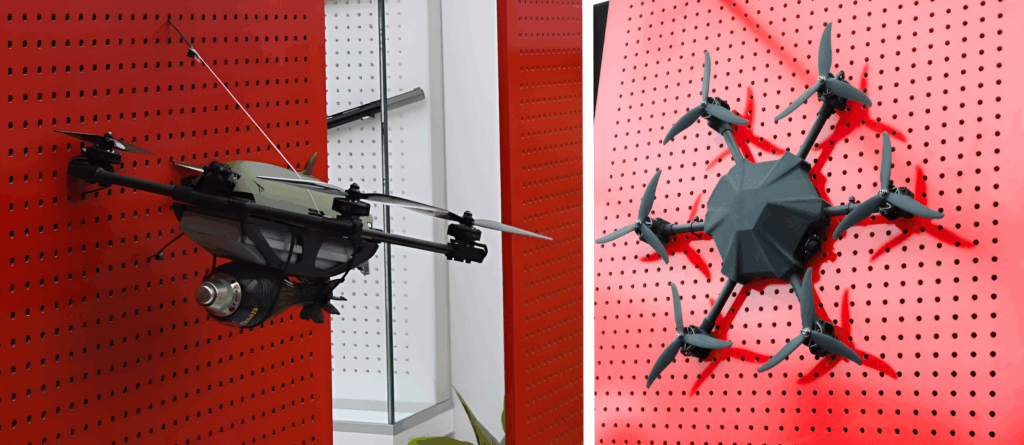
The WIL Guardian-S4 and S6 represent compact kamikaze multirotor UAVs engineered for short-range precision strike missions in contested tactical environments. Developed around lightweight carbon-fiber airframes, both variants prioritize manoeuvrability, low acoustic signature and rapid deployment directly from frontline units.
With a maximum take-off weights of 3.5 kg, the Guardian S4/S6 series can deliver high explosives or anti-personnel warhead of 1.5kg which makes it a suitable option for infantry teams requiring immediate point-attack capability. It has an Endurance of approximately 20 minutes which supports reconnaissance-to-strike cycles within a 4 km operational envelope, allowing operators to identify, verify and engage targets during a single mission without exposure to enemy fire.
The Guardian-S4/S6 family delivers a low-cost disposable strike capability that fills the critical gap between FPV racing-style munitions and larger, higher-endurance loitering systems. Their combination of hand-launch readiness, precise FPV targeting and warhead-level effects provides frontline Pakistani units operating in dense urban layouts, trench networks or semi-open rural terrain.
GIDS ZAP-I, ZAP-II & SkyRam
ZAP-I and ZAP-II
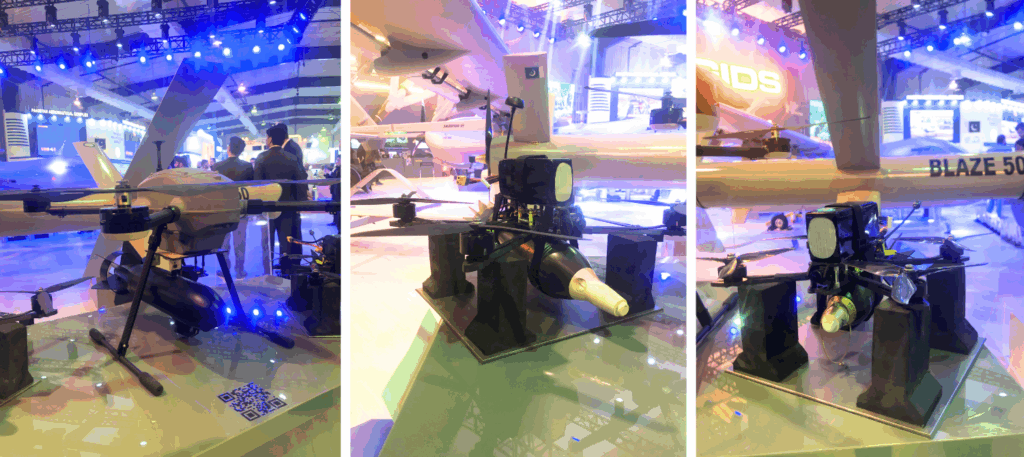
The ZAP-1 and ZAP-2 represent GIDS ultra-low-cost mortar carrier FPV kamikaze drones engineered for decentralized, high-tempo tactical strike operations. Both platforms employ 60 mm and 81 mm mortar bombs or RPG-class warheads as direct-impact munitions, converting inexpensive battlefield ordnance into pilot-controlled precision-guided strikes.
ZAP-I and ZAP-II use advanced starlight night-vision cameras paired with a 1.6W digital video transmission system to deliver real-time imagery for precision targeting during night missions. Both systems are built around lightweight carbon-fiber quadrotor airframes, easily field-assembled components and commercially scalable electronics which makes their mass production feasible even under battlefield consumption rates.
Their affordability enables deployment in large numbers, allowing frontline units to conduct saturation attacks through sheer volume, distributed control and multi-angle attack geometries. The minimal logistical footprint and very low per-unit cost position them as high-impact weapons ideal for trench penetration, neutralizing crew-served weapons and slashing attacks against light armored vehicles.
SkyRam
The SKY-RAM is GIDS’ more sophisticated man-portable ISR (Intelligence, Surveillance, and Reconnaissance) and kamikaze UAV system, designed for units requiring a balance of high-fidelity reconnaissance and precision strike capability. Built around a rugged carbon-fiber quadrotor airframe with vertical takeoff and autonomous flight modes, it combines rapid deployment supported by redundant IMUs and automatic return-to-base logic during link loss or battery depletion.
It is equipped with a stabilized EO sensor offering 1080p video and 4× optical zoom which provides real-time target detection, tracking and battle damage assessment before initiating a strike profile. Its modular design, man-portable capability and ability to shift seamlessly between ISR and kamikaze roles make it well-suited for special forces, counterterrorism units and conventional infantry requiring precision strike capability with an intelligence-driven lead-up.
Technical Specifications:
| Parameters | ZAP-I | ZAP-II | SKYRAM |
|---|---|---|---|
| Wheelbase | 7 inch | 10 inch | 10 inch |
| Warhead | 1.5 kg | 60 /81mm Mortar, RPG | 2 Kg |
| Range | 5 km | 5-8 km | 5-7 km |
| Endurance | 15-30 mins | 15-30 mins | 25-60 mins |
| Service Ceiling | 3000m ASL | 4000m ASL | 3000m ASL |
| Launch Mechanism | Hand Launched | Hand Launched | VTOL |
| Hit Accuracy | 5m CEP | 5m CEP | 5m CEP |
Integrated Dynamics E-RAD
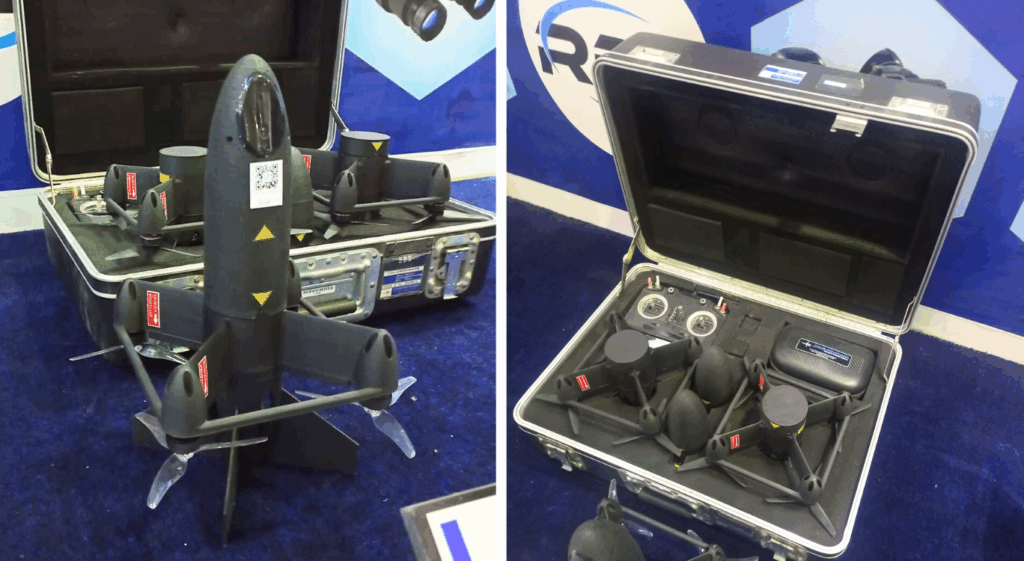
E-RAD is a hand-launched, rapid deployement micro loitering munition desinged and developed by Integrated Dynamics. Weighing only 0.5 kg dry and 1.0 kg at take-off, it is small enough for a single operator or SOF team to carry multiple units. Despite its compact airframe, the system integrates an HD EO/IR camera, autonomous loiter and waypoint navigation modes, object tracking and a high-speed terminal attack profile of 150–200 km/h.
Functioning as a flying grenade, E-RAD delivers a focused explosive effect with 10 minutes of endurance and a 5 km operational radius allowing SOF teams to conduct covert reconnaissance, pre-entry scans, anti-ambush overwatch and precision strike without compromising their position. E-RAD’s low acoustic signature and single-button launch capability make it exceptionally suited for urban, indoor-adjacent giving Special Operations Forces a and pocket precision strike asset tailored for high-density urban environments where larger drones cannot maneuver.
Shahab-SMF & Buster M-FB10
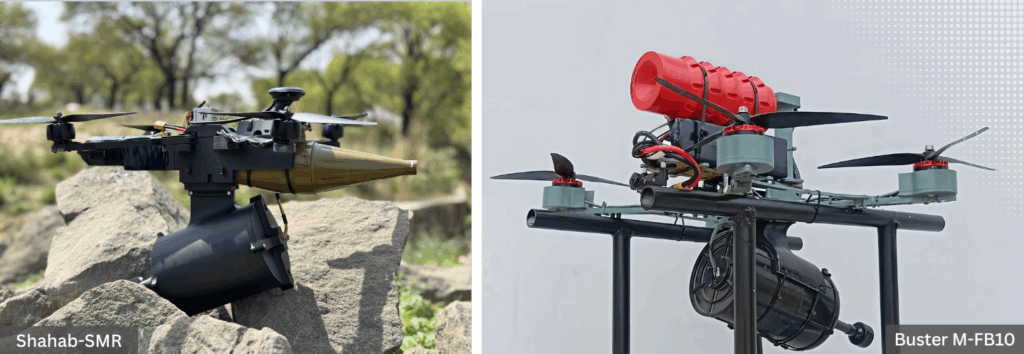
Along with radio-frequency (RF) FPV drones, Pakistan’s private UAV industry is now advancing towrds anti-jamming fibre-optic-guided FPV (FO-FPV) kamikaze drones. Sysverve Aerospace’s Shahab-SMF and WootTech’s Buster M-FB10 are fiber-optic operated suicide QCs, capable of operating in high-EW (Electronic Warfare) battlefields where radio-frequency (RF) communication becomes unreliable, disrupted or outright denied. Both these systems are equipped with RPG‑style anti‑armor warheads designed to neutralize adversary’s advancing armored units and destroy hardened military positions.
Technical Specifications:
| Parameters | Sysverve Aerospace Shahab SMR | Woot-Tech Buster MFB-10 |
|---|---|---|
| MTOW | 4.0 Kg | 5.0 Kg |
| Warhead | 2.0 kg | 1.0 kg |
| Range | 5 km | 10 km |
| Endurance | 15 mins | 20 mins |
| Speed | 20m/s | 175 km/h |
| Service Ceiling | 300m | 300m |
| Launch Mechanism | VTOL | VTOL |
Modern warfare trends indicate that the next Indo-Pak conflict will feature an intense electromagnetic environment in which conventional RF-guided drones will face severe operational limitations as both Pakistan and India continue to field a wide range of advanced EW syatems including wideband jammers, counter-FPV guns and GNSS denial equipment.
In such environment, fiber-optic-guided and anti-jam FPV kamikaze drones can provide a decisive survivability and precision advantage unmaned strike assets. This capability would allow frontline units to engage and defeat Indian armored units including infantry columns supported by battlefield EW assets and soft-kill protection systems.
Woot-Tech MQ-350 Murtajiz & Sysverve Aerospace Shahab SMR

The Murtajiz MQ-350 is a compact, multirole close-air-support loitering munition engineered to deliver precision anti-armor and anti-personnel effects at short ranges. Built around a 0.5 m multirotor airframe, the system incorporates a modular warhead bay capable of accommodating specialized anti-armor, anti-bunker, pre-fragmented high-explosive (HE) and focused-attack (FA) payloads.
Its multirotor configuration enables vertical takeoff and landing (VTOL) alongside steep top-attack geometries. This allows operators to exploit vulnerable turret roofs and engine decks of heavy armor, bypassing traditional ground-launched anti-tank guided missile (ATGM) countermeasures. Furthermore, the system supports algorithmic swarming operations, enabling operators to execute coordinated, massed strikes against moving armored colu
mns and fortified infantry positions in complex or urban terrain.
Shahab SMR
The Shahab SMR is a short-range loitering munition designed as a precision-strike asset for frontline tactical units. Functioning as a first-person view (FPV) suicidal drone, this lightweight platform provides infantry forces with immediate, cost-effective close support, effectively bridging the operational gap between tactical mortars and heavier guided weapon systems.
The defining feature of the Shahab SMR is its integrated artificial intelligence (AI) dataset model for target identification. This onboard tracking algorithm enables the munition to autonomously lock onto and engage targets during the terminal flight phase. By mitigating user error and electronic warfare interference, the AI-driven architecture ensures pinpoint terminal accuracy while delivering its customizable 2.0 kg high-explosive warhead against low-radar-signature tactical threats.
Technical Specifications:
| Parameters | Sysverve Aerospace Shahab SMR | Woot-Tech Murtajiz MQ-350 |
|---|---|---|
| MTOW | 4.0 Kg | 2.5 Kg |
| Warhead | 2.0 kg | 1.0 kg |
| Range | 5 km | 5 km |
| Endurance | 15 mins | 20 mins |
| Speed | 20m/s | 100 km/h |
| Service Ceiling | 200m | 300m |
| Launch Mechanism | VTOL | VTOL, Hand Launch, Grenade-launcher |
NASTP Drone Swarm System
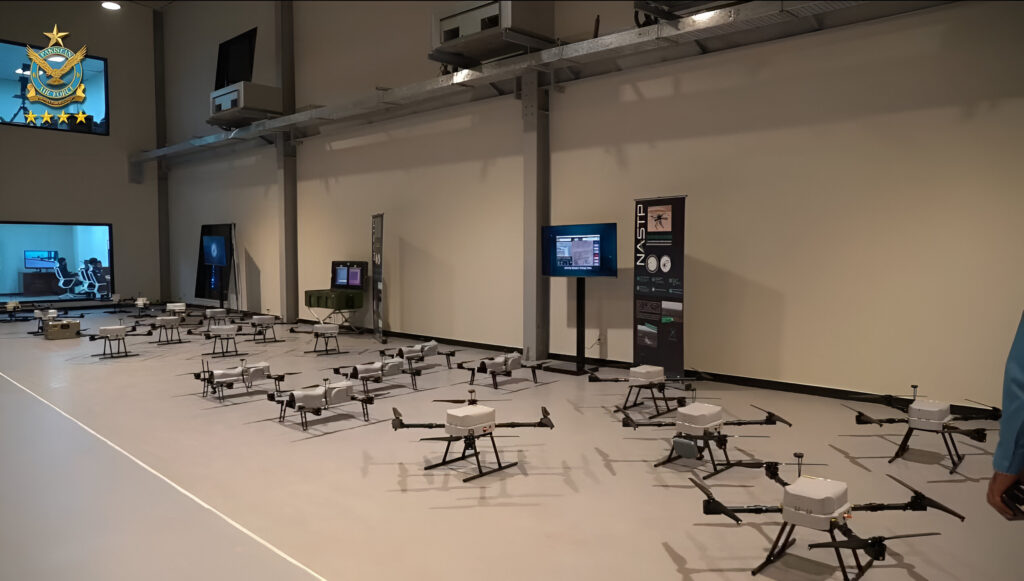
NASTP Drone Swarm System: Photo source: @FarooqB90714421 via X
NASTP’s drone-swarm system integrates different types of multi-rotor platforms that cooperatively execute search-and-track missions under a single operator’s high-level command. The swarm system uses a collaborative flight and autonomous task distribution algorithm to turn a single operator’s mission input into multiple actions such as search, track, decoy and strike.
Its Independent command-and-control capabilities allow individual drones to make mission-level decisions and reassign roles if communications or assets are degraded in contested electromagnetic environments, enabling rapid target prosecution and persistent area coverage.
Together, these elements position NASTP’s swarm system as a cost-effetive force-multiplier for both precision tactical strikes and complex ISR (intelligence, surveillance, reconnaissance) tasks across contested battlefields.
NASTP’s advancements in autonomy mark a clear step toward the development of a more capable, though carefully governed, lethal autonomous weapon systems (LAWS) which demonstrates Pakistan’s enhancing capability to develop sophisticated and strategically relevant technologies.
NASTP Python
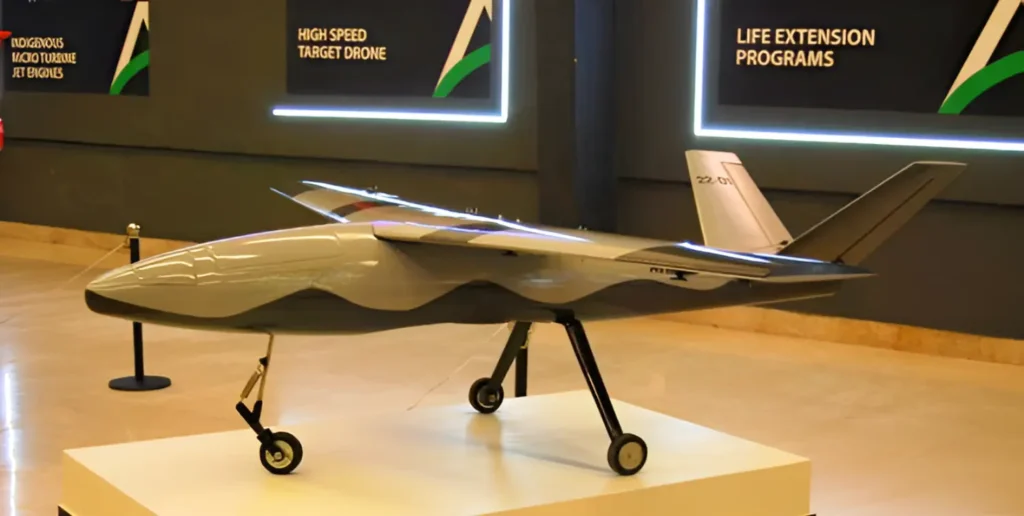
NASTP Python Loitering Munition: Photo source: @Defense_Talks via X
Python is a turbo-jet powered loitering munition currently under development at Pakistan’s National Aerospace Science and Technology Park (NASTP). Designed to achieve mission objectives with high accuracy and minimal collateral damage, the Python features a smooth aerodynamic fuselage tapering toward the tail, a high‑mounted tapered straight wing for aerodynamic efficiency and a V‑tail for flight control and stability. It uses a fixed tricycle landing gear which reduces its dependence on specialised launch hardware.
It appears to have a composite‑material structure to minimise thermal signature for reduced detectability during terminal approach in a contested battlefield. After its development it could be a potentially potent precision‑strike and deterrent asset, especially in the domains of SEAD against point defenses, logistics interdiction and time‑sensitive targeted strikes.
Detailed performance parameters (exact range, endurance, payload and avionics) remain internal to NASTP, the above assessment is based on described design features and intended mission sets.
Conclusion
The rapid diversification of Pakistan’s loitering munition portfolio represents a profound paradigm shift in the nation’s asymmetric defense strategy. By cultivating a collaborative ecosystem that pairs state-backed entities like NASTP, Heavy Industries Taxila and GIDS with agile private sector firms such as Sysverve Aerospace and Woot-Tech, Pakistan has successfully transitioned from a defense importer to a highly innovative producer. The transition from traditional propeller-driven tactical systems to long-range, turbojet-powered effectors such as the KaGeM V3, SARFIROSH and HiMark-25 TJ demonstrates a mature capability to project standoff power and threaten localized or deep high-value infrastructure far beyond conventional frontline areas.
Ultimately, these advancements establish a highly scalable “sensor-to-shooter” kill web uniquely optimized for contested electromagnetic environments. By integrating cutting-edge technologies like jam-resistant fiber-optic controls, autonomous AI terminal seekers and collaborative mesh-networked swarming algorithms, Pakistan is systematically altering the defense dynamics of the region. As these lethal autonomous and expendable platforms become fully integrated into multi-domain doctrine alongside traditional cruise and ballistic missiles, they provide Pakistan’s armed forces with an incredibly cost-effective, high-survivability mechanism to oversaturate and neutralize complex, layered adversarial air defense networks.