


1. Introduction to the Armored Paradigm Shift
The evolution of armored warfare has historically been defined by a continuous, reactionary escalation in the weight, firepower, and ballistic protection of the Main Battle Tank (MBT). Since the midpoint of the Cold War, military doctrines have prioritized the centralization of armored capabilities into single, universally capable platforms, resulting in modern MBTs such as the American M1A2 Abrams, the German Leopard 2A7, and the British Challenger 3, all of which routinely exceed 65 to 70 tons in their fully loaded combat configurations.1 While these massive platforms offer unparalleled survivability and lethality in conventional, linear warfare on firm, open terrain, their immense mass imposes severe logistical, strategic, and geographic constraints. Heavy armored formations demand highly specialized transport infrastructure, robust bridging capable of handling 70-ton point loads, high-capacity recovery vehicles, and immense fuel supply chains that rapidly degrade the pace of expeditionary operations.3 Furthermore, the deployment of 70-ton MBTs is functionally impossible in extreme, austere environments such as the high-altitude, hypoxic plateaus of the Himalayas, dense archipelagos, or soft-soil riverine basins where ground pressure limitations dictate mobility.4
To bridge this critical operational gap, military doctrines worldwide are experiencing a significant renaissance in the procurement of light tanks and medium-weight assault guns.1 Originally conceived during the pre-World War II military buildups as fast, exploitation vehicles or “combat cars” designed to disrupt enemy communications behind the front lines, the light tank evolved through platforms like the American M24 Chaffee, the M551 Sheridan, and the French AMX-13.1 Today, these platforms are designed to provide organic, direct-fire support to light infantry, airborne units, and expeditionary forces, prioritizing strategic and tactical mobility over absolute, passive survivability.3 Within this contemporary resurgence, the “sub-25-ton” weight limit represents the ultimate engineering threshold for rapid strategic deployment. A combat weight strictly maintained under 25 tons generally permits air-transportability via tactical airlifters like the C-130 Hercules or allows for dual-lift capabilities in strategic airlifters like the Boeing C-17 Globemaster III.4 It also enables inherent amphibious capabilities without the need for extensive flotation screens, and ensures exceptionally low ground pressure for traversal over snow, mud, and fragile mountainous infrastructure.4
However, engineering a highly lethal and adequately protected fighting vehicle within a strict 25-ton weight limit presents profound physical, thermodynamic, and metallurgical challenges. The fundamental physics of armored vehicle design, often referred to as the “Iron Triangle” of mobility, protection, and firepower, dictate that maximizing one attribute inherently compromises the others. Enforcing a 25-ton cap forces engineers into a zero-sum compromise where traditional steel armor and high-impulse cannons must be discarded in favor of exotic materials and highly complex recoil-mitigation technologies. This exhaustive technical report analyzes the physical limitations inherent in sub-25-ton light tanks, examines the state-of-the-art technologies utilized to overcome these barriers, and presents a detailed comparative analysis of contemporary light and medium tank programs: the Indian Zorawar, the Chinese Type 15 (ZTQ-15), the Turkish-Indonesian Kaplan MT (Harimau), and the recently canceled American M10 Booker.
2. The Physics and Thermodynamics of Sub-25-Ton Platforms
The design of a light tank is not merely a miniaturization of a Main Battle Tank; it is a fundamental reimagining of vehicle architecture bounded by strict physical laws. The limitations of a sub-25-ton tank can be categorized into three primary domains: the mass-volume paradox of ballistic protection, the kinematics of high-impulse recoil management, and the thermodynamic constraints of high-altitude powertrain operations.
2.1 The Armor-Volume Paradox and Ballistic Vulnerability
The most critical and inescapable limitation of a sub-25-ton tank is its inherent inability to carry thick, passive armor. Armor mass scales non-linearly with the internal volume of the vehicle. Providing all-around protection requires enclosing the human crew, ammunition stowage, sensors, and the powertrain in a continuous ballistic envelope. Because the surface area of this envelope grows rapidly as internal volume increases, traditional rolled homogeneous armor (RHA) or standard high-hardness steel plates exhaust a 25-ton weight budget long before MBT-level protection can be achieved.
To quantify these limitations, modern military vehicles are benchmarked against the NATO Standardization Agreement (STANAG) 4569, which defines the protection levels for occupants of logistic and light armored vehicles.9 The standard evaluates strikes from kinetic energy weapons, artillery fragmentation, and improvised explosive device (IED) blasts.9
| STANAG 4569 Level | Defined Kinetic Ballistic Threat | Velocity | Passive Armor Implication for 25-Ton Tanks |
| Level 3 | 7.62 mm x 54R B32 API at 30 meters | 854 m/s | Easily achievable baseline protection within a 15-20 ton chassis using standard steel or aluminum alloys.10 |
| Level 4 | 14.5 mm x 114 API/B32 at 200 meters | 911 m/s | The standard frontal and flank baseline for modern 25-ton light tanks, requiring careful material allocation.10 |
| Level 5 / 5B | 25 mm x 137 APDS-T at 500 meters | 1258 m/s | Highly difficult to achieve under 25 tons. Requires advanced ceramics, titanium castings, or modular composite appliqués.10 |
| Level 6 | 30 mm x 173 APFSDS-T at 500 meters | >1300 m/s | Historically pushes vehicle mass well beyond 30 tons. Achieving this under 25 tons represents the absolute limit of modern metallurgical science.10 |
Due to these volume-to-mass constraints, a 25-ton light tank generally maximizes passive frontal armor at STANAG Level 4 or Level 5, meaning it can only reliably withstand heavy machine gun fire, nearby 155mm artillery fragmentation (where a 155mm burst 10 meters away is roughly equivalent to a 30mm APFSDS strike at 500 meters), and older generation light autocannons.11 Without substantial technological intervention and exotic materials, a sub-25-ton tank is highly vulnerable to modern 30mm Armor-Piercing Fin-Stabilized Discarding Sabot (APFSDS) rounds fired by contemporary Infantry Fighting Vehicles (IFVs).11 Furthermore, it offers virtually zero passive resistance to shoulder-fired anti-tank weapons (like the RPG-7), recoilless rifles, or heavy Anti-Tank Guided Missiles (ATGMs) equipped with tandem-charge high-explosive anti-tank (HEAT) warheads.12 Consequently, in a high-intensity combat scenario, a sub-25-ton platform cannot survive direct hits from MBT main guns or heavy anti-armor munitions, relegating it strictly to a skirmishing, screening, infantry support, or ambush role rather than a spearhead breakthrough role.1
2.2 Recoil Kinematics, Trunnion Pull, and the Overturning Moment
Equipping a light tank with a main gun capable of defeating enemy fortifications and light armor, typically a 105mm or 120mm high-pressure cannon, introduces severe recoil management challenges that threaten the structural integrity of the vehicle. When a high-velocity projectile is fired, the conservation of momentum dictates that the forward momentum of the projectile and the expelled propellant gases perfectly equals the rearward momentum of the recoiling gun mass.
The physics of recoil in large-caliber tank guns can be modeled where the total momentum is defined by the mass and velocity of both the projectile and the charge, interacting with Krupp’s constant and acoustic velocity parameters.13 The kinetic recoil energy that must be absorbed by the vehicle’s trunnions is immense.13 Engineering projections for firing modern high-velocity rounds indicate that launch momentum can reach the neighborhood of 35,000 Newton-seconds (approximately 8,000 pound-force seconds).14
In a 65-ton MBT, the immense mass of the vehicle chassis, the heavy welded steel turret, and the wide track stance easily absorb this trunnion pull without destabilizing the platform. However, on a platform weighing under 25 tons, the trunnion force generated by a standard 105mm or 120mm tank gun creates extreme stress on the turret ring and the lightweight chassis.13 Firing a large-caliber weapon perpendicular to the direction of travel (over the side of the vehicle) on a lightweight, narrow-tracked chassis generates a severe overturning moment. The horizontal distance between the turret ring center and the trunnion acts as a lever arm. If the recoil impulse is too high, the light tank risks catastrophic structural damage to its turret ring bearings, extreme crew disorientation, or literally tipping over on its hydropneumatic suspension.13
Historically, this physical limitation forced engineers to equip light tanks with low-velocity guns. A prime example is the American M551 Sheridan of the Vietnam War era, which weighed 15.2 tons and utilized the troublesome M81 152mm gun/launcher.7 Because the Sheridan was too light to handle the recoil of a high-velocity kinetic penetrator, the M81 fired low-velocity conventional high-explosive rounds or the MGM-51 Shillelagh guided anti-tank missile, severely compromising its rapid-engagement anti-armor lethality.7 Overcoming this kinetic barrier on a modern 25-ton platform requires radical departures in cannon breech and recoil system design.14
2.3 Powertrain Hypoxia and High-Altitude Thermodynamics
Light tanks are specifically requested by modern militaries for deployment in environments where heavy tanks fail, most notably high-altitude mountainous terrains and extreme cold-weather theaters.4 Operating internal combustion engines at elevations up to 15,000 feet, such as the contested Himalayan borders of Ladakh and Arunachal Pradesh or the Tibetan plateau, introduces severe thermodynamic and mechanical constraints.4
At high altitudes, the atmospheric pressure drops significantly, and the air becomes thin and hypoxic. A standard, naturally aspirated or single-turbocharged diesel engine relies on a specific volumetric mixture of oxygen and atomized fuel to achieve combustion. In a hypoxic environment, the engine is starved of oxygen, causing incomplete combustion, heavy exhaust soot, and a drastic loss of power. Heavy MBTs like the T-72 and T-90 can lose over 30% to 40% of their rated horsepower at high elevations, destroying their power-to-weight ratios and rendering them incapable of navigating steep, rugged mountain passes.4
Furthermore, lightweight vehicles inherently have smaller internal hull volumes, leaving highly restricted space for large cooling packs, radiators, and auxiliary power units (APUs).15 When a diesel engine works harder to process thin air, it generates excessive heat. In sub-zero ambient temperatures (-20°C and below), the extreme temperature gradients place immense stress on metal components, synthetic rubber tracks, and hydraulic fluids used in the vehicle’s suspension and recoil systems.4 A modern sub-25-ton tank must therefore integrate specialized thermal management systems, advanced multi-stage turbochargers, and localized oxygen generation to maintain a power-to-weight ratio near the optimal 30 horsepower per ton.4
3. Next-Generation Technological Enablers in Light Armor
To circumvent the strict physical limitations imposed by the 25-ton weight limit, defense engineering laboratories are integrating a suite of cutting-edge materials, advanced weapon kinematics, and autonomous sub-systems. These technologies allow modern light tanks to generate the firepower and survivability traditionally associated with platforms twice their weight.
3.1 Soft Recoil and Fire-Out-of-Battery (FOOB) Mechanisms
To successfully mount a 105mm or 120mm high-pressure gun on a lightweight chassis without inducing structural failure via trunnion pull, modern light tanks utilize revolutionary “soft recoil” systems.14 The traditional recoil cycle of a tank gun holds the weapon in a static “in-battery” position before firing. Upon ignition, the entire recoil impulse violently forces the gun backward, requiring massive hydraulic buffers to absorb the energy.17
In contrast, soft recoil technology, specifically the Fire-Out-Of-Battery (FOOB) mechanism, holds the cannon latched in a rearward, heavily compressed position.14 Upon pulling the firing lanyard or engaging the electronic trigger, the latch releases, and the massive gun barrel is propelled forward by nitrogen-preloaded recuperators.16 The propellant is electrically ignited at a precise microsecond while the gun mass is still physically moving forward at a predetermined run-up distance.17 Because the weapon is already traveling in counter-recoil, the immense rearward recoil energy of the fired round must first arrest the forward momentum of the gun barrel before pushing it backward into the latch position. This practical application of the conservation of momentum effectively dissipates the energy over a longer cycle, reducing the peak recoil force transmitted to the vehicle’s trunnions by up to 60% to 75%.16
A paramount example of this technology is the American M35 105mm low-recoil tank gun (originally designated the EX35/XM35), developed by the Benét Laboratories at the Watervliet Arsenal.16 Weighing approximately 1,325 kg, the M35 integrates a hydropneumatic recoil system with dual recoil brakes and an integral pepperpot muzzle brake to reduce overall recoil stroke.16 Operating at hydraulic pressures up to 2,500 psi, this system allows light vehicles to safely fire standard NATO 105mm ammunition, including high-impulse discarding sabot rounds like the M392A2 APFSDS and M900 APFSDS, with cycle times as short as 0.112 seconds.16 This “shoot and scoot” capability ensures the platform can deliver MBT-level kinetic energy without destroying its own chassis.17
3.2 Volumetric Reduction via Unmanned Turrets and Autoloaders
Human crew members are the single most volume-intensive component in any armored vehicle. They require substantial physical clearance to operate safely, ergonomic seating, life support systems, and protection from toxic propellant fumes. In a traditional MBT with a four-man crew, the human loader dictates the internal height, width, and overall volume of the turret.20 Because armor mass scales exponentially with the surface area of the volume it protects, a large manned turret requires tons of steel to achieve basic STANAG protection.
To achieve strict weight savings without sacrificing lethality, modern light tanks increasingly adopt autoloaders and remote or unmanned turrets.20 By automating the ammunition loading sequence with a bustle-mounted or carousel autoloader, the turret crew is reduced from three to two (commander and gunner), or zero in the case of fully unmanned systems.20 The removal of a crew member eliminates the spatial volume previously required for the loader’s standing room and range of motion. Consequently, a smaller turret requires drastically less armor mass to achieve the same or higher STANAG protection levels.21
An exemplary integration of this concept is the Belgian John Cockerill 3105 turret.23 Utilized extensively in modern light tank designs, it is an aluminum-welded, two-person turret equipped with an autoloader that holds 12 to 16 rounds of 105mm ammunition.24 The autoloader system not only significantly reduces the need for manual ammunition resupply, allowing the crew to remain focused on prolonged combat operations, but it also removes the necessity for large, heavy fume extractors on the gun barrel.22 Furthermore, machine-driven loading ensures a consistent, rapid rate of fire regardless of crew fatigue or the physical roughness of the terrain being traversed, providing a distinct tactical advantage during high-speed skirmishing.22
3.3 Advanced Metallurgy: Titanium Castings and Nano-Composites
To defeat modern 30mm APFSDS rounds, which travel at over 1,300 meters per second, without ballooning vehicle weight past 25 tons, defense metallurgical laboratories rely on exotic materials.10 Traditional rolled homogeneous armor (RHA) steel has a high density; relying on thickness alone for protection is incompatible with air-transportable weight limits.
Instead, modern light tanks utilize advanced composite structures, alumina ceramic tiles, and Nano-Engineered Reactive Armor (NERA) to defeat kinetic penetrators through sheer stress-wave disruption and yaw-induction rather than raw material thickness.4 In highly advanced sub-25-ton designs, foundational structural components are increasingly cast from Titanium alloys.15 Organizations like India’s Defence Metallurgical Research Laboratory (DMRL) and MIDHANI have successfully produced critical tank components, such as suspension hubs and 80mm modular armored plates, using state-of-the-art titanium casting technology.15 Titanium provides a strength-to-weight ratio far superior to standard ballistic steel, allowing for robust, highly durable hulls that weigh a fraction of traditional designs.15 This metallurgical breakthrough is the primary enabler allowing vehicles to push toward NATO STANAG 4569 Level 5B and Level 6 protection parameters while maintaining the strict 25-ton limit.11
3.4 Active Protection Systems (APS) and Adaptive Camouflage
Because passive armor cannot be scaled up indefinitely on a light tank, survivability in a threat-saturated environment is increasingly ensured via Active Protection Systems (APS).11 APS technology fundamentally trades passive steel mass for active sensor-effector networks.
Modern systems utilize a combination of continuous-wave radar and electro-optical sensors distributed around the turret to detect incoming threats such as ATGMs, RPGs, or loitering munitions.11 Upon detection, the system’s fire control computer calculates the threat’s velocity and trajectory in milliseconds. It then intercepts the threat using “hard-kill” counter-munitions, such as explosively formed projectiles or dense fragmentation blasts, or “soft-kill” electronic and electro-optical jamming.11 Systems like the Israeli Trophy or Elbit Systems’ Iron Fist allow a thinly armored light tank to survive direct strikes from heavy tandem-charge anti-tank missiles that would ordinarily penetrate over 1,000mm of RHA equivalent.11 This active interception paradigm elevates the survivability of the platform against infantry anti-tank weapons without adding tons of passive armor.28
Further enhancing survivability are adaptive thermal camouflage systems. Currently under development for next-generation platforms, these systems utilize hexagonal thermoelectric panels to dynamically adjust the vehicle’s surface temperature to within ±3°C of its immediate surroundings.11 By blending into the ambient thermal background, the light tank effectively disappears from enemy thermal imaging sights and heat-seeking drone optics, granting a critical advantage in ambush and reconnaissance operations.11
3.5 Counter-UAS and Organic Loitering Munitions Integration
The modern battlefield is defined by the proliferation of cheap, highly lethal unmanned aerial vehicles (UAVs) and loitering munitions. To offset their inability to survive direct, protracted engagements with heavy armor, light tanks are being reinvented as highly mobile, network-centric warfare nodes equipped with intrinsic drone integration.4
Modern light tank iterations feature docking mechanisms and integrated launchers for tactical drones and loitering munitions, such as the Switchblade 300.4 This organic capability allows the tank’s three-man crew to conduct beyond-line-of-sight (BLOS) reconnaissance, identify targets over ridgelines, and execute precision strikes from defilade positions without ever exposing the vehicle to direct enemy fire.4 Furthermore, dedicated Counter-UAS (C-UAS) systems, utilizing AI-driven target recognition, localized RF jamming, and remotely operated weapon stations (ROWS) armed with 12.7mm heavy machine guns or 40mm automatic grenade launchers firing air-bursting ammunition, are integrated to protect the tank’s vulnerable top-armor from enemy drone swarms.4
4. Comparative Analysis: Global Light and Medium Tank Architectures
The modern landscape of light and medium armor is currently dominated by distinct approaches from the United States, China, Turkey/Indonesia, and India. While all four geopolitical projects began with the fundamental goal of high mobility and infantry direct-fire support, shifting military requirements and geographical realities resulted in vast divergences in weight, technology, and capability. This divergence demonstrates the profound difficulty of remaining under the 25-ton threshold while attempting to satisfy multifaceted combat requirements.
Comparative Specifications of Modern Light/Medium Tanks
| Feature | Zorawar (India) | Type 15 / ZTQ-15 (China) | Kaplan MT / Harimau (Turkey/Indonesia) | M10 Booker (USA) – Cancelled |
| Combat Weight | < 25 tons 4 | 33 – 36 tons 5 | 30 – 35 tons 31 | ~42 metric tons (46 short tons) 33 |
| Current STANAG Protection | Level 4 Frontal, Level 2 Base 11 | Level 4 | Level 4 Base to Level 5 Add-on 31 | Level 5 / 6 (Estimated) |
| Crew Complement | 3 (Autoloader) 4 | 3 (Autoloader) 5 | 3 (Autoloader) 31 | 4 (Manual Loader) 33 |
| Main Armament | 105mm High-Pressure Rifled 4 | 105mm Rifled (Improved ZPL94) 30 | 105mm Cockerill Rifled 31 | 105mm M35 Rifled (Low Recoil) 33 |
| ATGM & UAS Integration | External Nag Mk-II (10km) & organic loitering munitions 4 | 105mm Gun-Launched ATGM (5km); No organic UAS 5 | Falarick 105 Gun-Launched ATGM (5km); No organic UAS | No organic ATGM; SwitchBlade 300 loitering munitions 19 |
| Turret Architecture | Cockerill 3105 (Manned/Auto) 4 | Domestic Bustle Autoloader 30 | Cockerill 3105 (Manned/Auto) 32 | Abrams-derived Manned Turret 37 |
| Powertrain | 750-760 hp Cummins Diesel, RENK Transmission 4 | 1000 hp 8V132 Twin-Turbo Diesel 5 | 711 hp Caterpillar C13, Allison X300 31 | 800 hp MTU 8V199 Diesel, Allison 3040 MX 33 |
| Power-to-Weight | ~30 hp/ton 4 | ~27.8 – 30.3 hp/ton 5 | 22.2 hp/ton 31 | ~19 hp/ton 36 |
| Unique Capabilities | Titanium hull, Amphibious, C-17 dual-airlift, ATGM integrated 4 | High-altitude oxygen generators, extreme mobility 5 | V-hull underbelly, STANAG 5 mine resistance 31 | High Abrams interoperability, heavy base armor 8 |
| Program Status | Testing phase (2024+) 4 | In active service (2018+) 5 | In mass production/delivery 32 | Cancelled (June 2025) 33 |
4.1 The Indian Zorawar: The Pinnacle of the Sub-25-Ton Doctrine
Developed rapidly by India’s Defence Research and Development Organisation (DRDO) in collaboration with Larsen & Toubro (L&T), the Zorawar represents an aggressive attempt to strictly adhere to the sub-25-ton weight limit.4 Named after General Zorawar Singh Kahluria, the ‘Conqueror of Ladakh’, the project was accelerated directly in response to the 2020 border standoffs with China in the Galwan Valley, where the Indian Army recognized a severe capability gap in mountain warfare.6
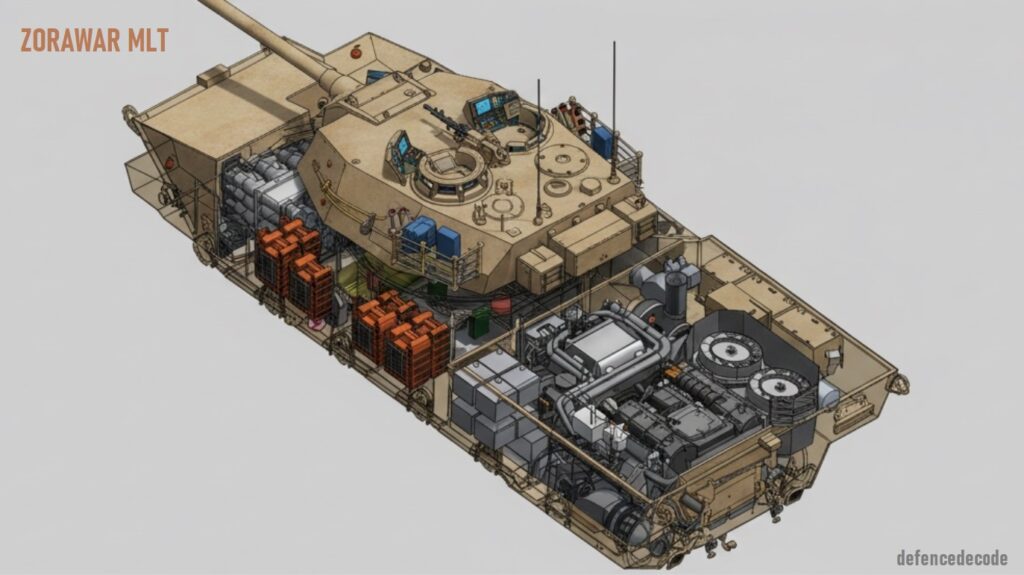
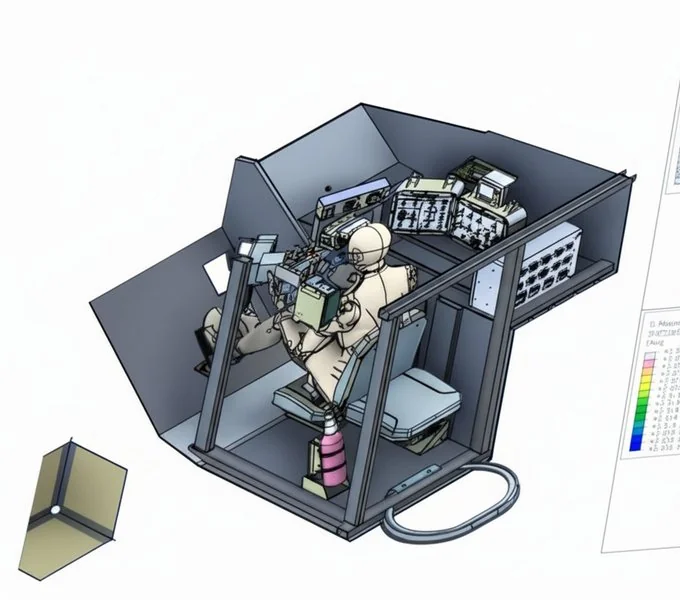
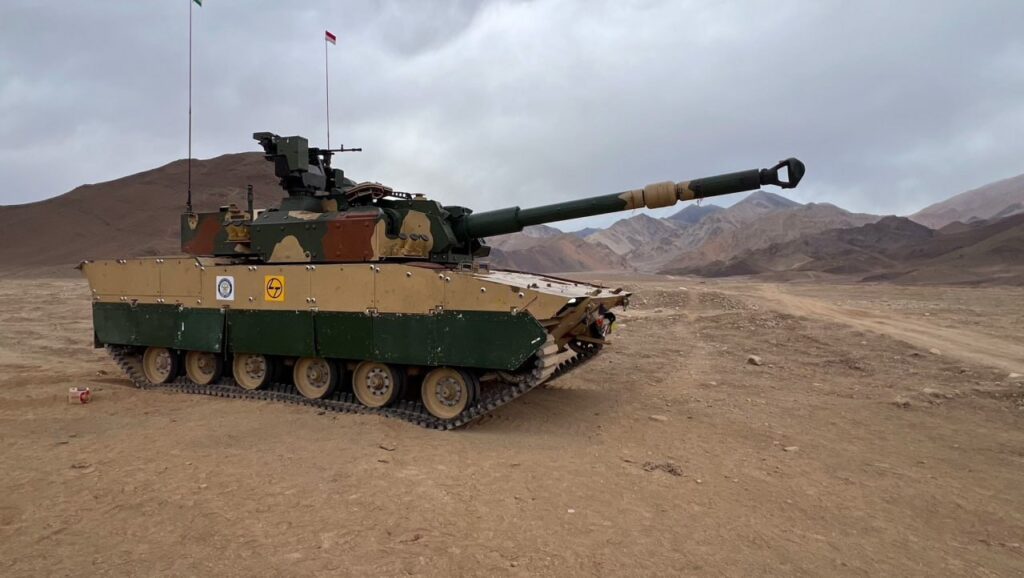
Operational Rationale and Design Architecture: The Zorawar was explicitly engineered from the ground up to operate at elevations up to 15,000 feet in sub-zero Himalayan environments like Ladakh and Arunachal Pradesh.4 At these extreme elevations, heavier assets like the T-72 and T-90 struggle with severe tactical mobility restrictions, logistical bridging constraints, and engine hypoxia.4 To maintain a base configuration mass under 25 tons, the tank utilizes a highly durable titanium alloy hull, advanced composite materials, and rubber-band tracks, achieving an exceptional power-to-weight ratio of approximately 30 hp/ton via a 750-760 hp Cummins VTA903E-T760 diesel engine paired with a RENK transmission.4 This severe, uncompromising weight restriction serves a critical strategic purpose: it allows the Indian Air Force to load two fully combat-ready Zorawar tanks aboard a single C-17 Globemaster III transport aircraft, ensuring rapid tactical deployment across disconnected mountainous theaters.4 Furthermore, the light weight enables true amphibious capabilities via a water-jet propulsion system and quick-drain bilge pumps, allowing it to navigate complex riverine areas such as the Pangong Tso lake.4
Lethality and Comparative ATGM Integration: Despite its diminutive size, the Zorawar boasts overwhelming firepower anchored by the Belgian-designed John Cockerill 3105 turret.6 Housing a 105mm high-pressure rifled gun with a reliable autoloader, the turret allows a high gun elevation angle of up to +42 degrees, a critical geometric advantage for engaging elevated infantry positions and fortifications in steep mountain passes.4
Uniquely among its peers, the Zorawar acts as a highly networked multi-domain node. It integrates twin launchers for the indigenous third-generation Nag Mk-II Anti-Tank Guided Missile (ATGM) system externally onto the turret.4 This fire-and-forget missile utilizes a tandem warhead and a top-attack trajectory, extending the tank’s lethal reach up to 10 km.4 This external launcher design provides a distinct tactical advantage over its global competitors. The Chinese Type 15 and the Turkish-Indonesian Kaplan MT (which also utilizes the Cockerill 3105 turret) both rely on Gun-Launched Anti-Tank Guided Missiles (GLATGMs) fired directly through the 105mm main barrel (such as the Type 15’s 5km range tandem-HEAT missile or the Kaplan’s compatibility with the Falarick 105). By utilizing external launchers, the Zorawar can engage heavily armored MBTs from standoff ranges without needing to clear a loaded kinetic round from the breech or stressing the main gun tube. In stark contrast, the recently canceled American M10 Booker completely lacked an organic, direct anti-armor ATGM capability, relying instead on 105mm kinetic rounds and the integration of Switchblade 300 loitering munitions for standoff engagements.19
Survivability Demands, Technical Hurdles, and Delays: However, the Zorawar program is currently grappling with the severe physical realities of the Iron Triangle. Recent reports indicate the project may face induction delays of up to two years past its original 2027 timeline.44 This delay is directly attributed to the Indian Army’s shifting requirements, which demand enhanced ballistic protection beyond the initial STANAG Level 4 baseline (which only resisted 14.5mm heavy machine gun fire).44 Upgrading the platform to withstand modern IFV threats, specifically 25mm and 30mm APFSDS rounds, meeting NATO STANAG Level 5B and Level 6 parameters, introduces profound engineering hurdles. Achieving this level of passive protection inherently demands more mass, threatening to push the vehicle beyond the critical 25-ton limit required for its dual-C-17 airlift and unhindered extreme-altitude mobility.44 Engineers at the DMRL are therefore forced to innovate further with lightweight modular composites and active protection systems (like Trophy) to satisfy the Army’s survivability demands without compromising the tank’s foundational strategic rationale.4
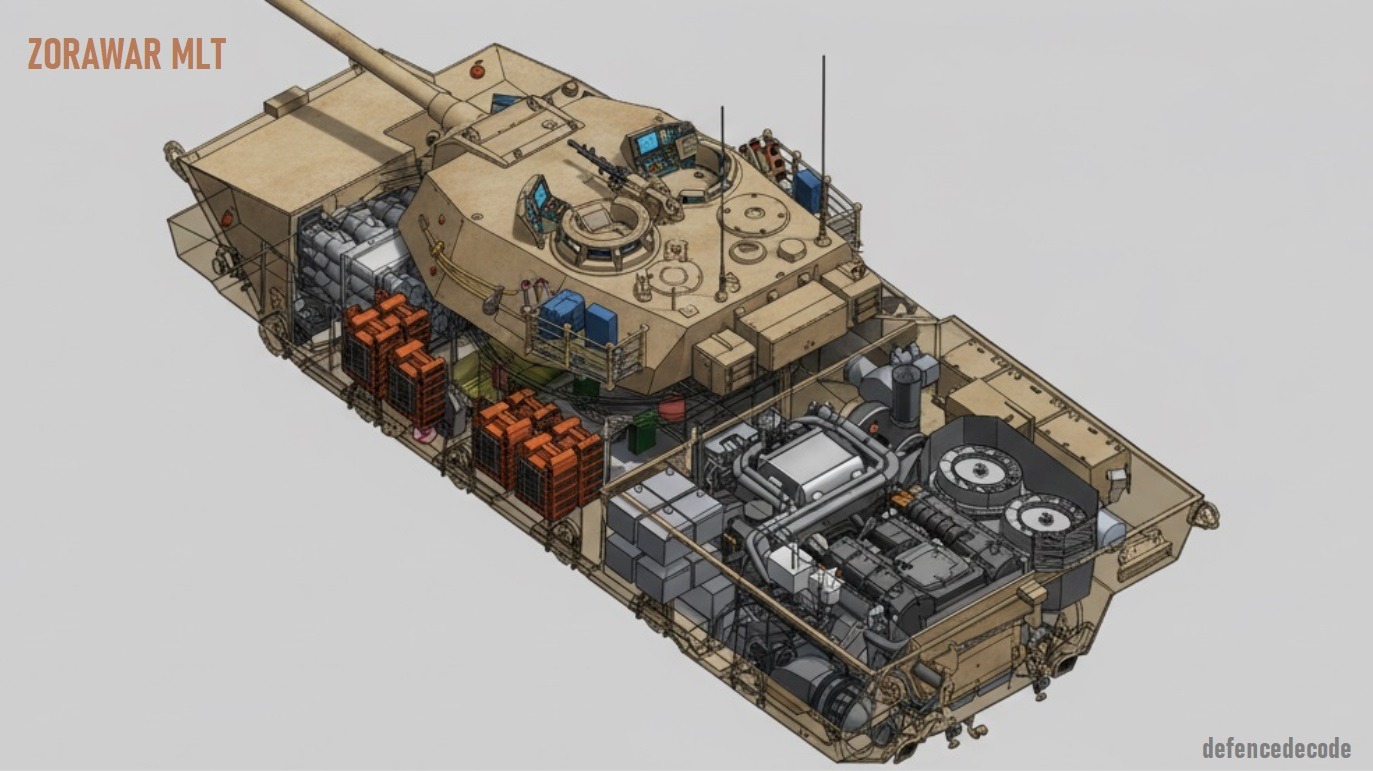
Compounding these survivability concerns is the vehicle’s internal architecture, specifically its ammunition stowage. While the Cockerill 3105 turret utilizes an autoloader for immediate readiness, the Zorawar incorporates additional main gun ammunition storage within the front hull, with the tank designed to carry an internal capacity of approximately 30 rounds for its 105mm gun. Placing reserve ammunition racks in the frontal hull represents a highly bold and risky design choice for a light tank. In the absence of the requested STANAG Level 6 protection upgrade, the tank’s current STANAG Level 4 frontal armor is highly vulnerable to modern 30mm APFSDS rounds and anti-tank guided missiles.11 A direct frontal penetration by an enemy Infantry Fighting Vehicle (IFV) or ATGM could strike this hull ammunition rack, likely resulting in a catastrophic ammunition cook-off that would instantly destroy the vehicle and kill the crew. This critical internal vulnerability underscores the Indian Army’s rigid insistence on upgrading the frontal ballistic envelope to Level 6, even at the cost of severe program delays and weight budget overruns.11
4.2 The Chinese Type 15 (ZTQ-15): The High-Altitude Heavyweight
The Type 15, militarily designated as the ZTQ-15 (and heavily exported under the designation VT-5 to nations like Bangladesh), was developed by the 201st Research Institute to replace the deeply antiquated Type 62 light tank.5 First confirmed in service in 2018, it is optimized to operate in the Tibetan plateau, southern forests, and water-heavy regions where the 55-ton Type 99 MBT is severely constrained.30
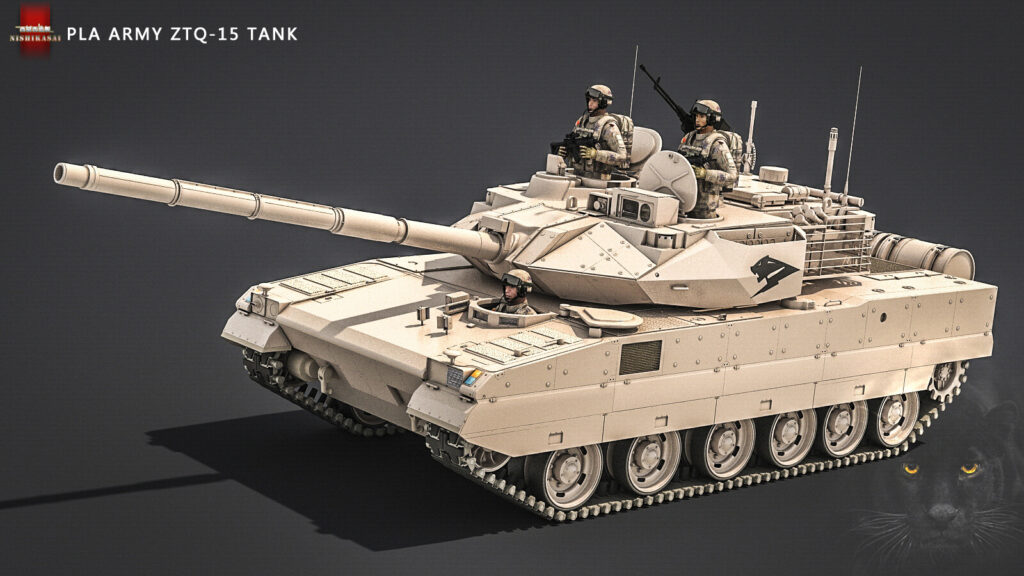
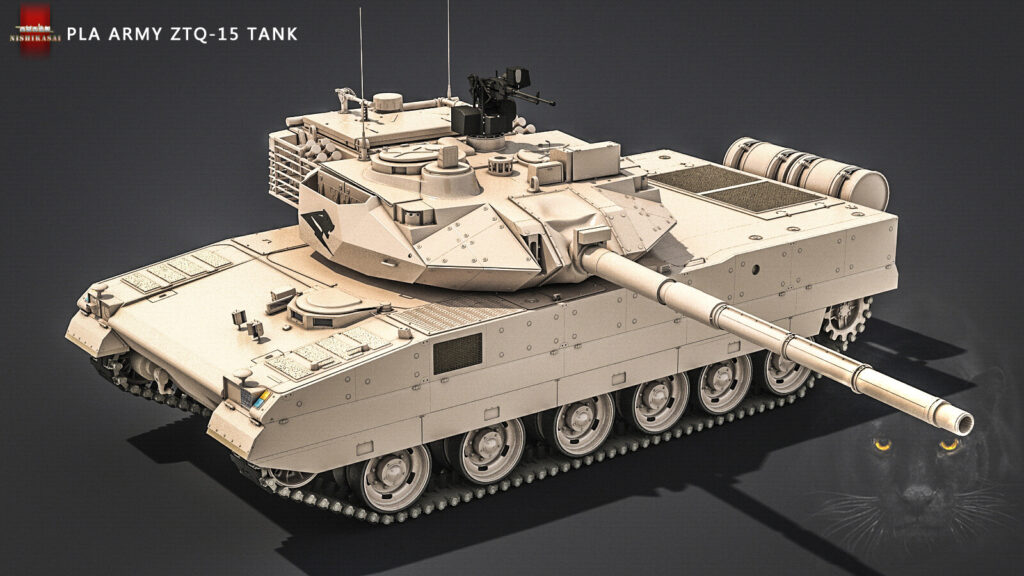
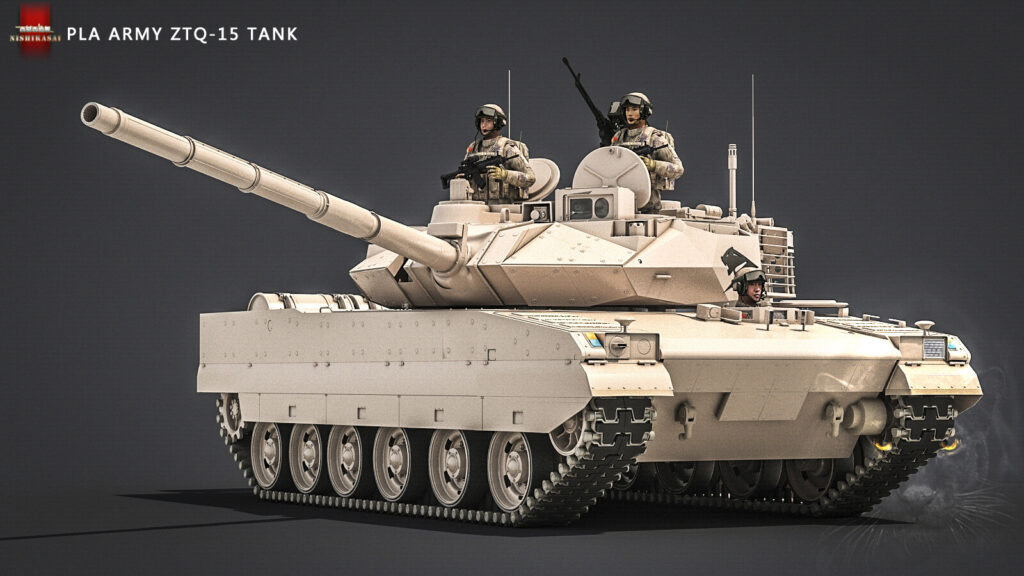
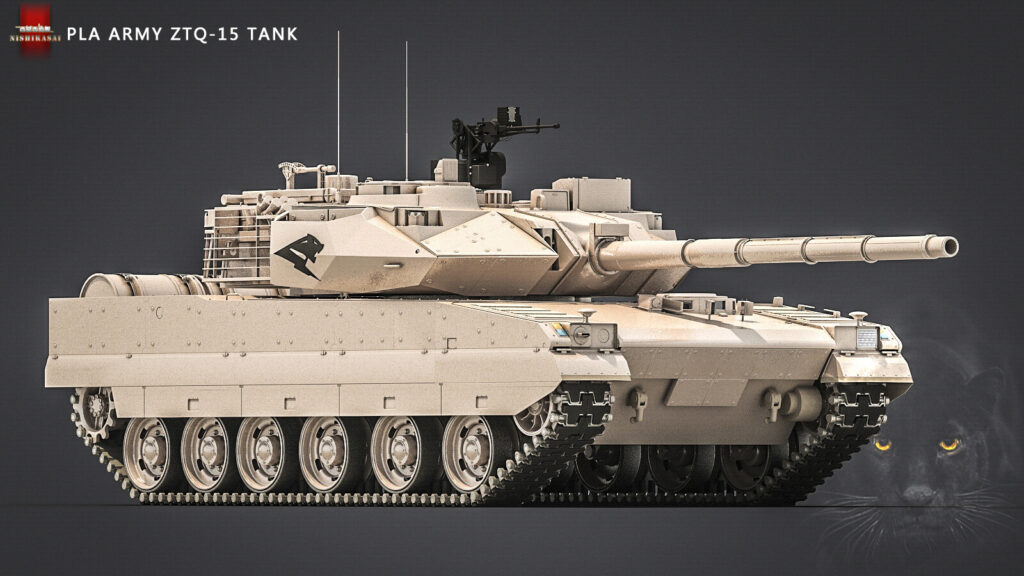
Operational Rationale and Design Architecture: While nominally classified as a light tank, the Chinese military abandoned the strict 25-ton limit during the Type 15’s development. The vehicle arrives at a combat weight of 33 tons in its standard configuration, climbing to 36 tons with its heavy modular armor packages installed.5 This weight gain indicates a strategic, doctrinal choice by the People’s Liberation Army (PLA) to prioritize increased base ballistic survivability and heavy firepower over ultra-lightweight, multi-vehicle air-drop parameters.45
Lethality and Thermodynamic Adaptations: To conquer the hypoxic environment of high altitudes without stalling, the Type 15 utilizes a heavily modified, compact electronically controlled 8V132 diesel engine.5 Featuring twin-stage turbocharging and integrated oxygen generators, this thermodynamic marvel allows the engine to output a sustained 1000 hp (746 kW) even in thin mountain air, maintaining a dominant power-to-weight ratio of roughly 27.8 to 30.3 hp/ton.5 Coupled with a low ground pressure of approximately 0.7 kg/cm2, the Type 15 possesses extreme tactical mobility over soft soil and snow.46
Its firepower relies on an autoloaded 105mm rifled gun (an improvement over the older ZPL94) fed by a bustle magazine.30 The system fires advanced APFSDS rounds capable of penetrating 500mm of RHA, and can barrel-launch ATGMs with tandem HEAT warheads to a range of 5 km.30 Its protection matrix relies on a welded steel hull supplemented by advanced composite armor and explosive reactive armor (ERA).5 While highly capable, it sacrifices the true amphibious nature and strict airlift efficiency of the sub-25-ton class to achieve this level of armored resilience.
4.3 The Turkish-Indonesian Kaplan MT (Harimau): The Archipelagic Skirmisher
Developed collaboratively as a medium-weight tank by Turkey’s FNSS Savunma Sistemleri and Indonesia’s state-owned PT Pindad under the Modern Medium Weight Tank (MMWT) program, the Kaplan MT (known as the Harimau, or “Tiger”, in Indonesian service) bridges the conceptual gap between a light tank and a medium assault vehicle.32
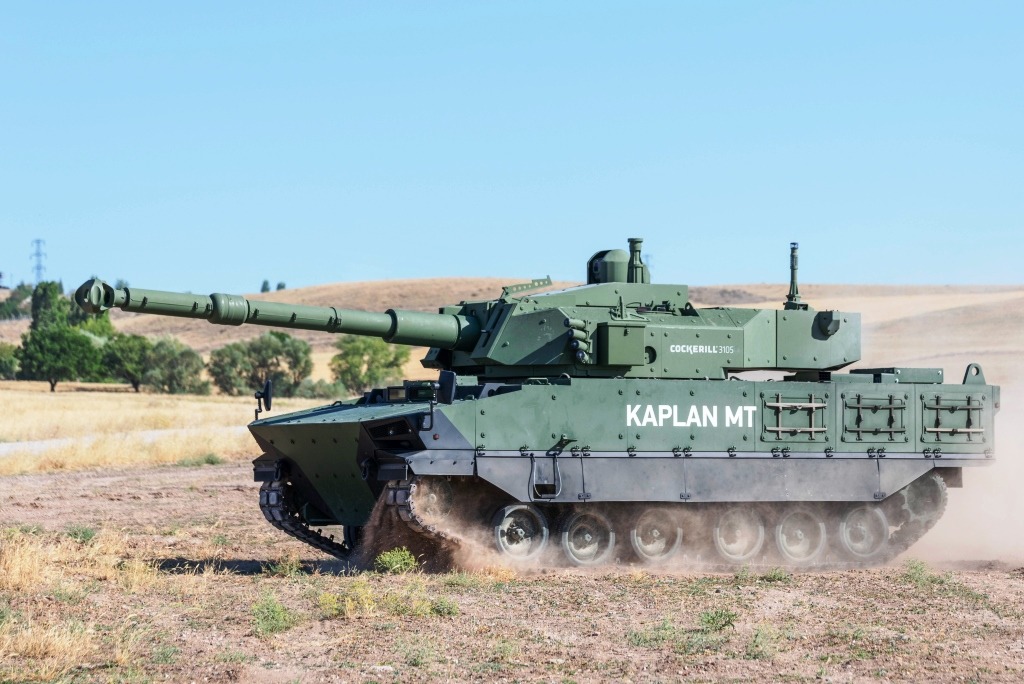
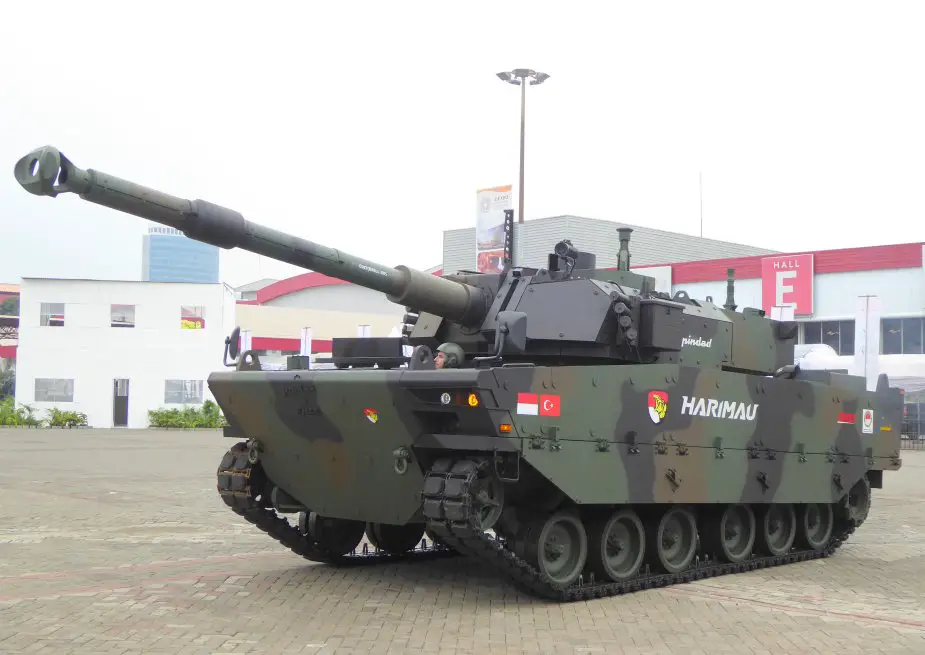
Operational Rationale and Design Architecture: Designed heavily for the tropical, jungle, and island-hopping geography of Indonesia, the Harimau prioritizes tactical road mobility, force multiplication, and asymmetrical threat resistance over high-altitude performance.35 Weighing between 30 and 35 tons, it sits slightly below the fully armored Type 15 but well above the sub-25-ton Zorawar.31 Built on the new generation Kaplan tracked chassis (which also spawned the Kaplan 30 IFV), it represents a modern interpretation of the skirmishing vehicle intended to replace aging fleets of AMX-13-105s.32
Lethality and Survivability: Like the Zorawar, the Harimau leverages the commercial off-the-shelf efficiency and ergonomic excellence of the Cockerill 3105 turret, maintaining a 105mm high-pressure rifled gun and a three-man crew via an autoloader.31 Its propulsion relies on a reliable 711 hp Caterpillar C13 inline-6 diesel engine paired with an Allison/Caterpillar X300 fully automatic transmission, yielding a modest power-to-weight ratio of 22.2 hp/ton and a governed top speed of 70 km/h.31
What truly distinguishes the Harimau is its robust focus on urban and asymmetrical warfare survivability. To protect its crew from the prolific threat of improvised explosive devices (IEDs) and anti-tank mines, it incorporates a specially designed V-hull underbelly.31 Its modular add-on armor pushes its ballistic protection to STANAG 4569 Level 5, allowing it to sustain damage from 25mm APDS-T rounds.31 To further enhance survivability against hostile ATGMs, the tank is equipped with laser warning systems, CBRN protection, and can be integrated with the ASELSAN PULAT active protection system.47 It functions as a highly durable force-multiplier for expeditionary marine and infantry forces operating in confined tropical environments.
4.4 The American M10 Booker: Procurement Drift and the Sunk Cost Fallacy
The American M10 Booker provides a profound, cautionary case study in military procurement drift, shifting doctrinal priorities, and the unforgiving physical realities of combat vehicle design. Originating from the U.S. Army’s Mobile Protected Firepower (MPF) program, the vehicle was initially envisioned as an air-droppable, lightweight asset to provide infantry brigade combat teams (IBCTs) with organic direct-fire support to breach secure defensive zones and destroy bunkers.33
Operational Rationale and Procurement Drift: Early doctrinal analyses spearheaded in 2015 by Lt. Gen. H.R. McMaster indicated a desperate capability gap: Infantry Brigade Combat Teams lacked a highly mobile, C-130 transportable light combat vehicle capable of providing “mobile protected firepower” in restricted, urban, or mountainous terrain.40 The Army launched a rapid prototyping competition, pitting BAE Systems (offering an updated M8 Buford Armored Gun System) against General Dynamics Land Systems (GDLS), who offered a design derived from the Griffin II and British Ajax chassis.33 GDLS eventually won the low-rate initial production (LRIP) contract in June 2022.40
However, as the Army’s requirements evolved during the development phase, the initial vision was severely compromised. Prioritization rapidly shifted away from lightweight mobility toward immense crew survivability, extreme IED resistance, and operational commonality with the heavy M1 Abrams MBT.8
The Frankenstein Vehicle and Eventual Cancellation: To meet these shifting protection and training requirements, the M10 Booker abandoned volumetric efficiency. The Army demanded a 4-man crew (commander, gunner, driver, and a manual human loader), intentionally discarding autoloader technology to ensure training pipelines remained identical to the M1A2 Abrams.8 This necessitated a massive internal turret volume.8 Consequently, passive armor had to be drastically increased to protect this larger volume from heavy machine guns, artillery, and IED blasts. As a direct physical result, the M10 Booker bloated to an operational combat weight of roughly 42 metric tons (46 short tons).33
While armed with the highly capable M35 105mm low-recoil cannon capable of firing advanced M900 APFSDS kinetic rounds 19, the vehicle fundamentally failed its original strategic intent. At 46 short tons, it could not be air-dropped from a C-130 aircraft.40 It required massive logistical support akin to medium armor, suffered from a low power-to-weight ratio (an 800 hp MTU 8V199 TE23 diesel engine moving over 42 tons yields under 19 hp/ton), and faced mechanical issues during testing, including toxic fumes venting into the crew compartment and hydraulic overheating.36 Furthermore, despite its massive weight, the initial LRIP Booker design did not include an integrated Modular Active Protection System (MAPS) like Trophy, leaving it highly vulnerable to modern ATGMs and drones in open terrain like the battlefields of Ukraine.28
Recognizing a severe “sunk cost fallacy,” Army Secretary Daniel Driscoll openly admitted that the Army’s constantly shifting requirements had helped create a “Frankenstein” vehicle that was “intended to be a light tank” but “ended up medium”.33 Citing excessive weight, over $1 billion in sunk costs, and a failure to meet modern rapid deployment needs, the U.S. Army officially canceled the M10 Booker program in June 2025, terminating procurement after taking delivery of roughly 26 initial units.33 The high-profile cancellation underscored a broader U.S. military pivot toward leaner forces, autonomous drone swarms, and a hard recognition that achieving MBT-level survivability on a light infantry support vehicle is a physical contradiction.40
5. Doctrinal and Strategic Implications for Future Armored Warfare
The comparative analysis of these four global platforms yields several critical, far-reaching implications for the future of armored warfare and military procurement doctrine.
First, the 25-ton weight limit represents an unyielding physical boundary governed by the laws of metallurgy and thermodynamics. To successfully stay beneath it, military forces must accept absolute tradeoffs in passive survivability. It is physically impossible to armor a 25-ton vehicle against direct fire from MBTs or heavy IFVs. Therefore, forces must compensate heavily with active defense systems (APS), networked autonomous drones, and exotic, highly expensive metallurgical solutions (like Titanium castings), as evidenced by the rigorous engineering of the Indian Zorawar.4
Second, the failure and subsequent cancellation of the American M10 Booker demonstrates that Western militaries conceptually struggle to accept the inherent vulnerability of light tanks.40 Attempting to up-armor a light tank to withstand linear, high-intensity attrition warfare inherently transforms it into a medium or heavy tank, entirely defeating its core purpose of strategic mobility and air-transportability.34 Light tanks are fundamentally not meant to fight MBTs head-on in open plains. Their survival depends entirely on tactical agility, advanced hunter-killer optics (like the Safran Paseo systems), FOOB soft-recoil guns that allow for rapid shoot-and-scoot tactics, and the deployment of beyond-line-of-sight munitions (ATGMs and kamikaze drones) to strike heavier armor from top-down trajectories where their armor is weakest.4
Finally, the geographical theater of operations heavily dictates the viability of the light tank class. Nations like China and India, facing severe mountainous and high-altitude border disputes, have successfully integrated light tanks (the Type 15 and Zorawar) out of absolute necessity, because heavy MBTs simply cannot physically function in the hypoxic, fragile infrastructure of the Himalayas.4 In these highly restrictive theaters, a 25-ton to 35-ton tank armed with a 105mm gun becomes the apex predator of the battlefield, not merely a support asset. Conversely, in the open plains of Eastern Europe, the desert expanses of the Middle East, or the heavy urban environments anticipated by U.S. and NATO forces, the vulnerability of light tanks to ubiquitous ATGM and drone threats becomes a severe, unacceptable liability.28 In these environments, the future likely points toward fully unmanned ground vehicles (UGVs) equipped with RWS, where the absolute removal of the human crew allows for extreme weight savings without the political and moral costs of crew casualties.21
6. Conclusion
The modern sub-25-ton light tank represents a masterclass in engineering compromise. Bounded strictly by the physics of ballistic volume scaling, the immense kinematic forces of trunnion pull, and the severe limitations of internal combustion in hypoxic, high-altitude environments, defense engineers have historically struggled to balance the Iron Triangle of lethality, protection, and mobility. However, the contemporary integration of soft-recoil Fire-Out-Of-Battery mechanisms, autoloaded unmanned turrets, active protection systems, titanium metallurgical castings, and intrinsically embedded UAS drone capabilities have revolutionized the platform’s viability on the 21st-century battlefield.
As demonstrated by the global comparative analysis, nations that adhered strictly to the core requirements of expeditionary and high-altitude mobility, such as India with the meticulously engineered, titanium-hulled Zorawar, have successfully created highly lethal, strategically agile platforms capable of multi-domain operations. Those that compromised on weight to chase the illusion of heavy passive survivability, most notably the bloated and subsequently canceled American M10 Booker, found themselves burdened with Frankenstein vehicles too heavy for rapid strategic deployment and too lightly armored for heavy mechanized combat. Ultimately, the modern light tank must be recognized not as a miniature Main Battle Tank, but as a highly specialized, sensor-rich, shoot-and-scoot network node designed explicitly to exploit terrain where heavy armor cannot follow, ensuring its enduring, critical relevance in the future of multi-domain operational doctrine.
Works cited
- Light tank – Wikipedia, accessed June 11, 2026, https://en.wikipedia.org/wiki/Light_tank
- Evolution Of Light Battle Tanks: A Swift Force On The Modern Battlefield, accessed June 11, 2026, https://aviationanddefensemarketreports.com/evolution-of-light-battle-tanks-a-swift-force-on-the-modern-battlefield/
- Just wondering if someone could explain to me what the combat purpose of a light tank is in modern day, focusing on the new American design? : r/TankPorn – Reddit, accessed June 11, 2026, https://www.reddit.com/r/TankPorn/comments/ygarlv/just_wondering_if_someone_could_explain_to_me/
- DRDO light tank — Grokipedia, accessed June 11, 2026, https://grokipedia.com/page/DRDO_light_tank
- Type 15 tank – Wikipedia, accessed June 11, 2026, https://en.wikipedia.org/wiki/Type_15_tank
- Zorawar tank: The made-in-India war machine built to dominate China on the LAC, accessed June 11, 2026, https://timesofindia.indiatimes.com/defence/news/zorawar-tank-the-made-in-india-war-machine-built-to-dominate-china-on-the-lac/articleshow/131521580.cms
- M551 Sheridan – Wikipedia, accessed June 11, 2026, https://en.wikipedia.org/wiki/M551_Sheridan
- M10 booker vs type 15 : r/TankPorn – Reddit, accessed June 11, 2026, https://www.reddit.com/r/TankPorn/comments/1cp873t/m10_booker_vs_type_15/
- STANAG 4569 – Wikipedia, accessed June 11, 2026, https://en.wikipedia.org/wiki/STANAG_4569
- STANAG 4569: Protection requirements for armoured military vehicles, accessed June 11, 2026, https://mehler-protection.com/blog/stanag-4569-protection-levels-for-light-armoured-vehicles-explained/
- Indigenous Zorawar Light Tank to Gain NATO-Level Armour Standards – Raksha Anirveda, accessed June 11, 2026, https://raksha-anirveda.com/indigenous-zorawar-light-tank-to-gain-nato-level-armour-standards/
- How much protected are modern tanks ? : r/WarCollege – Reddit, accessed June 11, 2026, https://www.reddit.com/r/WarCollege/comments/134phe8/how_much_protected_are_modern_tanks/
- Fitting a High-performance Gun on a Lighter Platform – Informit, accessed June 11, 2026, https://search.informit.org/doi/pdf/10.3316/informit.111165288140442?download=true
- A Fire Out of Battery Tank Gun: Theory and Simulation – DTIC, accessed June 11, 2026, https://apps.dtic.mil/sti/tr/pdf/ADP012454.pdf
- Zorawar (tank) – Wikipedia, accessed June 11, 2026, https://en.wikipedia.org/wiki/Zorawar_(tank)
- M35 tank gun – Grokipedia, accessed June 11, 2026, https://grokipedia.com/page/m35_tank_gun
- SOFT RECOIL – AM General, accessed June 11, 2026, https://www.amgeneral.com/wp-content/uploads/2024/10/Soft-Recoil-Technology.pdf
- M35 tank gun – Wikipedia, accessed June 11, 2026, https://en.wikipedia.org/wiki/M35_tank_gun
- M10 Booker: Sniper on Treads | ARTSTORM, accessed June 11, 2026, https://artstorm.com/en-US/news/m10-booker-sniper-on-treads
- Is having a smaller, lighter tank with an autoloader really worth the trade-offs in maintenance and logistics compared to having a fourth crew member? – Quora, accessed June 11, 2026, https://www.quora.com/Is-having-a-smaller-lighter-tank-with-an-autoloader-really-worth-the-trade-offs-in-maintenance-and-logistics-compared-to-having-a-fourth-crew-member
- Running Light – Escaping the Vehicle Growth and Weight Spiral, accessed June 11, 2026, https://euro-sd.com/2023/04/articles/31247/running-light-escaping-the-vehicle-growth-and-weight-spiral/
- Unmanned Turret Main Battle Tanks with Autoloaders and the Crew Sandwiched Together in the Front : r/TankPorn – Reddit, accessed June 11, 2026, https://www.reddit.com/r/TankPorn/comments/1dk76wk/unmanned_turret_main_battle_tanks_with/
- Cockerill® modular turret 3105 : Defense, accessed June 11, 2026, https://johncockerill.com/en/cockerill-3000-series/cockerill-3105/
- Cockerill 3105 Turret Capabilities – Zorawar Light Tank – YouTube, accessed June 11, 2026, https://www.youtube.com/watch?v=9U0QiliuXjI
- COCKERILL® 3105, accessed June 11, 2026, https://johncockerill.com/wp-content/uploads/2022/06/23606.jc-defense-3105-specsheet-a4h-en-hd.pdf
- Battle of Tanks India Zorawar v/s China Type 15, accessed June 11, 2026, https://dsalert.org/battle-of-tanks-india-zorawar-v-s-china-type-15/
- Zorawar: Light tank for Indian army | Page 14 | Strategic Front Forum, accessed June 11, 2026, https://www.strategicfront.org/forums/threads/zorawar-light-tank-for-indian-army.4292/page-14
- How The Army’s New M10 Booker Light Tank Will Actually Be Used – The War Zone, accessed June 11, 2026, https://www.twz.com/land/how-the-armys-new-m10-booker-light-tank-will-actually-be-used
- M10 Booker Armored Combat Vehicle. : r/TankPorn – Reddit, accessed June 11, 2026, https://www.reddit.com/r/TankPorn/comments/146f9fq/m10_booker_armored_combat_vehicle/
- ZTQ15 | Weaponsystems.net, accessed June 11, 2026, https://weaponsystems.net/system/1631-ZTQ15
- Kaplan MT / Harimau – Wikipedia, accessed June 11, 2026, https://en.wikipedia.org/wiki/Kaplan_MT_/_Harimau
- Harimau (Light tank) – Army Guide, accessed June 11, 2026, http://www.army-guide.com/eng/product6044.html
- M10 Booker – Wikipedia, accessed June 11, 2026, https://en.wikipedia.org/wiki/M10_Booker
- What is M10 Booker? : r/tanks – Reddit, accessed June 11, 2026, https://www.reddit.com/r/tanks/comments/1blvs94/what_is_m10_booker/
- Pindad Harimau: Turkish-Indonesian Skirmisher – Ground – War Thunder — official forum, accessed June 11, 2026, https://forum.warthunder.com/t/pindad-harimau-turkish-indonesian-skirmisher/89672
- The U.S. Army’s M10 Booker Summed Up in 4 Simple Words – 19FortyFive, accessed June 11, 2026, https://www.19fortyfive.com/2024/12/the-armys-m10-booker-can-be-summed-up-in-4-simple-words/
- M10 Booker tested at US Army Yuma Proving Ground | Article, accessed June 11, 2026, https://www.army.mil/article/283010/m10_booker_tested_at_us_army_yuma_proving_ground
- How do you think Type 15 compares to M10 Booker? : r/TankPorn – Reddit, accessed June 11, 2026, https://www.reddit.com/r/TankPorn/comments/1k42vgv/how_do_you_think_type_15_compares_to_m10_booker/
- John Cockerill Defense & FNSS to showcase cutting-edge armored vehicles at LAAD International Defense and Security Fair 2025, accessed June 11, 2026, https://johncockerill.com/en/press-and-news/news/fnss-john-cockerill-defense-laad-2025/
- Dead on arrival: Army pulls plug on M10 Booker light tank, accessed June 11, 2026, https://www.defensenews.com/land/2025/06/12/dead-on-arrival-army-pulls-plug-on-m10-booker-light-tank/
- KAPLAN-MT – FNSS, accessed June 11, 2026, https://www.fnss.com.tr/en/products/kaplan-mt
- ZTQ-15 (Type 15) Chinese Light Main Battle Tank (MBT) – ODIN, accessed June 11, 2026, https://odin.t2com.army.mil/WEG/Asset/Type_15_(ZTQ-15)_Chinese_Light_Main_Battle_Tank_(MBT)
- How the Zorawar Light Tank is Built to Dominate the Himalayas | Vantage on Firstpost | 4K, accessed June 11, 2026, https://www.youtube.com/watch?v=2z4oPxYjONc
- accessed December 31, 1969, https://economictimes.indiatimes.com/news/defence/indias-light-tank-zorawar-may-face-delays-of-up-to-2-years-as-army-demands-enhanced-protection/articleshow/131642804.cms
- Soo… china’s new light tank type 15 what are your guys thoughts on it? : r/TankPorn, accessed June 11, 2026, https://www.reddit.com/r/TankPorn/comments/11u1i85/soo_chinas_new_light_tank_type_15_what_are_your/
- ZTQ-15 light tank from China (info in description) : r/Warthunder – Reddit, accessed June 11, 2026, https://www.reddit.com/r/Warthunder/comments/hmtnl8/ztq15_light_tank_from_china_info_in_description/
- KAPLAN MT Modern Medium-Weight Tank – Army Technology, accessed June 11, 2026, https://www.army-technology.com/projects/kaplan-mt-modern-medium-weight-tank/
- Army to cease procurement of M10 Booker Combat Vehicles | Article …, accessed June 11, 2026, https://www.army.mil/article/286271/army_to_cease_procurement_of_m10_booker_combat_vehicles
- If the M10 Booker is added to the game, can it equip a Trophy like Armored warfare?, accessed June 11, 2026, https://forum.warthunder.com/t/if-the-m10-booker-is-added-to-the-game-can-it-equip-a-trophy-like-armored-warfare/209265
The U.S. Army Can’t Build an Army Any More – 19FortyFive, accessed June 11, 2026, https://www.19fortyfive.com/2026/03/the-u-s-army-cant-build-an-army-any-more/