


Introduction: The Digitization of the Modern Battlespace
The contemporary theater of conflict has undergone a foundational, irreversible shift from industrial-age, attrition-based warfare to decision-centric and network-centric warfare (NCW). In a multi-domain operational environment, where land, air, sea, cyber, and the electromagnetic spectrum converge, victory is increasingly dictated by the speed, security, and fidelity of information processing.1 The ability to seamlessly integrate scattered sensors, decentralized command centers, and diverse fire delivery platforms into a cohesive, synchronized, and resilient digital architecture defines the modern military’s lethality. This operational paradigm is entirely dependent on Command, Control, Communications, Computers, Intelligence, Surveillance, and Reconnaissance (C4ISR) systems. These networks reduce the “fog of war,” prevent fratricide (“blue-on-blue” incidents), and exponentially accelerate the sensor-to-shooter loop, thereby allowing a numerically inferior force to outmaneuver and out-decide a larger adversary.3
Within the geopolitically volatile landscape of South Asia, the conventional force asymmetry between India and Pakistan has necessitated a strategic reliance on technological force multipliers.4 As the Indian Army aggressively modernizes its conventional capabilities through sweeping digitization initiatives like Project Sanjay and the Artillery Combat Command and Control System (ACCCS-Shakti) 6, the Pakistan Army has responded by fielding an increasingly sophisticated, overlapping digital architecture. Central to Pakistan’s indigenous digitization efforts are two heavily integrated platforms: the Pak-IBMS “Rehbar” (Integrated Battlefield Management System) and the PAKFIRE Artillery Fire Control System.3
This comprehensive research report provides an exhaustive, expert-level analysis of the PAKFIRE and Rehbar systems. It dissects their underlying system architectures, core operational modules, hardware integrations, and the broader communications and space-based infrastructure that enables them. Furthermore, it explores the strategic implications of these systems within the context of Pakistan’s evolving “Full Spectrum Deterrence Plus” (FSD+) doctrine, offering second and third-order insights into how these digital battle networks are fundamentally altering the balance of power along the Line of Control (LoC) and shaping the future character of armored and artillery warfare in the region.4
Contextualizing the Threat Environment: From FSD to FSD+
To thoroughly understand the development, acquisition, and deployment of PAKFIRE and Rehbar, one must first analyze the strategic, operational, and doctrinal pressures faced by the Pakistan Armed Forces. For decades, Pakistan’s defense posture has been anchored in the concept of Full Spectrum Deterrence (FSD), a strategy designed to counter threats across all tiers of conflict, ranging from sub-conventional border skirmishes and proxy engagements to massive armored thrusts and strategic nuclear exchanges.4 Since the early 2010s, this posture served as a robust, albeit static, barrier against Indian military pressure, particularly India’s “Cold Start” doctrine, which envisioned rapid, shallow armored penetrations into Pakistani territory to deliver punitive strikes without crossing the nuclear threshold.4
However, the changing geopolitical landscape, coupled with the rapid induction of advanced military technologies by the Indian Armed Forces, has exposed critical vulnerabilities in legacy analog systems. The turning point occurred during a highly publicized incident in May 2025, when a conflict scenario demonstrated that advanced, highly maneuvering weapons, specifically enhanced models of the Indian BrahMos supersonic cruise missile, could successfully penetrate Pakistani airspace defenses and strike vital targets in proximity to the capital, Islamabad.4 This event was alarming both symbolically and strategically, as it unequivocally demonstrated that traditional, isolated air defense and artillery networks were insufficient against multi-domain, high-speed threats.4
The institutional response to this evolving threat matrix is the transition toward Full Spectrum Deterrence Plus (FSD+), a doctrinal evolution that heavily emphasizes conventional precision strike, cognitive warfare, and rapid, frictionless battlefield integration.1 In August 2025, signaling this shift, the Prime Minister of Pakistan announced the establishment of a new Army Rocket Force Command (ARFC), explicitly focused on managing conventional missile systems and advanced strike capabilities independently from the nuclear-focused Strategic Plans Division (SPD).4
The Pakistan Army recognized that while its procurement of modern kinetic platforms, such as the VT-4 main battle tanks from China and the SH-15 self-propelled howitzers, provided mechanical advantages, the true strategic potential of these weapons could only be unlocked through a unified digital nervous system.5 Without an overarching Battlefield Management System (BMS), localized commanders suffer from degraded situational awareness, delayed decision-making cycles, and disjointed maneuverability, rendering modern hardware highly vulnerable to coordinated multi-domain attacks.13 Thus, the accelerated development and deployment of Rehbar for armored maneuverability and PAKFIRE for artillery coordination became not just an iterative upgrade, but a vital survival imperative for the Pakistani military establishment.14
The Defense Industrial Ecosystem: Indigenous Production and Strategic Partnerships
Pakistan’s digital modernization is not the product of a single corporate entity or state bureau, but rather the synergistic output of a complex defense industrial base that increasingly relies on localized research and development, supplemented by deep, strategic technology transfers from the People’s Republic of China.16 Unlike purely indigenous defense ecosystems or those entirely reliant on foreign imports, Pakistan utilizes a hybrid model designed to maximize self-reliance in critical software architecture while leveraging foreign economies of scale for heavy hardware platforms.
Global Industrial & Defence Solutions (GIDS)
At the forefront of Pakistan’s military-technological complex is Global Industrial & Defence Solutions (GIDS). As a premier, state-owned defense conglomerate, GIDS is the primary developer of the PAKFIRE Artillery Fire Control System.18 However, GIDS’s portfolio extends far beyond artillery software. It represents a vast array of associated technologies, making it the central pillar of Pakistan’s sensor-to-shooter ecosystem.19 GIDS manufactures critical unmanned aerial vehicles (UAVs) such as the Shahpar, Uqab, Huma Tactical, and Scout Mini.16 It also produces the Nishana Precision Guidance Kit (PGK), the Baktar Shikan anti-tank guided missile weapon system, and advanced electronic warfare (EW) and countermeasure solutions like the MOHAFIZ chaff and flare dispenser system and the Spider anti-drone electronic warfare system.10
Heavy Industries Taxila (HIT) and CARE
The mechanization and armor component of the digitization effort is spearheaded by Heavy Industries Taxila (HIT). Founded in September 1971, with a major expansion into the Heavy Rebuild Factory in the 1980s and 1990s, HIT has grown into a massive military-industrial complex encompassing six major production units.11 HIT, in a critical partnership with the Centre for Advanced Research in Engineering (CARE), developed the Rehbar Pak-IBMS software and hardware suite.12 By combining HIT’s mechanical expertise with CARE’s software engineering, the military achieved a natively integrated digital suite tailored specifically for its armored fleets.
National Radio Telecommunication Corporation (NRTC)
Based in Haripur, the National Radio Telecommunication Corporation (NRTC) provides the foundational, secure communications infrastructure required by both PAKFIRE and Rehbar.20 A digital battlefield is useless without secure transmission mediums. NRTC designs and manufactures advanced Software Defined Radios (SDR), Land Mobile Radio Systems (LMR), and Smart Radio Gateways (SRG) that allow NCW systems to securely transmit data across the battlefield without succumbing to enemy electronic warfare (EW) jamming.26 Furthermore, NRTC’s portfolio includes digital forensics, EOD robots (Hadaf), AI, and cybersecurity systems, illustrating a broad mandate to secure Pakistan’s digital frontiers.27
SUPARCO and the Orbital Intelligence Network
The ultimate high ground in NCW is space. The Space and Upper Atmosphere Research Commission (SUPARCO), the national space agency, provides critical overhead orbital intelligence and communication relays.10 SUPARCO’s history dates back to 1962 with the successful launch of the Rehbar-I sounding rocket, making Pakistan the third country in Asia to conduct a successful spaceflight.24 Today, SUPARCO oversees advanced projects like the PRSC-EO satellite constellation and the PIESAT network, which feed strategic data directly into the tactical decision-making systems on the ground.10
Pak-IBMS “Rehbar”: Tactical Armor and Battlefield Awareness
The Rehbar system, officially designated as the Pak-IBMS (Integrated Battlefield Management System), represents the cognitive and digital leap of the Pakistan Army’s armored corps. A Battlefield Management System is fundamentally designed to integrate information acquisition and processing, providing commanding officers, Non-Commissioned Officers (NCOs), and individual vehicle crews with a real-time, comprehensive tactical picture of the battlespace.3
Prior to the induction of Rehbar, Pakistani tank crews, like many militaries operating older Soviet or Chinese-derived armor, relied heavily on analog methodologies. Navigation was dependent on paper maps and compasses. Target spotting required manual optical scanning, and intra-unit coordination relied on voice communications over vulnerable VHF radios. This analog framework resulted in a slow Observation, Orientation, Decision, and Action (OODA) loop, making armored thrusts highly susceptible to miscoordination, ambush, and fratricide.3 Rehbar, natively integrated into Pakistan’s premier armor, such as the Al-Khalid series and the newly procured VT-4 Main Battle Tanks, digitizes and automates this entire operational flow.12
System Architecture and Hardware Integration
The physical hardware of the Rehbar system consists of ruggedized, flat-screen digital displays mounted inside the tank crew compartments at the commander, gunner, and driver stations. These interfaces are built to stringent military specifications to withstand the extreme environmental conditions characteristic of South Asian combat zones, ranging from the extreme heat and abrasive dust of the Thar Desert to the freezing temperatures and kinetic shock inherent to the high-altitude mountainous borders of Kashmir.12
The system relies on a secure, encrypted data-link to facilitate the rapid communication of battlefield information between units.12 This is achieved through the ad-hoc networking of tactical radios, allowing tanks, infantry fighting vehicles, mechanized infantry, and specialized command posts (such as the HIT Sakb command vehicle) to form a self-healing digital mesh network.12 If one node, such as a frontline tank, is destroyed, disabled, or loses line-of-sight due to terrain masking, the Rehbar network automatically reroutes the data through other available nodes, ensuring continuous, unbroken situational awareness for the broader formation.
Core Modules of Rehbar
The software architecture of Rehbar is highly modular, allowing for continuous software upgrades and scalable deployment depending on the specific echelon of operations, from an individual tank crew to a battalion or brigade command center.
| Rehbar Module | Technical Functionality | Operational and Tactical Implication |
| Situational Awareness Module | Displays an integrated battlefield picture using GPS-based land navigation, scanned 3D terrain maps, and digitized vector overlays.14 | Prevents “blue-on-blue” fratricide by displaying real-time locations of friendly units; allows crews to navigate terrain effectively and anticipate enemy movements.3 |
| Tactical Mission Planning Module | Enables commanders to prepare complex tactical plans, draw military symbols, and mark specific “no-go” areas on digital maps.14 | Peacetime plans can be pre-loaded into the system and dynamically modified during active combat based on new intelligence, allowing for rapid tactical adaptation without halting momentum.14 |
| Combat Messaging System Module | Facilitates the exchange of critical operational information, target coordinates, and tactical orders in near real-time.14 | Drastically reduces reliance on easily jammed, intercepted, or misunderstood voice communications; creates a permanent, auditable history of battlefield orders for post-action review.14 |
Advanced Operational Features and Vehicle Synergy
Beyond basic digital mapping and text-based messaging, Rehbar interfaces deeply with the tank’s internal mechanical components and fire control systems (FCS).
- Remote Weapon Station Integration: A critical and highly advanced feature of the Pak-IBMS is its ability to facilitate the remote operation of the tank’s 12.7mm Anti-Aircraft Machine Gun (AAMG).14 Historically, the tank commander had to physically open the turret hatch and expose themselves to enemy sniper fire, artillery shrapnel, and small arms to operate the heavy machine gun. Rehbar allows the commander to operate the AAMG from safely inside the armored hull. Furthermore, the system utilizes auto-target tracking algorithms for both aerial threats (UAVs, loitering munitions, helicopters) and ground targets, massively increasing the commander’s survivability and lethality.14
- Laser Target Indication: The system integrates seamlessly with the tank’s laser warning receivers and laser designators. When a tank is “painted” by an enemy targeting laser, Rehbar instantly indicates the location of the hostile element on the digital map. This facilitates rapid, automated engagement by the main 125mm smoothbore gun, or allows the commander to seamlessly pass the hostile coordinates via the data-link to friendly artillery units for counter-bombardment.14
- Driver Navigation Panel: Driving a main battle tank is a complex task with severe visibility restrictions. The driver is provided with a specialized Rehbar panel featuring directional bars, guiding the heavy vehicle through pre-planned, digitally verified safe routes. This significantly minimizes the risk of driving into anti-tank minefields, natural terrain obstacles, or pre-registered enemy kill zones.14
The Platforms of Rehbar: Al-Khalid and VT-4
To appreciate the lethality of the Rehbar system, one must examine the kinetic platforms it is designed to command. The system is most prominently featured in the Al-Khalid series and the VT-4 main battle tanks.
The Al-Khalid Series (MBT-2000)
The Al-Khalid, jointly developed by Norinco and Heavy Industries Taxila, is the mainstay of the Pakistan Army’s armored corps, with over 600 units in service.33 Originally revealed in 1991, the tank represents a synthesis of Chinese, Soviet, and Western technologies.25
| Al-Khalid (MBT-2000) Specifications | Technical Details |
| Mass & Dimensions | 46 tonnes; Length 10.07m; Width 3.50m; Height 2.40m.25 |
| Armament | 125mm smoothbore gun (39 rounds); 7.62mm coaxial MG; 12.7mm external AA MG.25 |
| Engine & Mobility | KMDB 6TD-2 6-cylinder diesel (1,200 hp); Top speed 72 km/h; Combat range 500 km.25 |
| Armor | Composite armor, Rolled Homogeneous Armor (RHA), Explosive Reactive Armor (ERA).25 |
The subsequent upgrade, the Al-Khalid I, introduced critical enhancements ideally suited for Rehbar’s capabilities, including a Solid State Auto Loader (SSAL), an improved Muzzle Reference System, and higher strategic mobility capable of withstanding the rigors of urban warfare.33 The most advanced iteration, the Al-Khalid II, increases the weight to 47 tonnes, introduces a more powerful 1,500 hp Ukrainian engine, and heavily incorporates the Rehbar IBMS alongside an active threat-protection system, making it one of the most heavily weaponized tanks by tonnage.25
The VT-4 Main Battle Tank
To augment the indigenous Al-Khalid fleet, Pakistan procured a large fleet of Chinese VT-4 tanks. Pakistan is expected to manufacture or assemble around 679 VT-4s locally.35 The VT-4 is a modern, high-mobility tank chosen to offset the Indian Army’s induction of advanced Russian armor (T-90S/M) and the indigenous Arjun platform.35 The integration of the Rehbar IBMS into the VT-4 ensures that the foreign hardware operates seamlessly within Pakistan’s sovereign digital network. However, the reliance on the VT-4 has not been without operational friction. Export customers of the VT-4, such as the Royal Thai Army, have reported significant structural and reliability defects, including catastrophic barrel explosions while firing standard high explosive (HE) ammunition.17 While Pakistan has localized elements like the smoothbore gun to mitigate these risks 35, the integration of an advanced digital system like Rehbar into a potentially mechanically flawed foreign chassis highlights the third-order risks inherent in joint military ventures.
PAKFIRE: Revolutionizing Artillery Fire Control
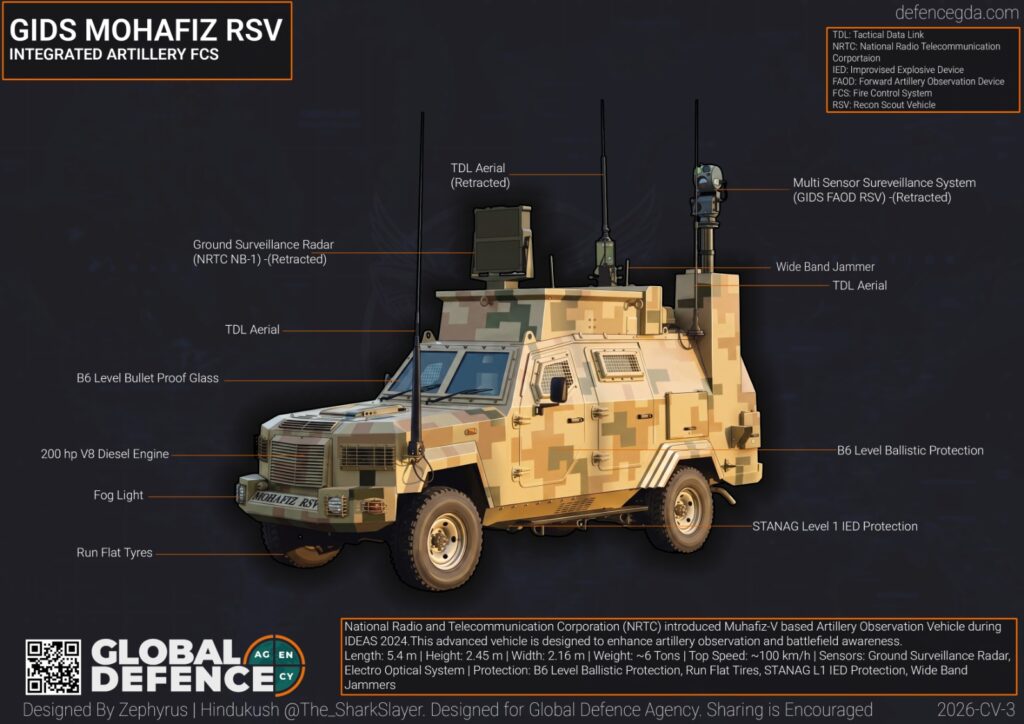
While Rehbar acts as the cognitive brain of the armored and mechanized maneuver units, the PAKFIRE system serves as the central nervous system of the Pakistan Army’s Artillery Corps. Developed by GIDS, the PAKFIRE Integrated Artillery Fire Control System automates the notoriously complex and mathematically demanding operational functions of artillery to ensure fast, highly accurate, and lethal fire on targets.8
In legacy artillery operations, the process of executing a fire mission is a labor-intensive, multi-step undertaking. Forward observers must manually calculate target coordinates, encode them, and transmit them via radio to a Fire Direction Center (FDC). At the FDC, artillery officers utilize manual charts, firing tables, and basic computation tools to determine the ballistic trajectory. This calculation must account for an immense array of variables: propellant temperature, barrel wear, projectile weight, crosswind speed, air density, and even the earth’s rotation (the Coriolis effect). This manual process consumes valuable minutes, time during which mobile targets can relocate, or enemy counter-battery fire (detected by Weapon Locating Radars) can strike the friendly artillery positions.5
PAKFIRE entirely automates this archaic process. It is a highly scalable, modular, reliable, secure, and user-friendly architecture that can be deployed at all combat echelons, from individual batteries up to regimental, divisional, and operational theater levels.15
PAKFIRE Modular Architecture
The true strategic strength of PAKFIRE lies in its discrete but deeply interconnected software modules, which digitally manage every aspect of the artillery kill chain from initial preparation and coordination to dissemination, execution, and post-strike modification of fire plans.18
| PAKFIRE Software Module | Technical Description | Tactical Output |
| Artillery Fire Direction Module | Receives target information directly from Forward Observers, UAVs, and Fire Support Organizations. Computes accurate ballistic data for all ammunition types.15 | Instantly calculates exact firing solutions taking into account all meteorological and ballistic variables, passing digital fire orders directly to the gun crews via wired/wireless media.18 |
| Fire Support Planning (FSP) Module | Designed to accurately integrate fire support with the maneuver plan. Embeds full Geographical Information System (GIS) capabilities, 3D terrain maps, and vector imagery.18 | Assists commanders in drawing military symbols, operational overlays, map navigation, and coordinating rolling barrages to support advancing armor units.18 |
| Counter Bombardment Module | Integrates directly with external sensors like Weapon Locating Radars (WLR) and UAVs for rapid data transfer.15 | Facilitates immediate, automated counter-battery fire missions to neutralize enemy artillery assets within seconds of their first fired shot.18 |
| Supporting Functions / Info Battle Management | Enables commanders to manage logistical resources, including ammunition stockpiles, weapon status, vehicles, and manpower.15 | Prevents frontline units from running out of specific shell types (e.g., High Explosive vs. Smoke) during critical phases of a sustained engagement.37 |
Hardware Integration and “Shoot-and-Scoot” Synergy
PAKFIRE’s utility is vastly amplified by its open-architecture ability to interface with virtually all external systems and existing combat apparatus with little to no modification.18 The system is built with ruggedized hardware to military standards, ensuring it functions in harsh environmental terrains.18
However, PAKFIRE’s most potent application is realized when paired with modern, automated kinetic platforms.
The Yarmuk 122mm MBRL: PAKFIRE integrates seamlessly with the indigenous 122mm Multi-Barrel Rocket Launcher (MBRL) Yarmuk. The Yarmuk fires highly efficient rockets equipped with Point Detonating/Air Burst fuzes, carrying an 18kg High Explosive warhead capable of generating a 50  lethal area.15 By feeding rapid targeting data to the Yarmuk, a battery can saturate area targets at ranges exceeding 35 km before quickly displacing.15
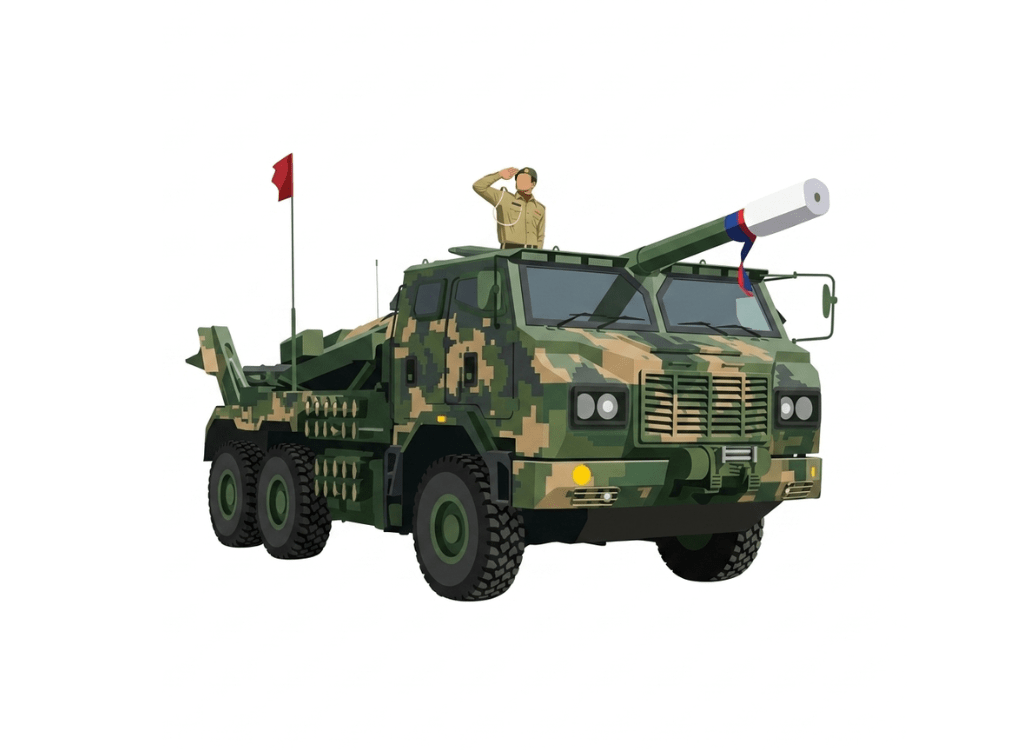
The SH-15 (PCL-181) 155mm Howitzer: The strategic value of PAKFIRE has been exponentially increased by the Pakistan Army’s recent massive procurement of 236 Chinese-made SH-15 (PCL-181) 155mm/52-caliber truck-mounted howitzers.9 Based on a Taian GM 6×6 truck chassis, the SH-15 is a highly mobile “shoot-and-scoot” platform.38 Spotted recently deployed just 80 kilometers from the Indian border near the contested Line of Control, the presence of these systems marks a severe escalation in artillery capabilities in the region.9

The SH-15 features its own computerized automatic fire control system, sophisticated navigation, positioning, and semi-automatic loading mechanisms.9 When the PAKFIRE network transmits a calculated firing solution to the SH-15’s onboard computer, the vehicle’s hydraulic system automatically lays the gun to the correct azimuth and elevation without human manual cranking.38 Coupled with Rocket-Assisted V-LAP projectiles capable of achieving maximum ranges of up to 53 km, and a sustained firing rate of 4 to 6 rounds per minute, the PAKFIRE/SH-15 combination represents a profound leap in precision, sustained firepower, and survivability.9 The 25-ton combat weight of the SH-15 also allows for rapid strategic airlift via PAF Il-78 transports, ensuring these integrated artillery units can be deployed rapidly to any theater.41
Closing the Sensor-to-Shooter Loop: Space, Drones, and Precision Munitions
A digital battlefield management system is only as effective as the sensors that feed it raw data, the munitions that execute its kinetic commands, and the communication networks that securely link them together. Pakistan has systematically built an ecosystem around Rehbar and PAKFIRE to close the “sensor-to-shooter” loop.10
The Airborne and Space-Based ISR Matrix
To detect targets deep within enemy territory and provide actionable intelligence to the PAKFIRE and Rehbar networks, Pakistan relies on a multi-layered Intelligence, Surveillance, and Reconnaissance (ISR) network.
- Unmanned Aerial Vehicles (UAVs): GIDS has heavily localized the production of UAVs, providing the Pakistan Army with platforms designed specifically for target acquisition. These include the Shahpar, Uqab, Huma Tactical, and Scout Mini UAVs.16 These UAVs loiter over the battlefield, capturing electro-optical data. When a target is identified, the drone’s coordinates can be transmitted directly into the Counter Bombardment Module of PAKFIRE or marked directly on the digital map of a Rehbar-equipped tank.3 Pakistan’s Aeronautical Complex also produces modular, autonomous UAVs equipped with electro-optical payloads for border security and perimeter surveillance.21
- Orbital Intelligence (SUPARCO): Pakistan is rapidly expanding its space-based ISR capabilities, deeply intertwining space tech with ground operations. In April 2026, the PRSC-EO3 earth observation satellite was launched aboard a Chinese Long March-6 rocket from the Taiyuan Satellite Launch Center.32 This high-resolution optical satellite completes Pakistan’s electro-optical constellation.10 The data from PRSC-EO3 serves strategic applications, including mapping and natural disaster monitoring.30 Furthermore, Pakistan has finalized a massive $406 million deal for the PIESAT Interferometric Synthetic Aperture Radar (InSAR) system.10 Unlike standard optical satellites, which are blinded by weather, InSAR can image the earth through dense clouds, smoke, and complete darkness. It can detect minute changes in terrain elevation, identifying the movement of enemy armor, the digging of new artillery emplacements, or the camouflage of logistical hubs. This constant, persistent overhead surveillance feeds strategic data directly into the military’s higher-echelon command systems.10
Precision Guided Munitions (PGMs)
Once a target is identified via InSAR or UAV, and the exact firing solution is calculated by PAKFIRE, the delivery mechanism must possess pinpoint accuracy to ensure target destruction and avoid collateral damage.
The introduction of the GIDS “Nishana” Precision Guidance Kit (PGK) serves as a critical enabler.10 The Nishana PGK is an affordable technological solution that transforms older, unguided “dumb” artillery shells into highly accurate smart munitions.23 By retrofitting existing stockpiles, Pakistan breathes new life into its legacy artillery shells at a fraction of the cost required to acquire brand-new, purpose-built guided shells like the American Excalibur.23 In the realm of deep, strategic strikes, the Army Rocket Force Command (ARFC) recently conducted the first training launch of the Fatah-II 300mm Multiple Launch Rocket System.4 Integrated tightly with digital fire control, these MLRS platforms offer precision deep-strike capabilities well beyond the traditional ranges of the LoC.
The Communications Backbone: NRTC Software Defined Radios (SDR)
The most vulnerable and critical node in any Network-Centric Warfare architecture is the communication link. If the digital data link between a Shahpar UAV, a PAKFIRE regimental command post, and a frontline SH-15 howitzer is severed by enemy Electronic Warfare (EW) jamming, the entire digital ecosystem collapses, forcing units back into isolated, analog tactics. To mitigate this catastrophic risk, Pakistan relies on the advanced capabilities of the National Radio Telecommunication Corporation (NRTC).20
NRTC produces highly advanced V/UHF and HF Software Defined Radios (SDR).26 Unlike traditional radios that are tied to fixed, hardwired parameters, an SDR’s core functions, such as waveforms, signal processing, and modulation, are driven dynamically by software.45 This provides unparalleled flexibility and resistance to interference. Following collaboration with Turkish defense contractor Aselsan, NRTC has been co-producing SDRs since 2013-2014, mastering encrypted and jam-resistant solutions.46
| NRTC SDR Feature | Technical Specification | Operational Benefit in NCW |
| Broad Frequency Agility | Covers 1.5-30 MHz (HF band) and 30-512 MHz (V/UHF band) with up to 20 MHz channel bandwidth.26 | Allows seamless transition between frequencies; HF provides Beyond Line of Sight (BLOS) communication over the mountainous terrain of Kashmir.26 |
| Frequency Hopping & TRANSEC | Capable of rapid, unpredictable frequency hopping across the electromagnetic spectrum.26 | Transmission Security (TRANSEC) makes it immensely cumbersome for enemy EW units to detect, track, geolocate, or jam the signal.45 |
| Built-in Encryption (COMSEC) | Hardware and software-level cryptographic protocols with “Emergency Erase (Zeroize)” features.26 | Communication Security (COMSEC) ensures that intercepted data packets cannot be decrypted by hostile intelligence agencies, protecting the Rehbar mapping data.26 |
| TDMA Network Architecture | Creates a 30-channel Time Division Multiple Access (TDMA) network.45 | Provides “cellular phone-like” services, allowing hundreds of distinct nodes (tanks, troops, guns) to communicate simultaneously without network collision.45 |
Furthermore, to bridge disparate legacy systems with modern digital networks, NRTC produces the Smart Radio Gateway (SRG). Showcased at defense exhibitions, the SRG is a compact, military-standard, plug-and-play device capable of connecting up to four different networks regardless of the manufacturer (e.g., bridging NRTC digital radios with legacy Motorola, I-COM, or analog systems).28 Operating on low audio codecs, the SRG facilitates Radio over IP (RoIP) and real-time satellite communication. Through Web GUI configuration, it seamlessly links tactical frontline units operating on battery power directly to strategic command centers without disrupting existing infrastructure.28
Multi-Domain Expansion: Naval and Air Integration
The digitization of the Pakistan Armed Forces is not restricted to the land domain. The logic of FSD+ demands that the sea and air domains are equally networked. The Pakistan Navy has recently commissioned the PNS/M Hangor, the first of eight Hangor-class (S26) Air Independent Propulsion (AIP) submarines derived from the Chinese Type 039B.10 This procurement followed the collapse of a deal for German Type 214 submarines.10
Simultaneously, the Navy is expanding its surface fleet with Babur-class corvettes and Jinnah-class frigates, testing advanced armaments like the Taimoor AS anti-ship cruise missile and the SMASH anti-ship ballistic missile.10 In the air domain, the induction of the 4.5-generation J-10CE fighters and JF-17 Block III aircraft (featuring Active Electronically Scanned Array radars) drastically increases the sensor range and tracking fidelity of the Pakistan Air Force.46 While PAKFIRE and Rehbar are explicitly land-based systems, their underlying C4ISR architecture is designed to interface with these naval and air assets. A target detected by a J-10CE’s AESA radar or an offshore Babur-class corvette could theoretically be passed through national command structures to direct an inland Fatah-II MLRS strike, realizing true multi-domain synergy.1
Comparative Analysis: India vs. Pakistan’s Digitization Trajectory
A comprehensive analysis of Pakistan’s digital battle systems is incomplete without contextualizing them against the modernization efforts of its primary adversary, India. The Indian Armed Forces are engaged in a massive digitization overhaul, mirroring Pakistan’s operational objectives but executing them through a vastly different procurement and developmental philosophy.6
Project Sanjay, ACCCS-Shakti, and SAMA
The direct Indian equivalent to Rehbar and the broader IBMS infrastructure is Project Sanjay, officially designated as the Battlefield Surveillance System (BSS).6 Conceived and developed on a turnkey basis by Bharat Electronics Limited (BEL) in collaboration with the Centre for Artificial Intelligence & Robotics (CAIR) under the DRDO, Project Sanjay aims to integrate thousands of sensors across the borders, including UAVs, satellites, and infantry patrols, into a centralized web application and customized GIS platform.7 Tested extensively in desert and mountainous terrains between August and October 2022, the system aims to operationalize over 60 surveillance centers for field formations by December 2025.51
Complementing Project Sanjay is SAMA (Situational Awareness Module for the Army). Developed with the Bhaskaracharya Institute for Space Applications and Geoinformatics, SAMA successfully integrates inputs from the BSS, E-Sitrep, and Management Information Systems, presenting a comprehensive battlefield picture to commanders.54 This serves the exact same cognitive function as Pakistan’s Rehbar, but at a broader, theater-level scale.53 Furthermore, India is upgrading its Combat Information Decision Support System (CIDSS) to the Army Information and Decision Support System (AIDSS) to further streamline command inputs.7
In the artillery domain, India utilizes the Artillery Combat Command and Control System (ACCCS), known as “Shakti”.6 Like PAKFIRE, Shakti is a subsystem for tactical command, automating operational procedures, fire control, and data management for artillery echelons.57 ACCCS-Shakti is being deeply integrated with India’s new generation of indigenous artillery, most notably the Advanced Towed Artillery Gun System (ATAGS).58
The ATAGS is a marvel of indigenous Indian engineering. A 155mm/52-caliber gun developed by DRDO in collaboration with Kalyani Strategic Systems and Tata Advanced Systems, the ATAGS broke the world record in 2017 by firing a High Explosive-Base Bleed (HE-BB) round to a distance of 48.074 kilometers.58 The ATAGS features an Integrated Fire Control System, an INS-based Automatic Gun Alignment and Positioning System (AGAPS), Muzzle Velocity Radar, and an autonomous Tactical Computer that interfaces directly with the ACCCS-Shakti network over radio and line.56 Furthermore, Kalyani Strategic Systems is actively developing a tracked self-propelled howitzer based on the ATAGS platform to provide rapid “shoot-and-scoot” capabilities akin to Pakistan’s SH-15.56
Strategic Divergence in C4ISR Development
While the intended operational outputs of the Indian and Pakistani systems are nearly identical (closing the sensor-to-shooter loop, preventing fratricide, enabling rapid maneuver), their developmental trajectories reveal significant second-order implications:
- Procurement Philosophies: India’s path relies heavily on massive, indigenous, “Make in India” and “Atmanirbhar Bharat” initiatives led by DRDO and BEL.59 While this ensures total sovereign control over the source code, cryptography, and hardware, it has historically subjected the Indian military to immense bureaucratic delays, pushing the full operationalization of systems like the BSS into the mid-2020s.6 Conversely, Pakistan operates on a hybrid model. State conglomerates like GIDS and HIT develop the software and architecture (PAKFIRE, Rehbar) 18, but the physical hardware and major platforms are frequently co-developed or directly imported from China (e.g., VT-4 tanks, SH-15 howitzers, Long March satellite launches).5
- Interoperability vs. Dependency: Pakistan’s heavy reliance on the Chinese defense ecosystem allows for rapid, cost-effective deployment and high levels of plug-and-play interoperability, as modern Chinese systems are inherently designed with NCW integration in mind from the factory floor.5 However, this creates a profound third-order risk: dependency. If platforms like the VT-4 experience mechanical failures, as reported by other international operators 17, Pakistan’s entire digitized armored thrust is compromised by foreign manufacturing defects, regardless of how advanced the internal Rehbar software may be.
- Scale and Sensor Density: India’s sheer economic size and robust space program allow it to saturate the border with a higher density of sensors. Project Sanjay will draw from a vastly larger pool of ISRO satellites and imported Western ISR assets.6 Pakistan must counter this massive data-gathering advantage through the speed of its execution, relying on PAKFIRE’s rapid counter-bombardment automation to neutralize threats before India’s larger sensor network can complete its own targeting cycle.18
Future Trajectories and Third-Order Implications
The maturation and widespread deployment of PAKFIRE and Rehbar within the Pakistan Army yield several profound strategic implications for South Asian stability and the future character of regional war.
Compression of the Escalation Ladder
The automation of counter-battery fire via PAKFIRE and the rapid maneuverability enabled by Rehbar drastically compresses the timeline of conventional engagements. In previous conflicts, manual artillery duels across the Line of Control allowed time for political de-escalation, as target verification and firing required human mediation.59 Today, a single border skirmish can instantly trigger an automated, mathematically precise artillery barrage from SH-15 howitzers guided by UAVs and Nishana PGMs.5 The speed of the automated sensor-to-shooter loop removes human hesitation, meaning conventional flare-ups have a much higher probability of rapid, kinetic escalation.1
The Dominance of the Electromagnetic Spectrum (EMS)
As armored columns and artillery batteries become entirely dependent on digital links for their situational awareness and targeting, the electromagnetic spectrum replaces physical terrain as the primary center of gravity. If the Indian Army successfully deploys advanced electronic warfare systems capable of penetrating or jamming the NRTC SDR frequency-hopping algorithms, the Rehbar and PAKFIRE networks could experience severe latency or total failure.1 A tank commander stripped of Rehbar’s GPS and blue-force tracking in the chaos of battle is instantly rendered blind, reverting to obsolete analog tactics.3 Consequently, the invisible war of waveforms, encryption algorithms, and cognitive EW is now as vital to victory as the physical caliber of the guns.1
FSD+ and the Nuclear Threshold
Pakistan’s Full Spectrum Deterrence Plus (FSD+) doctrine relies on utilizing advanced conventional capabilities to deter Indian aggression without immediately threatening nuclear retaliation.4 By equipping Al-Khalid and VT-4 tanks with Rehbar, and supporting them with PAKFIRE-controlled precision artillery and Fatah-II MLRS strikes, Pakistan significantly raises the material cost of any conventional land incursion by India.4 A more lethal, highly networked conventional force theoretically raises the nuclear threshold. Pakistan can rely on conventional digital supremacy and precision strikes to halt an Indian advance, rather than immediately resorting to tactical nuclear weapons (such as the Nasr missile).4
Conclusion
The Pakistan Army’s aggressive fielding of the PAKFIRE Artillery Fire Control System and the Rehbar Integrated Battlefield Management System represents a definitive, irreversible transition from an industrial-age military to an information-age fighting force. Through the synergistic efforts of state conglomerates like GIDS, HIT, CARE, NRTC, and SUPARCO, Pakistan has engineered a robust, indigenous software architecture capable of managing the chaotic reality of the multi-domain battlefield.12
Rehbar’s ability to provide real-time situational awareness, mitigate fratricide, and enable secure tactical communication transforms heavy armor like the VT-4 and Al-Khalid into agile, highly coordinated nodes within a wider digital mesh.3 Concurrently, PAKFIRE’s total automation of the complex artillery kill chain, fusing radar, UAV, and satellite data to feed automated firing solutions to modern, highly mobile platforms like the SH-15, ensures that Pakistan maintains a highly lethal, responsive, and survivable indirect fire capability capable of outranging analog adversaries.9
As India aggressively purges its own bureaucratic bottlenecks to operationalize Project Sanjay, SAMA, and ACCCS-Shakti 6, the Line of Control is rapidly evolving into one of the most densely digitized and lethally networked flashpoints on the globe. The ultimate victor in any future South Asian confrontation will not necessarily be the force with the heaviest armor or the largest guns, but the force that can maintain the integrity of its digital networks under EW duress, outpace the adversary’s cognitive decision-making cycle, and seamlessly close the sensor-to-shooter loop.1 By embedding PAKFIRE and Rehbar deeply into its combat echelons, the Pakistan Army has unequivocally signaled its intent to aggressively contest, and potentially dominate, the digital dimensions of modern warfare.
Works cited
- Multi-Domain Operations: Integrated Forces Shaping the Future of Warfare | ISPR – YouTube, accessed May 19, 2026, https://www.youtube.com/watch?v=HEflD7zOd98
- UK SDR: The Digital, Data-First Approach to Achieving the Integration of the UK’s Armed Forces, accessed May 19, 2026, https://systematic.com/int/industries/defence/news-knowledge/blog/uk-sdr-the-digital-data-first-approach-to-achieving-the-integration-of-the-uks-armed-forces/
- Battlefield management system – Wikipedia, accessed May 19, 2026, https://en.wikipedia.org/wiki/Battlefield_management_system
- Pakistan’s Army Rocket Force: Strategic Leap or Burdened Gamble? – Small Wars Journal, accessed May 19, 2026, https://smallwarsjournal.com/2025/12/22/pakistans-army-rocket-force/
- Special Budgetary Allocation: Enhancing Pakistan’s Network Centric Warfare (NCW) Capabilities, accessed May 19, 2026, https://pide.org.pk/research/special-budgetary-allocation-enhancing-pakistans-network-centric-warfare-ncw-capabilities/
- The Indian Army is finally making progress on digitisation, accessed May 19, 2026, https://www.orfonline.org/expert-speak/the-indian-army-is-finally-making-progress-on-digitisation
- PROJECT SANJAY-UPSC Current Affairs – IAS GYAN, accessed May 19, 2026, https://www.iasgyan.in/daily-current-affairs/project-sanjay
- PAKFIRE artillery fire-control system – Weapons – Military Periscope, accessed May 19, 2026, https://www.militaryperiscope.com/weapons/sensorselectronics/command-control-and-communications-c3/pakfire-artillery-fire-control/overview/
- Pakistan Deploys Chinese SH-15 155mm howitzers Near India Border Against a Backdrop of Regional Tensions – Army Recognition, accessed May 19, 2026, https://www.armyrecognition.com/news/army-news/2025/pakistan-deploys-chinese-sh-15-155mm-howitzers-near-india-border-against-a-backdrop-of-regional-tensions
- Pakistan Commissions Hangor Submarine, Tests SMASH Missile & Completes EO Satellite Constellation – YouTube, accessed May 19, 2026, https://www.youtube.com/watch?v=TzwtONpY3zs
- Pakistan’s Nuclear Tests and Military Developments | PDF | Treaty On The Non Proliferation Of Nuclear Weapons – Scribd, accessed May 19, 2026, https://www.scribd.com/document/975363716/Pak-Affairs
- Al-Khalid tank – Wikipedia, accessed May 19, 2026, https://en.wikipedia.org/wiki/Al-Khalid_tank
- C4ISR : A Case for Reviving the BMS Project | IMR – Indian Military Review, accessed May 19, 2026, https://imrmedia.in/c4isr-a-case-for-reviving-the-bms-project/
- Foreclosure of Army’s Battlefield Management System – SP’s MAI, accessed May 19, 2026, https://www.spsmai.com/experts-speak/?id=482&q=Foreclosure-of-Army-s-Battlefield-Management-System
- Products – GIDS, accessed May 19, 2026, https://www.gids.com.pk/land
- Potential and Prospects of Defence Production in the Context of Industrial Development in Pakistan – NIPA, Peshawar, accessed May 19, 2026, https://nipapeshawar.gov.pk/KJPPM/PDF/CIP/36th/P7.pdf
- China’s defence exports, a troubled tale, accessed May 19, 2026, https://www.calibredefence.co.uk/chinas-defence-exports-a-troubled-tale/
- GIDS PAKFIRE Integrated Artillery Fire Control System … – pakdefense, accessed May 19, 2026, https://www.pakdefense.com/blog/pakistan-army/gids-pakfire-integrated-artillery-fire-control-system/
- GIDS: Pakistan’s Defence Solutions Leader | PDF | Fire Control System | Military – Scribd, accessed May 19, 2026, https://www.scribd.com/document/394673532/Defence-English
- A Critical Analysis of Implementation of Economic & Industrial Development Strategies in Pakistan – NIPA, Peshawar, accessed May 19, 2026, https://nipapeshawar.gov.pk/KJPPM/PDF/CIP/36th/js5.pdf
- Pakistan Defence Production Overview | PDF | Ammunition | Unmanned Aerial Vehicle, accessed May 19, 2026, https://www.scribd.com/document/690595503/Defence-Products-Broshur-All
- GIDS: Pakistan’s Defence Solutions Leader | PDF | Fire Control System | Military – Scribd, accessed May 19, 2026, https://id.scribd.com/document/394673532/Defence-English
- Global Industrial Defence Solutions – Wikipedia, accessed May 19, 2026, https://en.wikipedia.org/wiki/Global_Industrial_Defence_Solutions
- Pakistan Defence Insustry – 03 04 17 | PDF | Military Technology – Scribd, accessed May 19, 2026, https://www.scribd.com/document/692657796/Pakistan-Defence-Insustry-03-04-17
- Al-Khalid tank | Military Wiki – Fandom, accessed May 19, 2026, https://military-history.fandom.com/wiki/Al-Khalid_tank
- Military Radios – National Radio Telecommunication Corporation, accessed May 19, 2026, https://nrtc.com.pk/NRTC/NRTC/assets/pdfs/Military-Radio.pdf
- nrtc products – | National Radio Telecommunication Corporation – Index, accessed May 19, 2026, https://nrtc.com.pk/NRTC/NRTC/products_description_defence.php
- Pakistani NRTC showcased its secure Smart Radio Gateway (SRG) at IDEAS, accessed May 19, 2026, https://www.armyrecognition.com/archives/archives-land-defense/2016/pakistani-nrtc-showcased-its-secure-smart-radio-gateway-srg-at-ideas-2016-72911162
- Defence Products – National Radio Telecommunication Corporation, accessed May 19, 2026, https://www.nrtc.com.pk/more_products.html
- CGWIC Successfully Launches PRSC-EO3 Satellite for SUPARCO by the Long March-6 Launch Vehicle, accessed May 19, 2026, https://cgwic.com/News/2026/20260425.html
- mk nambyar saarc law journal – Nalsar, accessed May 19, 2026, https://nalsar.ac.in/images/SAARC%20Law%20Journal%20vol.2&3_2016.pdf
- PRSC-EO3 – Wikipedia, accessed May 19, 2026, https://en.wikipedia.org/wiki/PRSC-EO3
- JF-17 Manufacturer’s Stock Soars After Pakistan Air Force’s Success Against India, accessed May 19, 2026, https://www.southasiainvestor.com/2019/03/jf-17-manufacturers-stock-soars-after.html
- Ph.D. Thesis Indian Military’s Strategic Thinking Since 2001, accessed May 19, 2026, http://theses.iiu.edu.pk:8008/greenstone/collect/electron/index/assoc/HASH016f/5b67704f.dir/doc.pdf
- Haider MBT and Alkhalid I, roll out ceremony Heavy Industries Taxila, Pak : r/TankPorn, accessed May 19, 2026, https://www.reddit.com/r/TankPorn/comments/1bhrwv9/haider_mbt_and_alkhalid_i_roll_out_ceremony_heavy/
- Pakistan Inducts Chinese-Made VT-4 Main Battle Tank | Indian, accessed May 19, 2026, https://www.indiandefensenews.in/2020/10/pakistan-inducts-chinese-made-vt-4-main.html
- Products – GIDS, accessed May 19, 2026, https://www.gids.com.pk/industrial
- PCL-181 – Wikipedia, accessed May 19, 2026, https://en.wikipedia.org/wiki/PCL-181
- Why Pakistan tested SH-15 Howitzer at LoC? – YouTube, accessed May 19, 2026, https://www.youtube.com/watch?v=EOxCh_9MYeY
- Pakistan army to receive 56 additional NORINCO SH-15 Self-Propelled Howitzers – DSA and NATSEC Asia, accessed May 19, 2026, https://www.dsaexhibition.com/pakistan-army-to-receive-56-additional-norinco-sh-15-self-propelled-howitzers
- Pakistan to Receive 56 SH-15 Self-Propelled Howitzers | TURDEF, accessed May 19, 2026, https://turdef.com/article/pakistan-to-receive-56-sh-15-self-propelled-howitzers
- Long March-6 launches PRSC-EO3 – YouTube, accessed May 19, 2026, https://www.youtube.com/watch?v=bos8tiCsWW4
- gids – – YouTube, accessed May 19, 2026, https://www.youtube.com/hashtag/gids
- OE Data Integration Network – ODIN, accessed May 19, 2026, https://odin.t2com.army.mil/WEG/List/ORIGIN_pakistan-b0ddab
- V/UHF Software Defined Radios SDR Family, accessed May 19, 2026, https://www.nrtc.com.pk/pdfs/NRTC%20Profile_Part9.pdf
- Karachi Defense Expo 2022: Pakistan Military’s Focus on AI, Connectivity and Drone Warfare – Haq’s Musings, accessed May 19, 2026, http://www.riazhaq.com/2022/11/karachi-defense-expo-2022-pakistan.html
- PAKISTAN’S DEFENCE INDUSTRIAL BASE: AN … – CENJOWS, accessed May 19, 2026, https://cenjows.in/wp-content/uploads/2025/12/Pakistan-Defence-Insustry_03-04-17.pdf
- Defence Uncut – Apple Podcasts, accessed May 19, 2026, https://podcasts.apple.com/us/podcast/defence-uncut/id1817881100
- Pakistan Navy Plans Modernization, Indigenization – South Asia Investor Review, accessed May 19, 2026, https://www.southasiainvestor.com/2025/02/pakistan-navy-plans-modernization.html
- SANJAY Battlefield Surveillance System – SP’s Land Forces, accessed May 19, 2026, https://www.spslandforces.com/experts-speak/?id=1238&h=SANJAY-Battlefield-Surveillance-System
- Indian Army towards Battlefield Supremacy, accessed May 19, 2026, https://indiandefenseanalysis.wordpress.com/2023/05/06/indian-army-towards-battlefield-supremacy/
- Indian Army marching towards Battlefield Supremacy with integrated battlefield management systems, accessed May 19, 2026, https://indiandefenseanalysis.wordpress.com/2023/05/07/indian-army-marching-towards-battlefield-supremacy-with-integrated-battlefield-management-systems/
- Battlefield surveillance system to situational awareness module, Army working on number of key projects to transform itself: Sources – Defence News | The Financial Express, accessed May 19, 2026, https://www.financialexpress.com/business/defence-battlefield-surveillance-system-to-situational-awareness-module-army-working-on-number-of-key-projects-to-transform-itself-sources-3076211/
- Army commanders to soon get real-time, comprehensive operational picture through automation initiatives – The Hindu, accessed May 19, 2026, https://www.thehindu.com/news/national/army-commanders-to-soon-get-real-time-comprehensive-operational-picture-through-automation-initiatives/article66817471.ece
- Army Fast-Tracks Work on Battlefield Surveillance System for Comprehensive Operational Image, Quick Decision Making – Raksha Anirveda, accessed May 19, 2026, https://raksha-anirveda.com/army-fast-tracks-work-on-battlefield-surveillance-system-for-comprehensive-operational-image-quick-decision-making/
- Strategic Initiative: KSSL to Develop 155mm / 52 Calibre Tracked Self-Propelled Howitzer Based on ATAGS – Raksha Anirveda, accessed May 19, 2026, https://raksha-anirveda.com/strategic-initiative-kssl-to-develop-155mm-52-calibre-tracked-self-propelled-howitzer-based-on-atags/
- ABBREVIATIONS / ACRONYMS USED – DSIR, accessed May 19, 2026, https://www.dsir.gov.in/static/uploads/2025/12/81d5bef591ec91d4c260c2fd2a0cee3f.pdf
- Military Balance India Vs China Part-3 Indian artillery systems – Full Afterburner, accessed May 19, 2026, https://fullafterburner.weebly.com/next-gen-weapons/military-balance-india-vs-china-part-3-indian-artillery-systems
- YEAR END REVIEW – 2016 Various Achievements Of Ministry Of Defence – PIB, accessed May 19, 2026, https://www.pib.gov.in/newsite/PrintRelease.aspx?relid=156049
- Kalyani Developing Tracked ATAGS Howitzer – BIGSTORY Network, accessed May 19, 2026, https://www.bigstorynetwork.com/content/kalyani-developing-tracked-atags-howitzer
- Army Modernisation : Advanced Towed Artillery Gun System 155mm/52 Calibre | IMR, accessed May 19, 2026, https://imrmedia.in/army-modernisation-advanced-towed-artillery-gun-system-155mm-52-calibre/
- 155 MM X 52 CAL ADVANCED TOWED ARTILLERY GUN SYSTEM (ATAGS), accessed May 19, 2026, https://www.fie.undef.edu.ar/ceptm/wp-content/uploads/2025/03/TF_Aug2023.pdf
- Military Multimedia – Indian Armed Forces – Page 51 – Bharat Rakshak Forum, accessed May 19, 2026, https://forums.bharat-rakshak.com/viewtopic.php?t=2969&start=2000