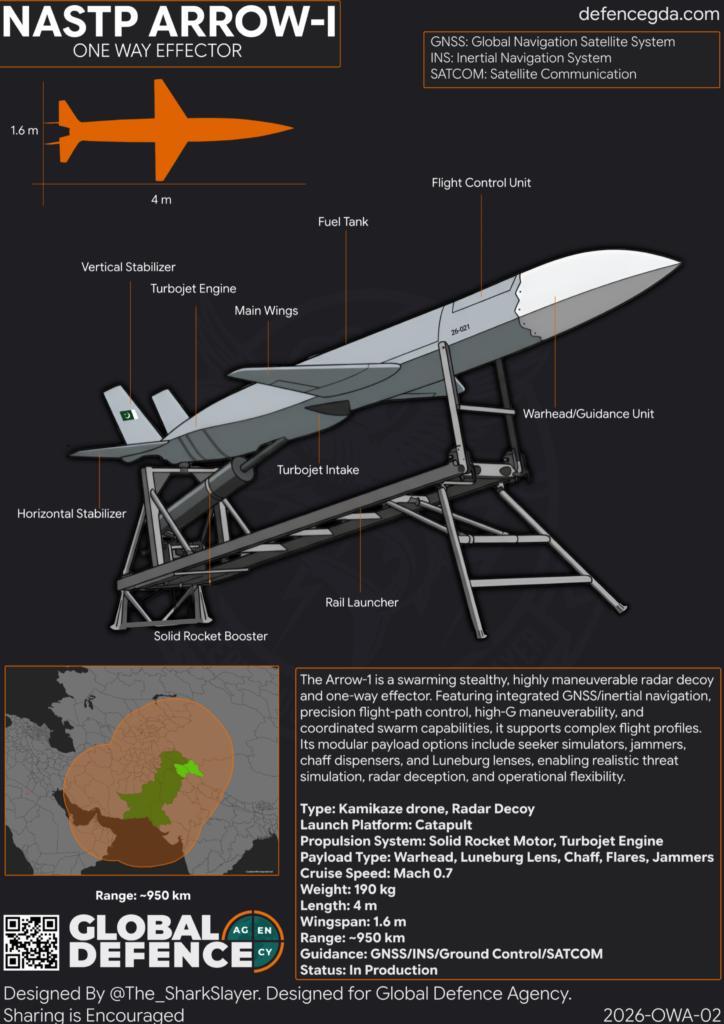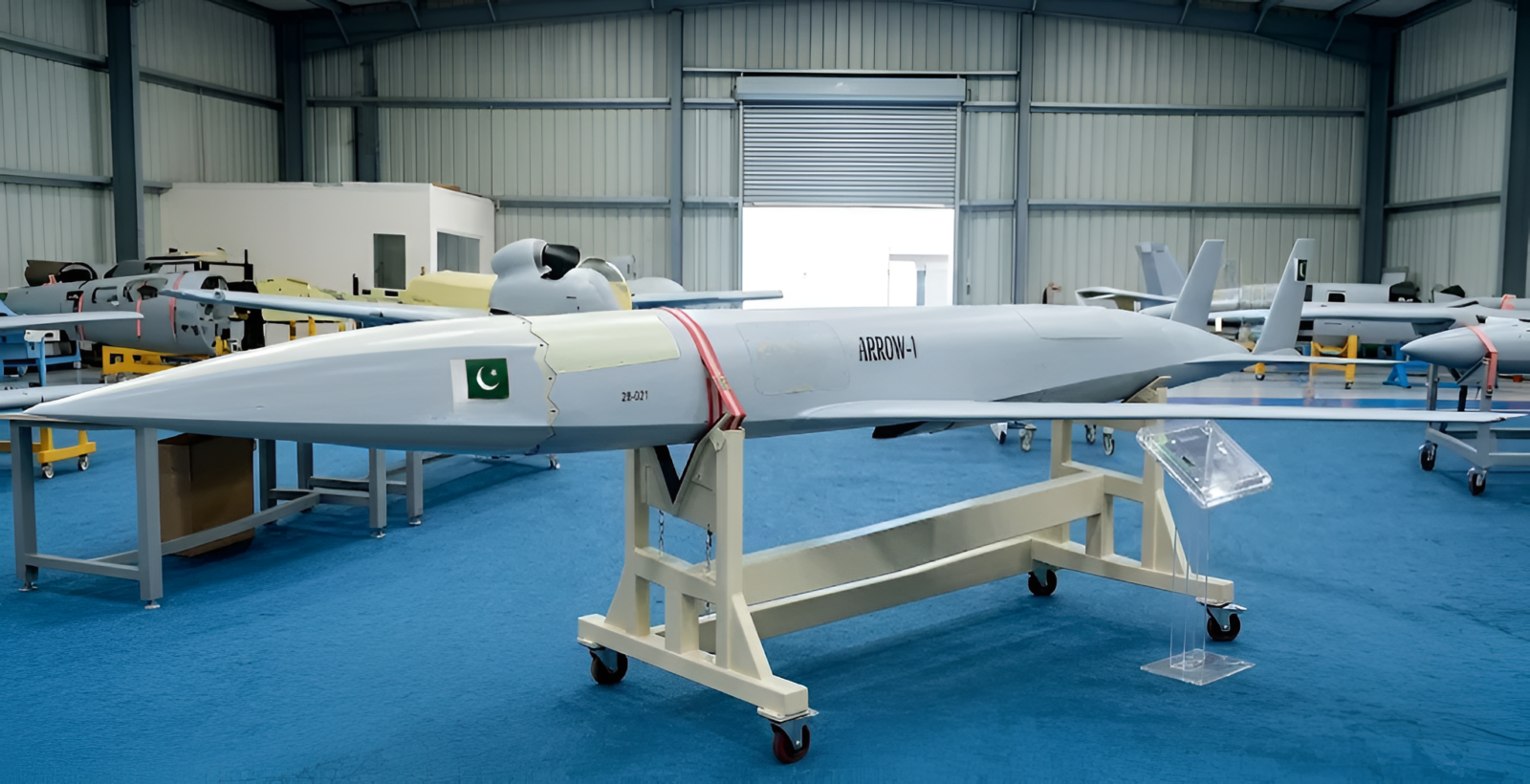



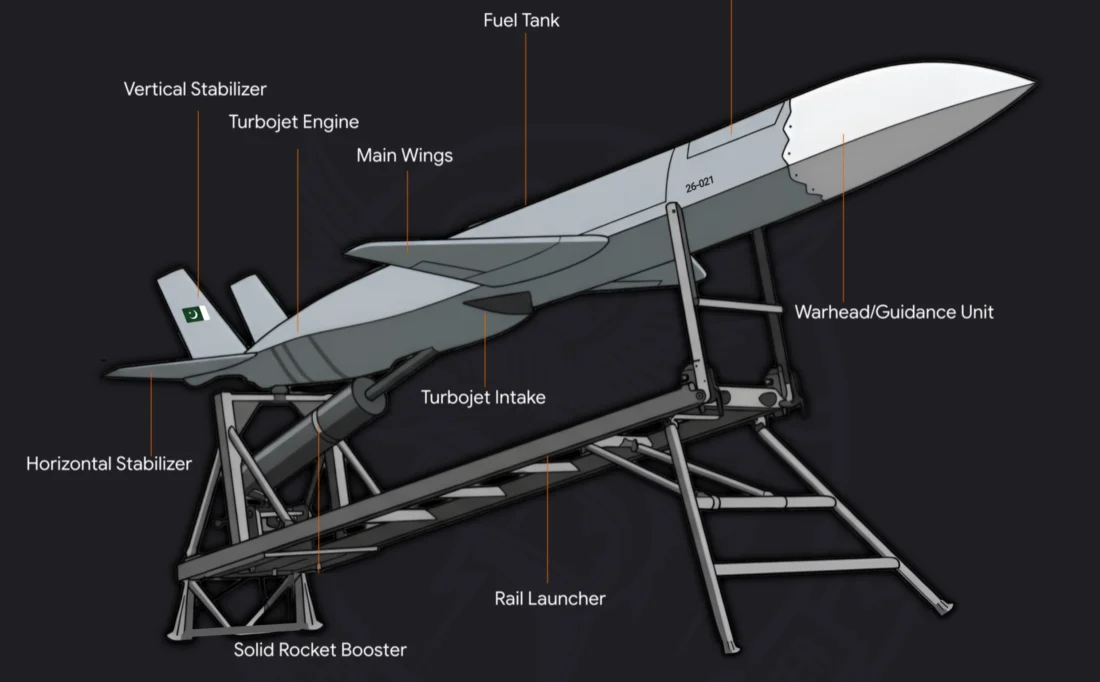

Pakistan’s drone industry has taken another step forward. The NASTP Arrow-1, shown in the unmanned systems hall of the National Aerospace Science and Technology Park (NASTP) November 2026 is a high-subsonic low-observable drone designed to fly fast, fly low and confuse enemy air defences.
The Arrow-1 is a licensed copy of China’s Starneto JY260 high-subsonic stealth drone and is now under mass production by NASTP. While the JY260 was originally developed as an advanced aerial target for training air-defence crews, Pakistan has adapted the platform into a multi-role attack and saturation drone. This combination of a proven Chinese airframe with local Pakistani production gives the Pakistan Air Force (PAF) a cheap, numerous and hard-to-detect tool for modern air warfare.
Arrow-1 Specifications at a Glance
The figures below are based on the manufacturer’s published data for the JY260, the parent design of the Arrow-1.
| Parameter | Arrow-1 / JY260 |
|---|---|
| Length | 4 m |
| Wingspan | 1.6 m |
| Take-off weight | 190 kg |
| Payload capacity | 35 kg |
| Maximum level speed | 270 m/s (about 970 km/h, roughly Mach 0.8) |
| Altitude band | 5 m sea-skimming to 12,000–12,500 m |
| Endurance | 60–70 minutes |
| Control radius | 150 km or more |
| Range | ~ 950kms |
| Radar cross section | Adjustable, 0.01 m² to 3 m² |
| Navigation | BeiDou satellite + inertial navigation |
| Launch | Rocket-booster launch from land or ship |
| Formation control | Multi-aircraft cooperative flight; up to 16 aircraft per station (some sources say up to 40) |
Key Capabilities of the Arrow-1
The most important feature of the Arrow-1 is its stealthy, angular airframe. In its clean form, its radar cross section (RCS) can be as small as 0.01 m², which is in the range of a small bird or a modern cruise missile. This makes it very hard for ground radars to detect it at long range.
At the same time, its RCS can be increased up to 3 m² using Luneburg lens reflectors. This means one Arrow-1 can appear on enemy radar as a much larger target, such as a fourth-generation fighter jet. The drone can therefore play two roles: hide when it needs to strike, or shout loudly on the radar when it needs to act as a decoy.
With a top speed of around 970 km/h and a 6 g manoeuvre limit, the Arrow-1 flies much faster than propeller-driven loitering munitions like the Shahed-style drones. It can carry out barrel rolls, serpentine (weaving) moves, high-altitude dives and jump-dives. These manoeuvres are the same ones used by real anti-ship and cruise missiles in their final attack phase, which makes the drone harder to shoot down with guns and short-range missiles.
The Arrow-1 can fly as low as 5 metres above the sea and about 20 metres over land. At this height, it stays below the radar horizon of most ground and ship-based radars until it is very close. This gives the Pakistan Navy a useful platform for simulating, or carrying out, attacks against surface ships.
One ground station can control a formation of Arrow-1 drones with less than 30 metres between aircraft. The system supports multi-direction arrival, single-direction streams and group manoeuvres. In simple words, Pakistan can launch many Arrow-1s at once from different directions so that they reach the target area at the same time, overloading the defender’s radars and fire-control systems.
The 35 kg payload bay can carry electronic jammers and radiation sources, seeker simulators that mimic incoming missiles, chaff and decoy flares, Luneburg lens radar reflectors and tracer tubes for training. This wide choice of payloads means the same airframe can be set up for very different missions, from confusing enemy radars to helping air-defence crews practise.
For the attack role, the same bay can be used for a small high-explosive or anti-radiation payload, turning the Arrow-1 into a fast one-way strike drone for hitting radars, command posts and parked aircraft.
Why Local Mass Production at NASTP Matters
Pakistan’s experience in the May 2025 conflict with India (India’s Operation Sindoor and Pakistan’s Operation Bunyan-um-Marsoos) showed that drones are no longer a side weapon. Both sides used large numbers of drones and loitering munitions, and the side that can produce drones quickly and in large numbers has a clear advantage.
Building the Arrow-1 under licence at NASTP gives Pakistan several benefits. The first is scale, because local production lines can build drones in the hundreds, not dozens. The second is supply security, as Pakistan does not have to wait for foreign deliveries during a crisis. The third is cost control, since a 190 kg drone costs only a small fraction of a fighter jet or a cruise missile. Finally, licence production supports industrial growth by transferring composite, avionics and integration skills to Pakistani engineers, which will help future indigenous designs.
The Arrow-1 also fits into a wider Pakistani drone family shown at NASTP including the KaGeM V3, Lightning-I and Lightning-II drones and the Turkish-Pakistani Yiha-III.
Importance of the Arrow-1 for Pakistan Armed Forces in future conflicts against India
India has built a dense, layered air-defence network that includes the S-400 Triumf, Barak-8 / MRSAM, Akash and Spyder systems. These are capable systems, but each interceptor missile is expensive and stocks are limited.
The Arrow-1 was originally designed to imitate third- and fourth-generation fighters, cruise missiles and anti-ship missiles. In wartime, this skill becomes a weapon. A wave of Arrow-1s, with their RCS turned up to look like fighter jets, could force Indian air-defence crews to fire costly surface-to-air missiles at cheap drones. Every interceptor fired at an Arrow-1 is one fewer interceptor available against real PAF aircraft or missiles.
When enemy radars switch on to track a swarm of Arrow-1 decoys, they reveal their locations. This creates an opening for PAF aircraft armed with anti-radiation missiles, and for Arrow-1s fitted with strike payloads, to hit those radars. In this way, the Arrow-1 supports Suppression of Enemy Air Defences (SEAD) one of the hardest missions in modern air warfare.
With a speed close to a cruise missile and a very small radar signature in clean form, an armed Arrow-1 can reach forward air bases, radar sites and logistics nodes within its operating radius. Its speed gives the defender far less reaction time than slow propeller drones, which were widely shot down by guns and short-range systems in May 2025.
Maritime Role for the Pakistan Navy
The ability to sea-skim at 5 metres and launch from ships makes the Arrow-1 useful in the Arabian Sea. It can be used to saturate the defences of Indian Navy surface groups, simulate incoming anti-ship missiles to confuse ship defences, or support real anti-ship missile salvos by flying alongside them.
Even in peacetime, the Arrow-1 adds value to Pakistan’s Armed Forces. Pakistan’s own air-defence units including those operating HQ-9 and other systems can train against a realistic, fast, stealthy target that behaves like modern Indian aircraft and missiles. Better-trained crews mean better results in a real conflict.
Limitations to Keep in Mind
A balanced assessment must also note the Arrow-1’s limitations. Its 35 kg payload is enough for a warhead against radars or parked aircraft but not against hardened targets such as bunkers or aircraft shelters. Its endurance of about one hour limits deep strikes and loitering over the battlefield. The drone also depends on BeiDou navigation and data links which Indian electronic warfare units will try to jam, although the system is designed with anti-jamming features. Lastly, real stealth depends on materials, engine installation and testing against actual Indian radars, not just the outer shape of the airframe.
Conclusion
The NASTP Arrow-1 is not a large combat drone like the Anka or Shahpar-III. Its value lies elsewhere. It is fast, stealthy, cheap and built in numbers. By turning a proven Chinese high-speed target drone into a licence-built attack and decoy platform, Pakistan has gained a tool that can exhaust India’s expensive air defences, expose its radars and support strikes by the PAF and the Pakistan Navy.
In a future India-Pakistan crisis, wars may be decided less by who has the most advanced fighter and more by who can overwhelm the other side’s defences at the lowest cost. The Arrow-1 places Pakistan firmly in that contest.