
Introduction
The character of modern aerial warfare has undergone a fundamental shift over the past three decades, moving decisively away from platform-centric engagements, where individual fighter aircraft rely primarily on their onboard organic sensors, toward highly integrated, network-centric operations. In this contemporary combat paradigm, victory is dictated by information superiority, electromagnetic spectrum dominance, and continuous, wide-area battlespace surveillance. Central to this networked architecture is the Airborne Early Warning and Control (AEW&C) aircraft. Functioning as the central nervous system of the contested airspace, these specialized platforms are tasked with fusing multi-domain sensor data, managing complex battle-space geometry, directing beyond-visual-range (BVR) missile engagements, and ensuring that friendly strike packages operate with maximum tactical awareness while remaining electromagnetically silent. Within this highly sophisticated operational context, the Shaanxi KJ-500 stands as a deeply transformative asset. Developed by the defense industrial base of the People’s Republic of China, the KJ-500 represents the pinnacle of Beijing’s sustained efforts to field a robust, scalable, and technologically advanced airborne command node.1
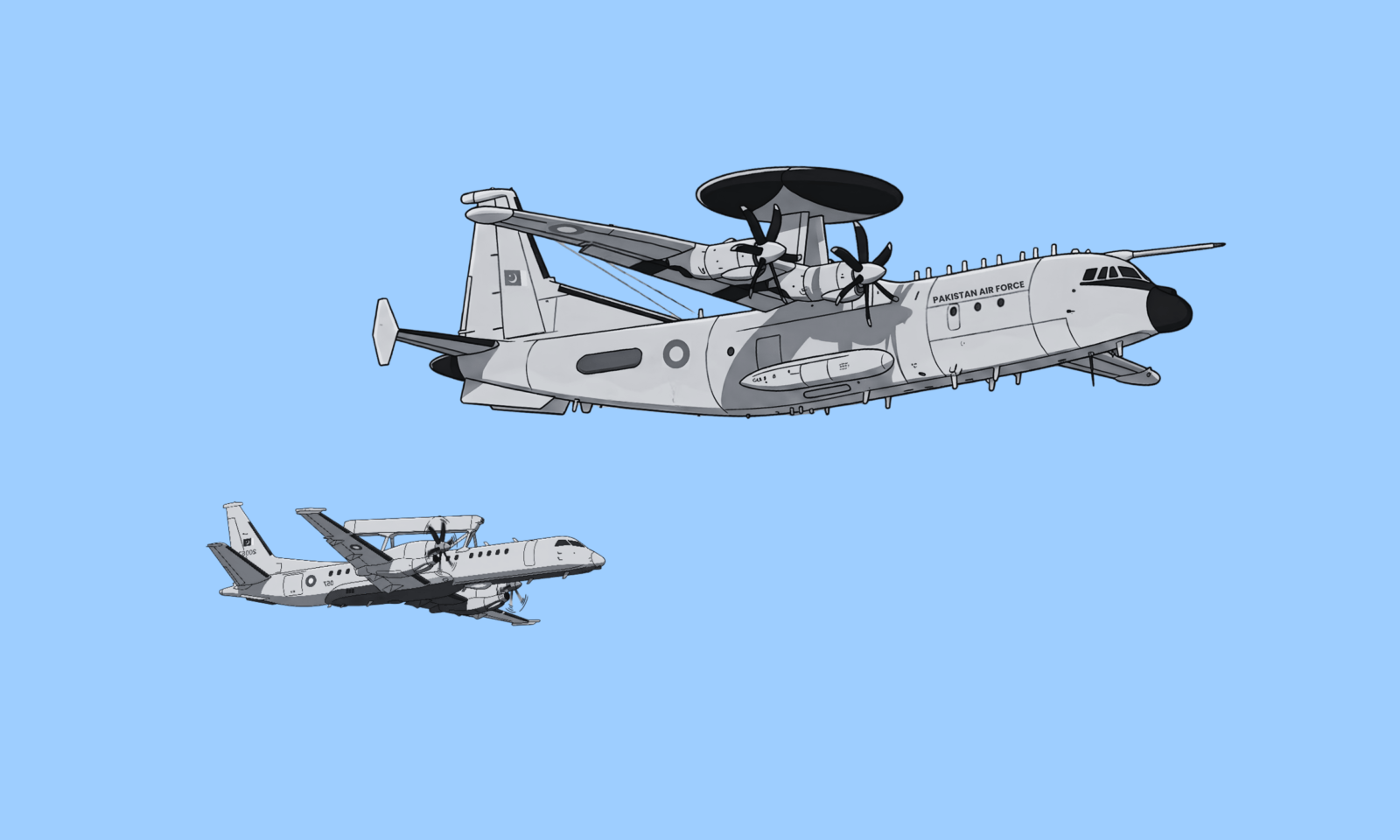
For the Pakistan Air Force (PAF), the acquisition and ongoing integration of the KJ-500 marks a critical inflection point in its strategic posture, particularly concerning its historical rivalry with the numerically superior Indian Air Force (IAF).2 Historically, the PAF has relied on a diverse mix of Western and Chinese early warning platforms to monitor its borders, most notably the highly capable Swedish-built Saab 2000 Erieye and the earlier Chinese-supplied ZDK-03 Karakoram Eagle.2 While the Erieye has proven exceptionally effective in localized conflicts and acute border skirmishes, the transition toward a purely informatized, high-end combat network necessitates a platform with the raw processing capacity, spherical radar geometry, and systemic integration capabilities native to China’s latest generation of combat aircraft. These modern combatants include the Chengdu J-10C, the JF-17 Block III, and the anticipated Shenyang J-35A fifth-generation stealth fighter.2
This exhaustive research report provides a granular examination of the technical architecture of the Shaanxi KJ-500, contrasting its specific capabilities with the PAF’s legacy Saab 2000 Erieye system. Furthermore, it analyzes the operational mechanisms through which the KJ-500 integrates with Pakistan’s indigenous Link-17 tactical data network, evaluating the “kill chain” mechanics utilized by PAF combat squadrons, and ultimately assessing the strategic and tactical implications of this advanced system on the broader South Asian balance of military power.
Evolutionary Context of Chinese Airborne Early Warning Systems
To fully comprehend the operational significance of the KJ-500, it is essential to trace the evolutionary trajectory of Chinese AEW&C development. The impetus for fielding dedicated airborne early warning assets became an urgent strategic priority for the Chinese People’s Liberation Army (PLA) following the 1991 Gulf War.1 During that conflict, the profound force-multiplying value of such assets was definitively demonstrated by the United States Air Force’s E-3 Sentry AWACS fleet, which orchestrated a massive, flawless air campaign against a heavily defended adversary.1 Realizing that modern air combat could not be won without airborne command posts, China embarked on a multi-decade development program characterized by iterative prototyping, technology transfers, and eventually, indigenous technological breakthroughs.1
China’s initial attempts to acquire AEW&C capabilities involved foreign acquisitions, most notably an aborted agreement to purchase the Israeli Phalcon radar system mounted on Russian Il-76 transport aircraft.6 When diplomatic pressure from the United States forced the cancellation of this contract, Beijing was compelled to develop an indigenous alternative, culminating in the KJ-2000 program.1 Entering service in the 2000s, the KJ-2000 mounted a domestically designed, three-panel Active Electronically Scanned Array (AESA) radar inside a fixed circular radome atop the massive Russian Il-76 jet airframe.1 While technically advanced and providing valuable operational experience, the KJ-2000 was fundamentally limited by China’s reliance on imported Russian Il-76 airframes, preventing the People’s Liberation Army Air Force (PLAAF) from fielding the system in sufficient numbers to cover its vast airspace.1 Ultimately, only four or five operational KJ-2000 units were built.9
Simultaneously, China developed a smaller, tactical AEW&C platform designated the KJ-200.1 Based on the domestically produced Shaanxi Y-8 turboprop airframe, the KJ-200 utilized a linear, two-planar “balance beam” radar array, conceptually identical to the Swedish Erieye system.10 While the KJ-200 solved the airframe dependency issue and was produced in larger numbers, its linear radar configuration suffered from severe blind spots directly at the nose and tail of the aircraft, requiring the platform to fly continuous figure-eight “racetrack” patterns to maintain complete airspace awareness.11
Recognizing the tactical limitations of the KJ-200 and the strategic unscalability of the KJ-2000, Chinese defense planners initiated the development of a “third-generation” AEW&C platform in the late 2000s.13 Originally progressing under the internal designation “Project 021,” this initiative sought to combine the superior spherical 360-degree coverage of the KJ-2000’s tri-panel AESA radar with the cost-effectiveness, high availability, and domestic supply chain of a turboprop airframe.6 The ultimate culmination of this ambitious development program is the Shaanxi KJ-500, a platform engineered from its inception to serve as the highly integrated core node of an informatized combat system.11
Technical Architecture of the Shaanxi KJ-500
The Shaanxi KJ-500 (commonly designated as “Kongjing-500,” translating literally to “Air Warning 500,” or colloquially known as “Qianliyan-500,” meaning “All-seeing-500”) represents a masterclass in systems integration, balancing aerodynamic efficiency with massive electrical power generation and heavy sensor payloads.13 Chinese aviation enthusiasts and open-source intelligence analysts frequently refer to the KJ-500 by its specific airframe designation, the Y-9W, or by its internal high-tech project designator, GX-10 (Gaoxin-10).14
Aerodynamic Platform and Propulsion Dynamics
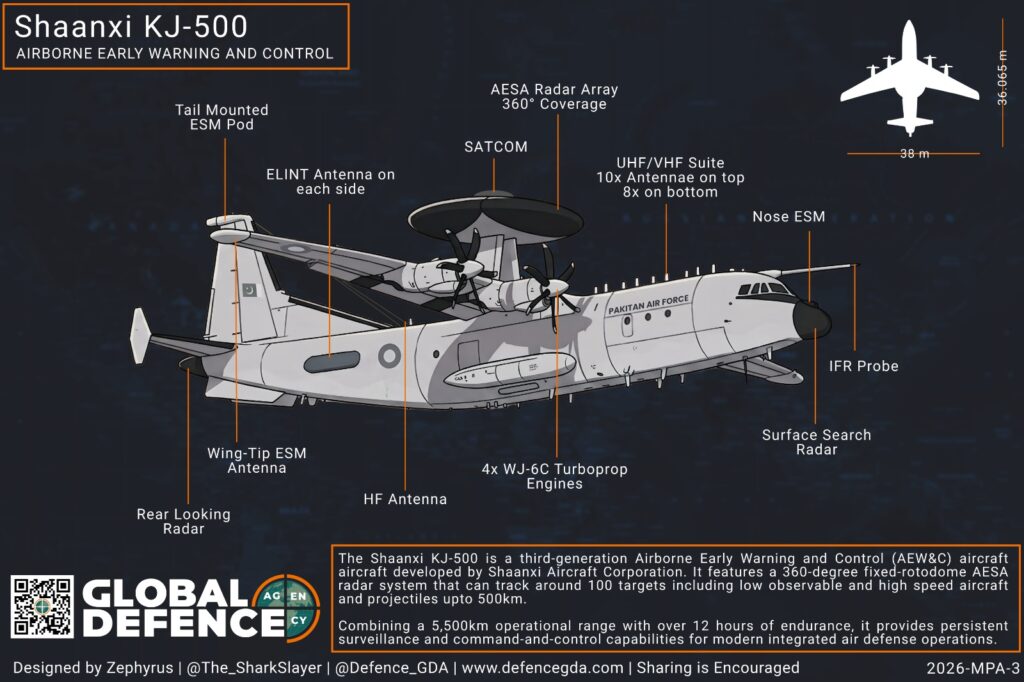
The foundational platform of the KJ-500 is the indigenous Shaanxi Y-9 four-engine turboprop transport aircraft.1 The selection of a turboprop platform over a turbofan-powered jet airliner (such as the Boeing 707 used for the E-3 Sentry or the Il-76 used for the KJ-2000) is highly deliberate and optimized for the specific requirements of the AEW&C mission profile.1 Turboprop engines inherently offer vastly superior fuel efficiency at the low-to-medium loitering speeds required for extended, persistent surveillance orbits.1 This propulsion choice maximizes the aircraft’s critical time-on-station, reducing the frequency of vulnerability windows that occur when early warning platforms must rotate out of their patrol zones to refuel.1 Furthermore, utilizing the Y-9 airframe provides the PLAAF with massive maintenance commonality across its tactical transport fleet and ensures relatively low operational costs compared to maintaining heavy jet aircraft.1
The KJ-500 is powered by an arrangement of four Zhushou Wojiang-6C (FWJ-6C) turboprop engines.1 Each of these advanced powerplants generates approximately 5,100 horsepower and drives a highly efficient six-bladed composite propeller designed to minimize acoustic signatures and maximize thrust at high altitudes.1 This robust propulsion system allows the heavily modified airframe to achieve a maximum top speed of 550 km/h (approximately 297 knots), ensuring it can reach its designated patrol orbits in a timely manner.13
In terms of physical dimensions and weight, the KJ-500 is a substantial aircraft capable of carrying heavy electronic payloads. The airframe possesses a total length of 118.1 feet, a broad wingspan of 131.2 feet, and a tail height of 37.7 feet.16 The empty weight of the heavily modified Y-9W airframe sits at 88,185 lbs, while its maximum takeoff weight reaches an impressive 77 tons.13
Operationally, the standard baseline variant of the KJ-500 boasts a formidable unrefueled endurance of up to 12 hours, providing a maximum theoretical range of approximately 5,700 kilometers (3,078 nautical miles).2 The aircraft operates at an optimal high-altitude patrol ceiling between 10,000 and 12,000 meters (roughly 33,000 to 39,000 feet), providing the dorsal radar with an incredibly long, unobstructed line-of-sight to the physical radar horizon, effectively eliminating terrain masking opportunities for low-flying adversaries.2
Recent iterations of the platform, most notably the upgraded KJ-500A variant which entered active service in late 2020, feature a prominent aerial refueling probe mounted directly above the nose cone.13 This critical enhancement theoretically extends the aircraft’s endurance indefinitely, limited only by the physical fatigue of the flight crew, engine oil consumption, and routine maintenance requirements.13 To manage its complex suite of sensors, radios, and command systems, the aircraft accommodates an exceptionally large operational crew of 24 personnel.16 This crew operates within a deeply modified main cabin featuring approximately 10 dedicated operator consoles and battle-management workstations, ensuring that the platform can simultaneously manage multiple complex engagements across vast geographical areas without overwhelming individual operators.1
Advanced Active Electronically Scanned Array (AESA) Radar Architecture
The most defining technological leap of the KJ-500, and the primary source of its strategic value, resides in its primary sensor suite. The aircraft is equipped with a massive fixed dorsal radome housing a highly advanced, three-panel Active Electronically Scanned Array (AESA) radar system.1 This radar platform was designed and developed by the 38th Research Institute of the China Electronics Technology Group Corporation (CETC-38), officially known as the East China Research Institute of Electronic Engineering (ECRIEE), based in Hefei, Anhui Province.1
Unlike traditional legacy AEW&C systems that rely on a large rotating mechanical radome to physically sweep a radar beam across a 360-degree arc (such as the American E-3 Sentry or the Chinese ZDK-03), the KJ-500’s circular, saucer-shaped radome is entirely fixed to the aircraft’s spine.1 Inside this static dome, three distinct AESA arrays are arranged in an equilateral triangular configuration.8 Each of these individual flat-panel arrays electronically steers its radar beam over a dedicated 120-degree azimuth sector.15 By precisely fusing the raw data inputs from all three panels in real-time through powerful onboard computers, the system achieves continuous, highly persistent, and completely uninterrupted 360-degree surveillance coverage of the surrounding airspace.2
This fixed-panel, electronic scanning architecture offers profound tactical advantages over mechanical systems. Mechanical rotodomes inherently suffer from a critical vulnerability known as a “refresh gap”, the time it takes for the heavy antenna to physically complete a full 360-degree rotation, which often takes between 10 and 12 seconds.15 During this seemingly brief gap, a highly maneuverable supersonic fighter aircraft or a fast-moving, sea-skimming cruise missile can cover significant distances unobserved, resulting in stale track files that complicate the generation of accurate fire-control solutions for intercepting aircraft.15 The KJ-500’s electronic beam steering eliminates this mechanical latency, allowing for instantaneous target revisit rates.15 The radar can dedicate immediate, focused energy bursts to establish and maintain highly accurate, persistent track files on rapidly maneuvering, highly agile targets.15
The underlying technology of the CETC-38 radar represents a significant maturation of China’s domestic semiconductor industry. Widespread technical assessments strongly indicate the heavy integration of advanced Gallium Nitride (GaN) or sophisticated Gallium Arsenide (GaAs) transmit/receive (T/R) modules within the AESA arrays.1 These advanced materials drastically increase the peak power output, thermal efficiency, and bandwidth of the radar compared to legacy systems.1 Operationally, the system is capable of simultaneously establishing high-fidelity tracks on between 60 and 100 airborne targets.1 Its raw detection capability is equally impressive, boasting an effective detection range of 470 kilometers against standard, fighter-sized targets possessing a typical radar cross-section (RCS).2
Furthermore, the inherent nature of AESA technology allows for sophisticated digital signal processing techniques, including advanced pulse compression, adaptive side-lobe blanking, and rapid frequency agility.2 These characteristics render the KJ-500’s primary radar highly resilient against enemy electronic countermeasures (ECM), dedicated jamming platforms, and digital radio frequency memory (DRFM) spoofing, ensuring a clear operational picture even in highly contested, dense electromagnetic environments.2 The radar is specifically optimized to detect targets with low RCS profiles, including stealth aircraft, unmanned aerial vehicles (UAVs), and terrain-following cruise missiles that traditional radars struggle to acquire.2
Multi-Spectral Electronic Intelligence (ELINT) and Network Infrastructure
Beyond its primary air search AESA radar, the KJ-500 is heavily outfitted for multi-spectral electromagnetic warfare and comprehensive intelligence gathering. Unlike Western AWACS designs that primarily focus on air traffic control and radar surveillance, the KJ-500 essentially merges the role of an early warning platform with that of a dedicated Electronic Intelligence (ELINT) aircraft, bearing striking similarities to the sensor suites found on dedicated Chinese signal intelligence platforms like the Y-9JB.14
The airframe bristles with an array of secondary sensors and conformal antennas. Mounted prominently atop the primary radar radome sits a satellite communications (SATCOM) dome.1 This high-bandwidth SATCOM link is critical for modern warfare, enabling secure, beyond-line-of-sight data transmission, allowing the aircraft to stream real-time operational pictures back to national command centers, distant naval strike groups, and strategic missile forces located thousands of kilometers away.14
For electronic warfare and passive sensing, rectangular fairings located on the left and right sides of the aft fuselage house highly sensitive, passive ELINT arrays.1 These passive sensors are designed to detect, characterize, categorize, and geolocate enemy radar emissions across a wide frequency spectrum without giving away the KJ-500’s own position.14 Additionally, a forward-looking Electronic Support Measures (ESM) antenna is mounted as a distinct protrusion above the nose cone, while further ESM arrays are integrated onto the wingtips and the tail of the aircraft.14 This distributed ESM architecture provides the KJ-500 with a spherical, 360-degree threat radar warning system, allowing the crew to instantly identify the direction of arrival and the specific classification of hostile radar locks, seamlessly generating an accurate electronic order of battle (EOB) for the theater commander.5
To function as the central, controlling node of a sprawling aerial kill chain, the KJ-500 must possess extraordinary communication capabilities. To this end, the aircraft incorporates high-frequency (HF) antennas strung tightly between the tail and the fuselage.14 Furthermore, up to eighteen very-high frequency (VHF) and ultra-high frequency (UHF) blade antennas are mounted extensively along the dorsal and ventral surfaces of the fuselage.8 This massive, high-bandwidth communication architecture allows the aircraft to ingest vast amounts of data from distributed ground-based early warning radars, surface-to-air missile (SAM) batteries, and friendly fighter aircraft.4 The onboard computers fuse this disparate data into a single, coherent, highly accurate battlespace picture, and then distribute precise targeting vectors and situational updates back to the engaged combat assets in real time.4
The Saab 2000 Erieye System: The Legacy Backbone of the PAF
Prior to the planned integration of the KJ-500, the Pakistan Air Force’s premier airborne surveillance capability rested entirely upon the proven, Swedish-built Saab 2000 Erieye AEW&C system.2 Originating from a major $500 million defense contract in the late 2000s, Pakistan initially acquired four systems, later expanding this vital fleet to nine fully operational aircraft through subsequent procurement deals, cementing the Erieye as the undisputed backbone of Pakistan’s airborne command and control network for over a decade.22
Platform Performance and Characteristics
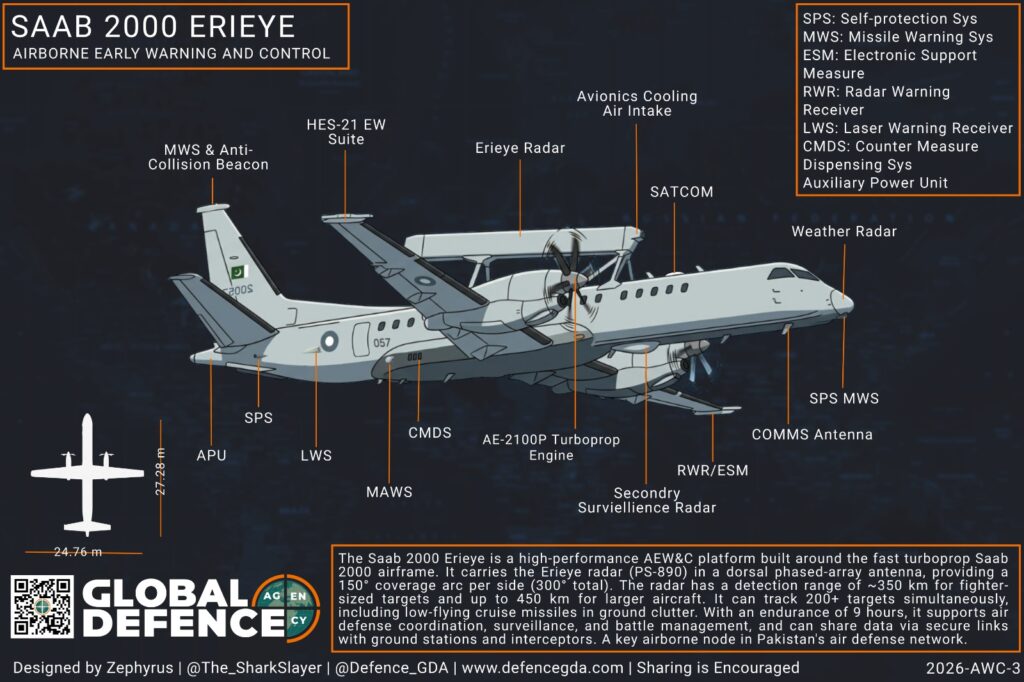
The Saab 2000 airframe is a twin-engine commercial regional turboprop, heavily engineered and modified by Saab Group for intensive military applications.5 Powered by two highly reliable Rolls-Royce AE 2100A turboprop engines, each derated to 3,390 kW (roughly 4,550 shaft horsepower), the aircraft swings six-bladed Dowty-Rotol fully feathering composite propellers designed with a slow rotational speed of 1,100 rpm at takeoff to reduce acoustic vibration.5
The Saab 2000 offers distinct aerodynamic and rapid-response performance advantages within its specific weight class. The aircraft possesses a maximum takeoff weight of 23,000 kg and can achieve a remarkably high maximum cruise speed of Mach 0.62 (685 km/h, or 370 knots), making it significantly faster and more agile than many peer turboprop platforms.5 This speed allows the Erieye to scramble rapidly and reach its patrol orbits with minimal delay during sudden border crises. The aircraft’s operational service ceiling exceeds 30,000 feet (9,144 meters), and it boasts a maximum unrefueled endurance of over 9.5 hours, providing a highly respectable patrol range of over 3,218 km (2,000 nautical miles).5 Given its smaller size relative to the KJ-500, an operational crew typically consists of only two flight pilots and a team of five to seven mission specialists tasked with operating the onboard tactical consoles.5
The PS-890 Erieye Radar and Electronic Support Measures (ESM)
The true core of the Swedish system is the Saab Microwave Systems (formerly Ericsson) PS-890 Erieye side-looking reconnaissance radar.5 This sensor is an active phased array pulse Doppler radar operating primarily in the S-band frequency range (3.1 GHz to 3.3 GHz).5 Physically, the radar is housed in a distinctive, rectangular, dorsal-mounted “balance beam” structure situated squarely above the fuselage of the aircraft.5
Unlike the KJ-500’s fixed tri-panel design that ensures total spherical awareness, the Erieye relies on a dual-sided linear array configuration. It utilizes precise electronic beam steering to scan a 150-degree sector on both the left and right sides of the aircraft.5 While this design provides truly excellent, high-fidelity coverage parallel to the aircraft’s flight path, it results in inherent 30-degree radar “blind spots” directly in front of the nose and directly behind the tail of the aircraft.5 To operationally mitigate this physical limitation, the Saab 2000 must fly specific “racetrack” or tight figure-eight orbit patterns, continuously shifting its orientation to sweep its field of view and ensure the blind sectors are periodically illuminated.20
Despite this geometrical constraint, the Erieye radar demonstrates exceptional technical performance, particularly in dense electronic warfare environments. The system utilizes advanced fast Fourier transforms (FFT) and highly selective channelization signal processing.5 Combined with adaptive sidelobe cancellation, these features effectively eliminate heavy ground radar clutter and severely diminish the negative effects of hostile EW jamming.5 In terms of tracking capacity, the Erieye sensor can process raw data for up to 300 airborne targets simultaneously.20 The system provides an instrumental range of 450 km, and a highly reliable, proven detection range of 350 km against standard fighter-sized targets, even at extremely low altitudes where ground clutter typically confuses legacy early warning radars.5 The total effective surveillance volume is vast, covering roughly 500,000 square kilometers horizontally and projecting up to 60,000 feet vertically.5
Complementing this potent radar is the integrated Saab Avitronics HES-21 electronic warfare and self-protection suite.5 This highly automated system utilizes digital narrow-band and wide-band receivers equipped with interferometer antenna arrays to achieve a near 100% probability of intercept (POI) for enemy electromagnetic emissions.5 Covering low (2-7 GHz), mid (2-18 GHz), and high (28-40 GHz) frequency bands, the HES-21 suite allows the Erieye to operate autonomously, passively intercepting, characterizing, and identifying the direction of arrival (DOA) of enemy signals, thereby compiling a real-time electronic order of battle without activating its primary radar.5
Comparative Analysis: The Shaanxi KJ-500 versus the Saab 2000 Erieye
While the Saab 2000 Erieye remains a highly potent, combat-proven, and agile platform for the PAF, a direct, rigorous technical comparison with the Shaanxi KJ-500 reveals a stark generational and structural divergence in AEW&C philosophy. The Erieye represents a specialized, highly efficient, western-oriented tactical surveillance asset optimized for specific border patrols. The KJ-500, conversely, represents a heavy-duty, omnidirectional, strategic battle-management node designed to dominate the electromagnetic spectrum across an entire theater of combined-arms operations.
Radar Geometry, Coverage, and Physics
The most critical and consequential distinction between the two systems lies in the physical geometry of their primary radars. The Erieye’s balance beam configuration restricts its optimal, high-gain performance to two 120-degree to 150-degree lateral sectors.5 The underlying physics of linear phased arrays dictate that as the electronic beam is steered further away from the array’s perpendicular center (known as boresight), the effective aperture of the antenna naturally decreases. This physical phenomenon widens the radar beam, reducing both the signal gain and the angular resolution at the extreme edges of its scan volume. Consequently, the Erieye suffers degraded tracking fidelity at the edges of its 150-degree arcs and features total, undeniable blind spots at the nose and tail.5
The KJ-500 circumvents this limitation entirely. Its massive, fixed dorsal radome houses three distinct AESA panels, each responsible for a dedicated 120-degree sector.2 Because no single panel is forced to steer its radar beam to extreme, inefficient off-boresight angles, the radar maintains maximum gain, optimal resolution, and peak detection probability uniformly across a full, uninterrupted 360-degree sphere.2 This allows the KJ-500 to orbit lazily in any orientation while maintaining high-fidelity track files on all targets in all directions, a critical operational advantage when managing complex, multi-axis saturation attacks from swarming drones, low-altitude cruise missiles, and stealth fighters.2
Target Processing and Operational Reach
The KJ-500 also possesses a markedly superior detection envelope. While the Erieye provides a highly respectable 350 km detection range against fighter-sized targets, the KJ-500 pushes this boundary out to an impressive 470 km.2 In the compressed, high-stakes context of South Asian geography, an extra 120 kilometers of radar horizon is an eternity; it provides several crucial additional minutes of warning time against supersonic threats, drastically compressing the adversary’s decision loop while expanding the defender’s window to react.2
Furthermore, the physical scale of the platforms directly dictates their battle-management capacity. The Saab 2000 is a regional turboprop accommodating a small, highly tasked team of operators. The much larger, heavy-lift Y-9 airframe of the KJ-500 comfortably accommodates 24 crew members and approximately 10 command and control consoles.1 This architectural difference translates directly to a vastly higher human and computational capacity for simultaneous target tracking, complex data fusion, and the simultaneous vectoring of multiple friendly fighter squadrons across completely disparate, disconnected combat zones.1 While the Erieye can track 300 targets at a sensor level, the KJ-500 system is designed to deeply process, categorize, and actively manage engagements against 60 to 100 targets simultaneously as a systemic whole.1
| Feature | Shaanxi KJ-500 | Saab 2000 Erieye |
| Airframe / Role Category | Y-9W / Heavy Strategic AEW&C | Saab 2000 / Agile Tactical AEW&C |
| Propulsion System | 4x FWJ-6C Turboprops (5,100 hp each) | 2x Rolls-Royce AE 2100A (4,550 shp each) |
| Radar Configuration | Tri-panel fixed AESA | Dual-sided linear array AESA |
| Airspace Coverage | Continuous 360° Spherical | 300° Total (150° lateral arcs, blind spots fore/aft) |
| Detection Range (Fighter) | ~470 km | 350 km |
| Simultaneous Engagement | 60–100 airborne targets (Systemic processing) | Up to 300 airborne tracks (Sensor raw data) |
| Maximum Endurance | 12 hours (Indefinite via refueling on KJ-500A) | > 9.5 hours |
| Maximum Range Limit | ~5,700 km | 2,869 km |
| Optimal Patrol Altitude | 33,000 – 39,000 ft | > 30,000 ft |
| Crew / C2 Consoles | 24 personnel / ~10 operator workstations | 7 personnel / 5 operator workstations |
Pakistan’s Networked Airspace: The ZDK-03 Legacy and the Birth of Link-17
To fully comprehend the transformational impact of the KJ-500 on the PAF, one must critically examine the historical context of Pakistan’s early warning fleet and the arduous evolution of its indigenous networking capabilities. The PAF did not arrive at the KJ-500 in a vacuum; rather, it was a decision forged through earlier, difficult experiences with Chinese AEW&C integration.
The ZDK-03 Karakoram Eagle Precedent
The KJ-500 is notably not Pakistan’s first foray into Chinese airborne radar technology. In the late 2000s, responding to frustrating delays and geopolitical complications regarding further Western procurement, Pakistan ordered four ZDK-03 Karakoram Eagle AEW&C aircraft from China under a comprehensive $278 million contract.6 Based on the older, less advanced Y-8F600 airframe, the ZDK-03 represented an export derivative of China’s “Project 021”.6 It featured a conventional rotating mechanical rotodome housing a single AESA radar array, a system that uniquely blended mechanical horizontal scanning (by spinning the dome) with electronic vertical scanning.6
However, the ZDK-03 faced severe, ultimately insurmountable operational friction within the highly demanding PAF ecosystem. Reports overwhelmingly indicate that the platform suffered from deep maintenance inefficiencies and profound digital integration difficulties, particularly when attempting to communicate and share data with Pakistan’s predominantly Western-origin combat equipment, such as its prized F-16 interceptors and the Saab Erieye AWACS fleet itself.2 The closed digital architecture of the ZDK-03 was fundamentally misaligned with the PAF’s established Western tactical data links.3 Consequently, its operational availability remained distressingly low during periods of high-intensity operations, failing to provide the seamless battle management required.2 Ultimately, the PAF was forced to prematurely phase out the ZDK-03 as a primary AEW radar platform after a relatively short service life of just 7-8 years.3 In a testament to operational adaptability, the PAF physically removed the heavy radar domes from these airframes, reconfiguring and reassigning the fleet to dedicated Electronic Warfare (EW), Electronic Countermeasures (ECM), and Electronic Support Measures (ESM) roles.3
The Development of the Link-17 Architecture
The digital isolation and subsequent failure of the ZDK-03 underscored a critical reality for the PAF high command: possessing advanced radar sensors is functionally irrelevant without a unified, secure, and highly resilient data link capable of instantly sharing that information across highly diverse platforms of varying national origins. To solve this existential bottleneck, Pakistan invested heavily in the development of “Link-17,” a highly secure, jam-resistant, indigenous tactical data link.32
Often described by defense analysts as the “digital backbone” of the PAF, Link-17 functions conceptually similarly to the NATO standard Link-16, but is tailored to Pakistan’s unique geopolitical requirements.34 It enables real-time, bi-directional, encrypted voice and data exchange not only between fighter aircraft and AEW&C platforms, but also across entirely different military branches, integrating ground-based radars, army surface-to-air missile batteries, UAV drone swarms, and even naval surface combatants operating in the Arabian Sea.32 Link-17 effectively acts as the universal translator, definitively bridging the technological divide between Pakistan’s legacy Western assets (like the Erieye and F-16) and its rapidly expanding, highly lethal fleet of modern Chinese platforms, ensuring the KJ-500 will not suffer the isolated fate of the ZDK-03.3
Operational Integration: The ‘Kill Web’ and Tactical Implementation
The true strategic value of the KJ-500 does not lie solely in its impressive radar range, but rather in its seamless, native integration with Pakistan’s latest generation of combat aircraft: specifically, the Chengdu J-10C and the jointly developed PAC/CAC JF-17 Block III.2 Both of these modern fighters are equipped with highly capable indigenous AESA radars, advanced digital avionics, and most importantly, the lethal PL-15 beyond-visual-range (BVR) air-to-air missile, a weapon system that boasts operational ranges approaching a staggering 300 kilometers.2
However, simple physics inherently limit the size, power generation, and therefore the maximum detection range, of any fighter’s nose-mounted radar.2 If a PAF J-10C activates its onboard radar to actively search for Indian targets at extreme ranges, it emits massive amounts of localized electromagnetic energy, instantly alerting enemy ESM systems and radar warning receivers to its exact location, altitude, and vector, thereby surrendering the element of surprise.4
The KJ-500, operating flawlessly via Link-17 and native Chinese high-bandwidth data links, completely upends this traditional dynamic by enabling a distributed, highly lethal “kill chain”.4 Operating safely behind the international border, the KJ-500 utilizes its massive 470 km radar horizon to detect and track Indian strike packages as they form up.4 The AEW&C platform processes this raw data and transmits precise, three-dimensional tracking vectors down to patrolling PAF J-10Cs and JF-17s.4
This networked capability allows the Pakistani fighters to operate in complete electromagnetic silence, with their own radars turned completely off.4 Utilizing the continuous data feed provided by the KJ-500, a J-10C can maneuver into an optimal, highly advantageous firing position entirely undetected by the adversary.4 The fighter can then launch a PL-15 BVR missile and immediately turn away to evade counter-fire.4 The KJ-500 then assumes total responsibility for the missile, providing critical mid-course data updates via a secondary data link directly to the weapon, guiding it precisely toward the target until it is close enough to activate its own terminal active radar seeker for the final kill.4 This highly coordinated tactic, characterized by analysts as ‘A’ (the AWACS) tracking, ‘B’ (the Fighter) launching, and ‘C’ (the AWACS) guiding, makes the J-10C an exponentially more lethal platform, drastically reducing the adversary’s reaction time to near zero.32
Real-World Combat Applications
This is not merely a theoretical doctrine; the PAF has rigorously tested and proven these network-centric concepts in actual combat and high-tension standoffs. The Saab 2000 Erieye gained immense international prominence during the February 2019 Balakot crisis, widely known as Operation Swift Retort. During this high-stakes aerial skirmish, PAF Erieye platforms continuously monitored Indian Air Force movements, maintained the tactical picture despite intense Indian electromagnetic interference, and successfully vectored PAF fighters to intercept and engage Indian strike packages.22
More recently, during the intense April 2025 border tensions following the Pahalgam incident, and the subsequent aerial engagements on May 7-8 (where PAF J-10Cs reportedly downed IAF Rafales using PL-15 missiles guided by AEW&C assets), Pakistan heavily relied on its Erieye fleet to monitor IAF deployments.22 Furthermore, during Operation Bunyan-um-Marsoos, the Erieye network functioned as an “invisible air commander,” coordinating defensive screens of J-10C and JF-17 aircraft operating under strict radar silence.39 The introduction of the KJ-500 will take this proven operational concept and vastly expand its geographical reach, tracking volume, and EW resilience.2
Strategic Implications for the India-Pakistan Balance of Power
The impending, full-scale induction of the KJ-500 into the Pakistan Air Force transcends a mere tactical equipment upgrade; it represents a systemic shift that threatens to permanently alter the operational balance of military power over the entire South Asian subcontinent.2
Nullifying Indian Numerical and Technological Advantages
The Indian Air Force has historically relied upon a military doctrine predicated heavily on numerical superiority, deep-strike capabilities, and overwhelming tactical mass.2 India maintains a vast, highly capable fleet of air superiority fighters, notably the heavy Russian-designed Su-30MKI, alongside highly advanced multirole jets like the Dassault Rafale.2 The traditional Indian strategic assumption is the ability to achieve localized information superiority quickly enough to dominate the opening hours of a conflict, overwhelming Pakistani defenses through sheer volume and advanced kinematics.2
The deployment of the KJ-500 systematically dismantles this core operational assumption.2 The aircraft violently compresses the engagement timeline entirely to Pakistan’s advantage. Because the KJ-500 operates at extreme altitudes up to 12,000 meters and detects targets out to 470 kilometers, a single KJ-500 placed in a defensive holding orbit near the border city of Lahore can effectively monitor the entirety of India’s Western Air Command, peering deep past the Indian capital of New Delhi without ever crossing the international border.2 This extreme, unprecedented radar horizon explicitly denies the IAF the ability to secretly assemble strike packages, marshal forces, or conduct vulnerable airborne refueling operations without immediate, real-time detection by the PAF.2
Furthermore, the highly advanced AESA architecture of the KJ-500 is specifically designed and optimized to detect stealthy profiles, low-flying cruise missiles, and terrain-following aircraft attempting to mask their approach within the heavy ground clutter of the Himalayan foothills.2 This capability effectively denies Indian mission planners the critical element of tactical surprise, ensuring that PAF interceptors and ground-based air defenses are pre-positioned and actively tracking long before IAF jets ever cross the Line of Control (LoC).2
Exploiting the Severe Indian AEW&C Deficit
The induction of the KJ-500 also acutely highlights and brutally exploits India’s most significant contemporary military vulnerability: a stark, persistent deficit in AEW&C platforms.2 Despite fielding a massively larger fighter combat fleet, the IAF currently operates only five dedicated AEW&C aircraft, consisting of three Israeli-built Phalcon AWACS heavy systems mounted on Il-76 airframes, and two smaller indigenous Netra systems mounted on Embraer ERJ-145 business jets.2
Conversely, Pakistan already operates nine highly capable Saab 2000 Erieye systems.3 The addition of a rumored 4 to 6 new KJ-500 platforms will grant Pakistan an overwhelming, insurmountable numerical and technological advantage in airborne battle management.3
In the high-speed reality of modern warfare, a lack of AEW&C platforms equates directly to strategic blindness. India’s five aircraft are simply mathematically insufficient to maintain continuous, 24/7 coverage across both the highly contested Pakistani border and the expansive Chinese border simultaneously.2 Pakistan, with an eventual fleet approaching 15 operational early warning platforms, will be able to guarantee persistent, highly redundant surveillance over every single critical sector of the frontier. This glaring asymmetry means that in any sustained, multi-day conflict, the PAF will possess a continuous, uninterrupted “God’s eye” view of the entire battlespace, while the IAF will inevitably suffer from periodic sensor blackouts and operational blind spots.2
The Future Architecture: The Automated Aerial Kill Web
Looking slightly forward into the near future, the KJ-500 is not just a radar; it is the absolute linchpin for Pakistan’s transition into automated, fifth-generation warfare. The Pakistani government has already indicated strong intentions to procure the advanced Shenyang J-35A stealth fighter and the highly capable HQ-19 long-range surface-to-air anti-ballistic missile system.2
If fielded together, these disparate systems create a tightly closed-loop, Chinese-designed “aerial kill web”.2 The KJ-500 will serve as the central processing brain of this vast web. It will utilize its massive high-bandwidth datalinks to synchronize the low-observable J-35A fighters (which will penetrate enemy airspace passively without emitting radar signals) with the HQ-19 batteries (which will provide layered, long-range area denial from the ground).2 This highly integrated, highly automated architecture makes it virtually impossible for India to isolate, jam, and destroy individual Pakistani combat units; engaging a single PAF fighter means engaging the entire, interconnected, continent-spanning network.2
System Vulnerabilities and Tactical Countermeasures
Despite its overwhelming capabilities, the KJ-500 is not an invincible platform; its unique role presents specific, exploitable vulnerabilities. The very attributes that make the KJ-500 effective, its massive, continuous electromagnetic radar emissions and its central, irreplaceable role in the command-and-control network, also make it the single highest-priority target on the modern battlefield.2
The prevailing modern military doctrine of “killing the kill chain” focuses precisely on prioritizing the neutralization of high-value C4ISR nodes exactly like the KJ-500.15 Because the sudden loss of an AWACS can instantly decapitate the coordination of an entire fighter wing, rendering them blind to the broader tactical picture, adversaries will dedicate disproportionate, extreme resources to its destruction.15
The KJ-500’s reliance on the Y-9 turboprop airframe strictly limits its maximum speed and its physical escape kinematics compared to faster jet-powered AWACS platforms.1 If an Indian strike package equipped with ultra-long-range air-to-air missiles manages to successfully bypass or penetrate the PAF fighter screen, the KJ-500’s ability to simply outrun the incoming threat is severely mechanically limited.17 Consequently, the PAF will be forced by necessity to allocate a highly significant portion of its premium fighter fleet solely to defensive Combat Air Patrol (CAP) missions designed exclusively to escort, screen, and defend the KJ-500, thereby tying down valuable offensive assets that could otherwise be used for strike missions.
However, the sheer, unprecedented scale of Chinese aerospace production heavily mitigates some of this systemic risk. With well over 60 KJ-500 units already built and deployed across the PLAAF and PLANAF, the manufacturing base and supply chain for the platform are fully mature and highly robust.13 If Pakistan secures sufficient airframes, the built-in redundancy of the fleet ensures that the catastrophic loss of a single aircraft will not result in a complete network collapse, as other, overlapping KJ-500 nodes in the Link-17 network can seamlessly assume the command responsibilities of the downed aircraft without missing a beat.15
Conclusion
The Shaanxi KJ-500 represents a monumental, generational leap in Airborne Early Warning and Control capabilities, definitively transitioning the PLAAF and its export partners’ military doctrine from simple, platform-based radar surveillance to holistic, highly integrated electromagnetic battlespace management. Through its massive three-panel fixed AESA radar, immense simultaneous tracking capacity, and exceptionally deep integration of passive ELINT and high-bandwidth data links, the KJ-500 achieves the absolute apex of modern C4ISR networking, overcoming the inherent limitations of legacy mechanical and linear phased-array systems.
For the Pakistan Air Force, the successful integration of the KJ-500 alongside its already highly capable and combat-proven Saab 2000 Erieye fleet fundamentally and permanently shifts the strategic military calculus in South Asia. By natively networking the KJ-500 via the jam-resistant, indigenous Link-17 system, the PAF can effectively mask the physical radar limitations of its J-10C and JF-17 fighters, enabling passive, highly lethal, and virtually undetectable beyond-visual-range missile engagements. Furthermore, the KJ-500’s extreme 470-kilometer radar horizon decisively neutralizes the historical numerical superiority and massive territorial depth of the Indian Air Force, granting Pakistan an unprecedented level of real-time information superiority. As modern warfare increasingly relies heavily on the speed, security, and volume of digital data transmission rather than mere airframe kinematics, the KJ-500 ensures that the Pakistan Air Force commands a highly resilient, exceptionally lethal, and virtually impenetrable aerial kill web for the foreseeable future.
Works cited
- China’s KJ-500 ‘Flying Radar’ Fleet Growing Fast: Why America Hates This AEW&C Platform – Military Watch Magazine, accessed June 3, 2026, https://militarywatchmagazine.com/article/kj500-flying-radar-america-hates
- Pakistan’s KJ-500 AEW&C Could Cripple India’s Air Superiority as China Builds Islamabad a New Air War Network, accessed June 3, 2026, https://defencesecurityasia.com/en/pakistan-kj-500-aewc-could-cripple-india-air-superiority-china-builds-new-air-war-network/
- Pakistan likely to acquire AEW&C aircraft from China: report – Reddit, accessed June 3, 2026, https://www.reddit.com/r/LessCredibleDefence/comments/1sj4h0z/pakistan_likely_to_acquire_aewc_aircraft_from/
- Chinese J-10C Fighters Integrate With KJ-500 ‘Flying Radar’ Aircraft to Enhance Performance in High Intensity Combat Drills – Military Watch Magazine, accessed June 3, 2026, https://militarywatchmagazine.com/article/chinese-j10c-kj500-flying-radar-drills
- Saab 2000 Airborne Early Warning and Control (AEW&C) Aircraft – Airforce Technology, accessed June 3, 2026, https://www.airforce-technology.com/projects/saab-2000/
- Aircraft Spare – Micro Electronics International, accessed June 3, 2026, https://www.mei.com.pk/solution-aircraftspare.html
- Eyes in the Sky: India’s Push for Advanced AEW&C Capabilities – SP’s Aviation, accessed June 3, 2026, https://www.sps-aviation.com/story/?id=3668&h=Eyes-in-the-Sky-Indias-Push-for-Advanced-AEWandC-Capabilities
- China’s Massive Fleet Of Radar Planes And The Strategy Behind It – The War Zone, accessed June 3, 2026, https://www.twz.com/chinas-massive-fleet-of-radar-planes-and-the-strategy-behind-it
- Difference Between PAF AWACS ZDK-03 and Chinese KJ-500. Also where are KJ-2000 and KJ-200 gone? – YouTube, accessed June 3, 2026, https://www.youtube.com/watch?v=OZ1WNql9vTM
- China Reveals Origin of AEWC Radar – Defense News, accessed June 3, 2026, https://www.defensenews.com/pentagon/2016/03/14/china-reveals-origin-of-aewc-radar/
- KJ-500 Chinese Airborne Early Warning and Control (AEW&C) Aircraft – ODIN, accessed June 3, 2026, https://odin.t2com.army.mil/WEG/Asset/KJ-
- Shaanxi KJ-200 – Grokipedia, accessed June 3, 2026, https://grokipedia.com/page/Shaanxi_KJ-200
- Shaanxi KJ-500 – Wikipedia, accessed June 3, 2026, https://en.wikipedia.org/wiki/Shaanxi_KJ-500
- Special Mission Aircraft and Unmanned Systems – DTIC, accessed June 3, 2026, https://apps.dtic.mil/sti/trecms/pdf/AD1128646.pdf
- China’s ‘All-Seeing’ KJ-500 AWACS Is Rewriting Indo-Pacific Airpower — U.S. and Allies Face Compressed Kill Chains and Stealth Exposure, accessed June 3, 2026, https://defencesecurityasia.com/en/china-kj500-awacs-indo-pacific-kill-chain-airpower-shift/
- KJ-500 (Y-9W) – Mitchell Institute for Aerospace Studies, accessed June 3, 2026, https://www.mitchellaerospacepower.org/weapons/kj-500/
- Shaanxi KJ-500 – Grokipedia, accessed June 3, 2026, https://grokipedia.com/page/Shaanxi_KJ-500
- CHINA’S AIR DEFENSE RADAR INDUSTRIAL BASE, accessed June 3, 2026, https://www.airuniversity.af.edu/Portals/10/CASI/documents/Research/Infrastructure/2025-03-10%20Air%20Defense%20Radars.pdf
- GlobalEye’s Erieye vs KJ-500 as complement to E-7 Wedgetail (2026) – YouTube, accessed June 3, 2026, https://www.youtube.com/watch?v=bt7IVuwLM6U
- Saab 2000 AEW & C Detailed – TRISHUL, accessed June 3, 2026, http://trishulgroup.blogspot.com/2008/11/saab-2000-aew-c-detailed.html
- Bolstering Pakistan’s Aerial Kill Chains: Talks Underway to Procure Chinese KJ-500 ‘Flying Radar’ Planes – Military Watch Magazine, accessed June 3, 2026, https://militarywatchmagazine.com/article/bolstering-pakistan-aerial-kill-chains-talks-chinese-kj500
- How Sweden’s Erieye AWACS Transformed Pakistan’s Air Power Against India – YouTube, accessed June 3, 2026, https://www.youtube.com/watch?v=508J-ougyIg
- Saab 2000 – Wikipedia, accessed June 3, 2026, https://en.wikipedia.org/wiki/Saab_2000
- Saab 2000 AEW&C | Constructed Worlds Wiki – Fandom, accessed June 3, 2026, https://conworld.fandom.com/wiki/Saab_2000_AEW%26C
- Erieye – Wikipedia, accessed June 3, 2026, https://en.wikipedia.org/wiki/Erieye
- Saab 2000 Erieye AEW&C, accessed June 3, 2026, https://www.saab.com/products/saab-2000-erieye-aewc
- ZDK-03 AWACS: China’s Eyes in the Sky for Pakistan Air Force – Defense Feeds, accessed June 3, 2026, https://defensefeeds.com/military-tech/air-force/reconnaissance-aircraft/zdk-03-awacs/
- Is China in Talks with Pakistan to Supply KJ-500 Airborne Early Warning and Control Aircraft? – RESONANT NEWS, accessed June 3, 2026, https://resonantnews.com/2025/06/11/is-china-in-talks-with-pakistan-to-supply-kj-500-airborne-early-warning-and-control-aircraft/
- List of active Pakistan Air Force aircraft – Wikipedia, accessed June 3, 2026, https://en.wikipedia.org/wiki/List_of_active_Pakistan_Air_Force_aircraft
- A PAF Saab 2000 Erieye AWACS [1397×861] : r/WarplanePorn – Reddit, accessed June 3, 2026, https://www.reddit.com/r/WarplanePorn/comments/1kiazxc/a_paf_saab_2000_erieye_awacs_1397x861/
- Pakistan looks to vintage defense equipment deals to generate money for ailing economy, accessed June 3, 2026, https://www.thecitizen.co.tz/tanzania/news/international/pakistan-looks-to-vintage-defense-equipment-deals-to-generate-money-for-ailing-economy-4563376
- Pakistan’s Homegrown Link-17 Kill Chain Helped Shoot Down India’s Rafale Fighter Jets, accessed June 3, 2026, http://www.riazhaq.com/2025/05/pakistans-homegrown-link-17-kill-chain.html
- Inside Pakistan’s Indigenous Tactical Data Link – YouTube, accessed June 3, 2026, https://www.youtube.com/watch?v=geCzj3jQhWM
- Link-17 of the Pakistan Air Force – Global Defense News – gsdn.live, accessed June 3, 2026, https://gsdn.live/link-17-of-the-pakistan-air-force/
- PAKISTAN’S INDIGENOUS DATA LINK SYSTEM – LINK 17 – Sino – Turkiye, accessed June 3, 2026, https://sinopakmilitaryforumzs.quora.com/PAKISTAN-S-INDIGENOUS-DATA-LINK-SYSTEM-LINK-17
- CAC/PAC JF-17 Thunder – Wikipedia, accessed June 3, 2026, https://en.wikipedia.org/wiki/CAC/PAC_JF-17_Thunder
- Pakistan’s Impressive Fighter Jet Is Disrupting Indian Airstrikes – Here’s What Makes The J-10 So Deadly – SlashGear, accessed June 3, 2026, https://www.slashgear.com/1855957/pakistan-fighter-jet-disrupting-india-airstrikes-what-makes-china-j-10-aircraft-deadly/
- Pakistan’s Homegrown Link-17 Kill Chain Helped Shoot Down India’s Rafale Fighter Jets, accessed June 3, 2026, http://www.pakalumni.com/profiles/blogs/pakistan-s-homegrown-link-17-kill-chain-helped-shoot-down-india-s?xg_source=activity
- Pakistan’s ‘Invisible Air Commander’: How SAAB-2000 Erieye Quietly Directed J-10C and JF-17 Operations During Operation Bunyan-um-Marsoos – Defence Security Asia, accessed June 3, 2026, https://defencesecurityasia.com/en/pakistan-saab-2000-erieye-j10c-jf17-operation-bunyan-um-marsoos-network-centric-warfare/
Pakistan’s Secret Air Shield: J-10C Fighters, Erieye AWACS and EW Aircraft Escort Iranian Delegation Amid Fears of Israeli Strike – Defence Security Asia, accessed June 3, 2026, https://defencesecurityasia.com/en/pakistan-secret-air-shield-j10c-erieye-awacs-ew-aircraft-escort-iranian-delegation-fears-israeli-strike/