


Introduction
The character of modern naval warfare has undergone a profound and irreversible transformation, shifting from localized, platform-centric engagements to highly distributed, network-centric operations. In this contemporary paradigm, the survivability and lethality of a maritime force are dictated less by the sheer tonnage or armor of its surface combatants and more by its ability to dominate the electromagnetic spectrum, fuse multi-domain sensor data, and execute decision cycles at a pace that paralyzes the adversary. For the Pakistan Navy (PN), operating within the complex, congested, and heavily contested littoral environments of the Arabian Sea and the broader Indian Ocean Region (IOR), this transition to an interconnected force structure is not merely a scheduled operational upgrade; it is an absolute strategic imperative. Facing a numerically and technologically expanding regional adversary, the Pakistan Navy has systematically overhauled its Command, Control, Communications, Computers, and Intelligence (C4I) architecture to achieve a critical asymmetric advantage through superior situational awareness, electronic resilience, and rapid joint-strike coordination.
At the epicenter of this sweeping, multi-billion-dollar modernization effort lies a multi-layered, highly redundant, and securely encrypted communication infrastructure explicitly designed to integrate the navy’s surface flotillas, subsurface assets, maritime patrol aviation, and shore-based strategic command centers. This comprehensive research report provides an exhaustive technical, operational, and strategic analysis of the Pakistan Navy’s primary networking capabilities. It meticulously deconstructs the Naval Information Exchange System (NIXS), a sophisticated architectural framework developed by the Turkish defense contractor MilSOFT. Furthermore, it examines the physically dispersed RedLine country-wide communication infrastructure, the indigenous Link Green tactical data link (TDL) pioneered by Stingray Technologies, and the Pakistan Air Force-led Link-17 system that acts as the critical bridge for inter-service interoperability.
By dissecting the precise technical specifications, routing architectures, and operational deployments of these interconnected systems, this analysis elucidates the second and third-order effects of Pakistan’s network-centric evolution. It evaluates how the integration of advanced Combat Management Systems (CMS), particularly the HAVELSAN GENESIS ADVENT suite, interfaces seamlessly with these tactical data links on next-generation platforms, including the heavily armed Babur-class (PN MILGEM) corvettes and the forthcoming Jinnah-class frigates. Additionally, this report contextualizes these technological acquisitions within the volatile geopolitical landscape of South Asia. It assesses the real-world performance, tactical successes, and infrastructure vulnerabilities of these networks in light of recent regional escalations, most notably the intense May 2025 conflict known in regional defense discourse as Operation Sindoor. Through this exhaustive examination, the report demonstrates how the Pakistan Navy is bridging critical communication gaps, enabling highly complex multi-domain “kill chains,” and fundamentally redefining its strategic posture to project power and ensure sea-denial in a modern, multi-threat battlespace.
The Geopolitical Crucible: Asymmetry and the South Asian Naval Balance
To accurately understand the engineering architecture and tactical deployment of the Pakistan Navy’s C4I network, one must first deeply analyze the unforgiving strategic environment that necessitates its existence. The maritime dynamics of the South Asian theater are characterized by acute, structural asymmetry. The Indian Navy’s aggressive, multi-decade modernization program, centered around carrier strike groups, nuclear-powered ballistic missile submarines (SSBNs), and an extensive, multi-layered maritime surveillance network, presents a persistent, multifaceted threat to Pakistan’s sea lines of communication (SLOCs) and coastal economic infrastructure. Indian strategic doctrine, which openly and structurally contemplates a “two-front war” scenario involving simultaneous high-intensity conflict with both Pakistan and China, places a heavy, doctrinal emphasis on dominating the Arabian Sea to exert coercive influence over the continental land battle.1
In this asymmetrical context, the Pakistan Navy acknowledges that it cannot successfully compete in a symmetric, attrition-based war of tonnage. Instead, its naval doctrine has evolved to focus rigorously on sea-denial, anti-access/area-denial (A2/AD) capabilities, and the seamless integration of joint-service operations to maximize the lethal output of its available, smaller-footprint assets. The core philosophical driver of this doctrine is that a widely dispersed but highly networked force can outmaneuver, out-target, and ultimately defeat a larger, less agile, and more concentrated fleet. However, realizing this vision requires overcoming substantial technological barriers. In the absence of a structured, formalized strategic restraint regime between the two nuclear-armed neighbors, the risk of localized conventional conflicts escalating inadvertently into a strategic nuclear exchange is exceptionally high. Utilizing the Barry Posen model of inadvertent escalation, it becomes clear that precision, real-time command and control, and unambiguous situational awareness are absolute necessities to prevent tactical skirmishes from triggering broader, catastrophic conflagrations.1
The severe operational realities of this theater were starkly demonstrated during the unprecedented 88-hour India-Pakistan conflict in early May 2025, referred to extensively in regional defense literature under operational monikers such as “Operation Sindoor” and “Operation Bunyan-um-Marsoos”.3 This brief but highly kinetic conflict provided a real-world crucible that stress-tested both nations’ network-centric warfare capabilities. During the escalation, the Pakistan Air Force (PAF) successfully leveraged its advanced data-link networks to execute highly complex, multi-platform kill chains. This networking directly resulted in the confirmed downing of advanced Indian Air Force fighter jets, notably including the newly inducted, French-made Dassault Rafales.3
However, the broader infrastructure vulnerabilities of the Pakistani military apparatus were also severely exposed during this engagement. According to post-conflict assessments, intense Indian kinetic strikes and electronic attacks reportedly destroyed approximately 20% of the PAF’s operational infrastructure within those 88 hours.7 Furthermore, in the maritime domain, Indian defense officials, including Defense Minister Rajnath Singh, publicly claimed that aggressive deployments by the Indian Navy in the Arabian Sea effectively confined the entirety of the Pakistan Navy to its home ports during Operation Sindoor, establishing what Indian military commanders described as a completely “new redline” against cross-border operations.5 Conversely, Pakistani diplomatic and military leadership asserted that they had established their own “new redline of strategic conventional deterrence,” demonstrating the profound psychological and strategic weight placed on communication and command integrity during the crisis.4
These intense events underscore a profound strategic lesson for maritime planners: possessing advanced strike platforms and highly capable supersonic or hypersonic missiles is entirely insufficient if the underlying C4I networks and supporting physical infrastructure are vulnerable to decapitation, broad-spectrum electronic jamming, or kinetic destruction. Consequently, the Pakistan Navy’s heavy reliance on interwoven, redundant systems like NIXS, RedLine, Link Green, and Link-17 represents a concerted, existential effort to build a resilient, multi-path, and jam-resistant architecture. By aggressively diversifying its technological base, combining advanced Turkish software engineering from MilSOFT and HAVELSAN with heavy Chinese hardware platforms, and indigenous Pakistani tactical data links developed by Stingray Technologies and Project Vision, Islamabad is actively mitigating the critical risks of single-point communication failures and restrictive vendor lock-in.3 This strategic diversification is a highly calculated maneuver to preserve operational autonomy, ensure weapon release authority, and maintain fleet cohesion even under severe external military pressure or the threat of international sanctions.11
The Architectural Foundation: NIXS and the MilSOFT Paradigm

The Naval Information Exchange System (NIXS) developed by MilSOFT is built upon a framework explicitly designed for real-time performance, maintainability, and scalable future growth. A core technical pillar of this system is its Open Architecture Computing Environment (OACE), which implements the Object Management Group (OMG) Data Distribution Service (DDS) middleware.
MilSOFT’s specific implementation of DDS is completely decentralized and utilizes the Real-Time Publish-Subscribe (RTPS) protocol as its underlying communication mechanism. This architecture guarantees high-performance, zero-copy data transfers across the network. To ensure maximum stability during high-stress combat operations, the system is designed to require absolutely no dynamic resource allocation, such as new memory or thread allocations, after its initial startup and initialization phase. It efficiently routes information by assigning a multicast address to each specific data topic.
Additionally, the real-time version of this middleware (Mil-DDS RT) utilizes static or semi-static discovery protocols during initialization to locate network participants, data writers, and data readers. This approach guarantees that all critical discovery and read/write operations are completed within a strictly defined, deterministic timeframe. The transport layer is also highly adaptable, supporting both UDP/IP and ARINC-653 transport plugins.
Because it is built on these standardized, open-architecture principles, the NIXS framework is highly modular. It can be easily expanded from providing basic weapon control capabilities up to functioning as a comprehensive Combat Management System (CMS), offering common features that are inherently reusable across a wide variety of different naval platforms.
Open Architecture Computing Environment and Middleware
From a fundamental software engineering perspective, NIXS is built entirely upon an Open Architecture Computing Environment (OACE). This framework heavily utilizes the Object Management Group (OMG) Data Distribution Service (DDS) middleware.12 This specific architectural choice is highly significant and forms the bedrock of the system’s resilience. DDS provides a decentralized, low-latency, and highly reliable publish-subscribe communication model. Unlike legacy, centralized client-server naval architectures that suffer from catastrophic single points of failure (where the destruction of a command ship blinds the entire task force), the DDS middleware ensures that data is decoupled from specific hardware nodes. If one node, whether a leading frigate, a shore-based radar station, or an airborne early warning aircraft, is disconnected due to jamming or kinetic destruction, the rest of the network continues to publish and subscribe to tactical data seamlessly. This inherent decentralization makes NIXS extraordinarily robust against localized electronic warfare (EW) and anti-ship missile strikes.
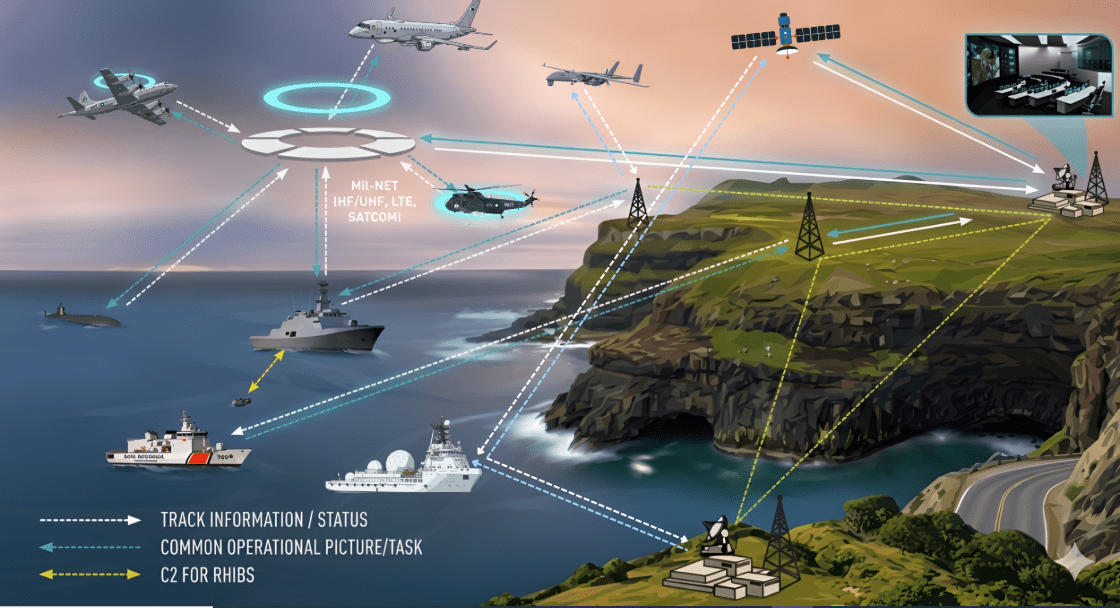
The NIXS infrastructure is specifically designed to operate over expansive Wide Area Networks (WAN). To achieve this, it utilizes high-bandwidth shipborne Digital Video Broadcasting – Satellite (DVB-S) arrays alongside Ultra-High Frequency (UHF) broadband IP radios to facilitate continuous, long-haul communication across the vast expanses of the Arabian Sea.12 Through this heavily encrypted physical infrastructure, NIXS continuously collects near-real-time sensor data from highly dispersed surface ships, submerged submarines, and high-altitude maritime patrol aircraft. Within the NIXS environment, intelligence officers and combat commanders can perform high-speed, multi-dimensional analysis on these incoming, massive data streams, extracting significant tactical intelligence, utilizing customized visual views, and disseminating optimized action plans across the fleet instantaneously.12
Common Operational Picture (COP) and Advanced Sensor Data Fusion

The primary tactical output and most visible component of the NIXS architecture is the automated generation of a synchronized Common Operational Picture (COP). In legacy, platform-centric naval operations, individual ships relied almost exclusively on their organic sensors, leading to fragmented, delayed, and often highly contradictory situational awareness across a task force, resulting in a dangerous “fog of war.” NIXS systematically eliminates this operational friction through advanced, algorithmic sensor data fusion.8
When a modern Pakistani warship, such as a Babur-class corvette, detects an incoming aerial threat or surface contact using its Aselsan SMART-S Mk2 S-Band 3D radar, that raw track data is instantly digitized, formatted, and shared via NIXS. A trailing Jinnah-class frigate or a shore-based coastal defense battery, which may be located far beyond the radar horizon and entirely lack line-of-sight to the target, receives this correlated track data in near-real-time. This allows the receiving platform’s Combat Management System to evaluate, prioritize, and prepare to engage the threat long before its own organic sensors are ever activated.10
Furthermore, NIXS features a sophisticated automatic threat evaluation engine. As disparate sensor inputs, comprising radar tracks, sonar anomalies, electronic support measures (ESM) intercepts, and optical visual system feeds, pour into the network from across the fleet, the NIXS software algorithms autonomously classify the tracks. The system determines precise threat priorities based on complex kinematics, electronic signature matching, and historical data, ultimately recommending the most efficient engagement strategies to human operators.12 This automation drastically compresses the Observe, Orient, Decide, and Act (OODA) loop, granting Pakistani naval commanders a crucial, split-second temporal advantage in the fast-paced, high-stakes environment of littoral combat.
Network Enabled Weapon Control (NEWC) and Post-Launch Retasking
Perhaps the most tactically lethal and transformative aspect of the NIXS framework is its embedded capacity for Network Enabled Weapon Control (NEWC) and seamless third-party weapon sensor integration.12 In a fully networked engagement facilitated by NIXS, the platform launching a kinetic weapon is not necessarily required to be the platform illuminating or tracking the target. This enables highly cooperative, distributed engagement strategies that deeply complicate the adversary’s defensive calculus.
For example, an advanced, stealthy platform like a Hangor-class AIP submarine or a Sea Sultan patrol aircraft could track an adversary’s carrier strike group and silently, seamlessly pass the precise, constantly updating targeting coordinates through NIXS to a smaller, less advanced missile boat, or a heavily fortified shore-based battery. This rear-echelon asset could then launch long-range anti-ship cruise missiles (ASCMs) like the Harbah or the advanced hypersonic P282 ship-launched ballistic missile.19
Crucially, the NIXS architecture possesses the advanced ability to authorize a net-enabled weapon to be actively re-tasked post-launch if critical C2 activities or battlespace parameters change.12 This means that if a much higher-priority target suddenly emerges from radar cover while a missile is currently in mid-flight, or if the original target is successfully destroyed by another asset or allied platform, NIXS operators can transmit updated, encrypted terminal coordinates to the missile’s seeker via the data link. This capability significantly reduces weapon wastage, preserves limited magazine depth, and enhances unprecedented strike flexibility across the naval theater.
Multi-Link Processing and NATO Interoperability (Mil-DLP, Link-M, and Mil-LINK)

To ensure that the NIXS ecosystem does not operate as an isolated technological silo, unable to communicate with external or legacy assets, MilSOFT provides a critical integration gateway known as the Multi Data Link Processor (Mil-DLP).14 The Mil-DLP serves as the universal translator and central nervous system for tactical data routing, providing the air, surface, subsurface, and land platforms with the capability to exchange tactical information seamlessly.
The Mil-DLP natively supports multi-data link processing for Link 11, Link 16, and Link 22 equivalents, ensuring that the Pakistan Navy maintains a high degree of interoperability with NATO standards. This is particularly crucial given Pakistan’s extensive joint naval exercises and procurement ties with Turkey, a NATO member state.12 The processor allows for advanced local-remote, remote-remote, and target-track correlation, ensuring that tracks generated by a Link 16-equipped fighter jet perfectly align with tracks generated by a Link 22-equipped frigate on the same NIXS display. Furthermore, Mil-DLP facilitates the digital exchange of high-resolution imagery in the NATO STANAG 4545 format, allowing for the rapid dissemination of reconnaissance photos across the fleet.14
| Mil-DLP Functional Capability | Operational Significance for the Pakistan Navy |
| Link 11/16/22 Translation | Enables seamless data forwarding among distinct tactical data links, ensuring interoperability between diverse international and indigenous platforms.12 |
| JREAP A/B/C & SIMPLE Integration | Extends range-limited tactical networks Beyond Line of Sight (BLOS) via satellite, reducing dependency on vulnerable airborne relay platforms.20 |
| Common Track Number Management | Prevents radar screen clutter by assigning a single, unified track identifier to an enemy asset, regardless of how many different allied sensors are detecting it.21 |
| Data Filtering & Normalization | Communicates with Combat Management Systems using normalized messages, ensuring legacy systems can interpret advanced sensor data.14 |
Link-M: The Indigenous Alternative
Recognizing that reliance on Western-standard data links like Link 16 introduces political and operational vulnerabilities, such as end-user agreements, geographical restrictions, or the threat of remotely triggered encryption lockouts, MilSOFT developed “Link-M” to operate seamlessly over the NIXS infrastructure. Link-M emerges when a tactical data link processor and network control software are layered over the NIXS backbone.8
Link-M provides a Link 22-equivalent capability but is specifically designed as an indigenous, “National” tactical data link solution tailored for non-NATO nations.20 The fundamental advantage of Link-M is its absolute independence. The network control software is developed fully indigenously, allowing it to operate without any restrictions over national hardware crypto devices, existing commercial modems, or standard HF and V/UHF radios.8 Link-M utilizes a highly resilient Dynamic Time Division Multiple Access (TDMA) architecture. In this multi-network system, Participating Units (MUs) are pre-assigned time slots for data transmission, but the dynamic nature of the architecture allows platforms to demand more bandwidth dynamically when they have large amounts of data to transfer, releasing those slots when the requirement decreases.20
Complementing Link-M is the Mil-LINK protocol, which is based on the STANAG 4691 standard. Mil-LINK is a member of the Mobile Ad Hoc Networks (MANET) family and is specifically engineered to enable IP-based communication using existing HF and V/UHF radios.24 A critical feature of Mil-LINK is its automatic relay selection capability. Particularly in UHF frequencies, which are strictly limited to line-of-sight, Mil-LINK uses optimal selection algorithms to designate specific ships as communication relays. This allows for complex network topologies and provides high-speed data transfer for vessels operating with separation distances exceeding 100 nautical miles, ensuring fleet cohesion even when widely dispersed.24
RedLine: The Strategic Wide-Area Terrestrial and Maritime Backbone
While NIXS and Mil-DLP provide the sophisticated software environment, graphical interfaces, and C2 routing logic for complex naval operations, these systems rely entirely on an uninterrupted, high-bandwidth flow of physical data. To address this absolute layer-one physical requirement, the Pakistan Navy conceptualized and established “RedLine,” a dedicated, highly classified, country-wide communication infrastructure explicitly designed to enable secure, high-speed, and continuous data sharing between NIXS-equipped platforms and deep-bunker shore installations [User context].
The establishment of the RedLine infrastructure indicates a profound strategic acknowledgment by the Pakistan Navy that utilizing commercial telecommunication networks, or even shared, general-purpose military communication networks, is grossly insufficient for the demands of high-intensity naval warfare. Given the intense, persistent electronic attack (EA) environment and the highly sophisticated cyber espionage campaigns active in the South Asian region, a physically, logically, and electromagnetically segregated network is paramount. This threat environment is actively hostile; cybersecurity threat intelligence reports, such as those comprehensively documented by the BlackBerry Research and Intelligence team, have tracked suspected nation-state advanced persistent threat (APT) groups like “SideWinder” actively targeting Pakistan Navy digital infrastructure, strategic ports, and maritime facilities utilizing novel, custom-built malware infrastructure.25
RedLine functions as the unbreachable backbone that physically and wirelessly connects coastal radar early warning stations, naval headquarters in Islamabad, and heavily dispersed operational command bases along Pakistan’s approximately 1,000-kilometer coastline, stretching from Karachi to Gwadar.19 By creating this highly dedicated infrastructure, the Navy ensures that sensitive command orders, immense logistical data streams, and the massive data packets required for the NIXS-generated COP can be transmitted securely without the severe bandwidth bottlenecks, latency issues, or cyber vulnerabilities associated with broader inter-service networks.
From a technical and topological standpoint, wide-area maritime networks utilizing RedLine concepts typically rely on highly directional, robust point-to-multipoint (PtMP) broadband architectures. For analogical reference within the defense industry, the deployment of specialized Redline Communications systems (such as the AN-50e PtMP Base Stations) in complex maritime and urban littoral testing environments has historically demonstrated the robust capability to establish high-throughput, over-the-horizon 802.16 wireless mesh networks across vast distances.26 In the specific operational context of the Pakistan Navy, the RedLine infrastructure essentially acts as the primary “master” station layer. It utilizes advanced, hardened Orthogonal Frequency-Division Multiplexing (OFDM) transmission techniques and localized, proprietary encryption modules to push dense NIXS data seamlessly from secure, subterranean bunkers to warships operating far out in the Exclusive Economic Zone (EEZ) and beyond.
The strategic value of RedLine cannot be overstated in a warfighting context. During the onset of hostilities, an advanced adversary will inevitably attempt to completely sever the sea-to-shore communication links, seeking to isolate naval task forces and force them to operate autonomously with heavily degraded situational awareness. By maintaining a dedicated, heavily hardened infrastructure that spans the physical geography of the country, the Pakistan Navy virtually guarantees that its strategic operational hubs remain perfectly synchronized with the fleet. This absolute continuity of operations is the very foundation that allowed the Pakistani strategic command to confidently declare the establishment of a “new redline of strategic conventional deterrence” during the height of the May 2025 escalations 4, ensuring that even if forward naval units are engaged or destroyed, the broader C4I architecture remains perfectly intact, highly aware, and fully capable of coordinating massive, synchronized retaliatory strikes.
Link Green: Autonomous Tactical Precision and the Stingray Ecosystem

While the NIXS software environment and the RedLine infrastructure manage the macro-level strategic operational picture and long-range shore-to-ship connectivity, the actual, split-second tactical execution of kinetic naval engagements requires a highly secure, localized, and ultra-low-latency data link. This specific operational requirement is masterfully fulfilled by “Link Green,” officially designated as Pakistan’s first fully indigenously created tactical data link. Engineered and developed locally by the defense firm Stingray Technologies (often stylized as Stingray Tec), Link Green was formally inducted into active service with the Pakistan Navy in 2018. Since its induction, it has been extensively stress-tested and utilized in various massive, multi-national naval exercises to validate complex, network-centric war-fighting concepts.15
Link Green is explicitly engineered as an AI-driven, mission-ready technology framework that facilitates the rapid, unerringly accurate, and near-real-time interchange of vital tactical information across the fleet.28 By utilizing Link Green, diverse naval platforms can interchange precise tracking data, terminal targeting information, and command orders securely, completely bypassing the need for foreign-supplied encryption boxes or highly vulnerable commercial waveforms that can be exploited by adversarial intelligence agencies.9
MANET Topology and Technical Characteristics
From a network topology perspective, Link Green operates as a highly dynamic, self-healing, self-organizing Mobile Ad-Hoc Network (MANET).30 This ad-hoc routing capability represents a massive tactical advantage: there is no reliance on a designated, vulnerable “central server” ship or an airborne AWACS node to process data. Instead, every single participating node in the Link Green network acts simultaneously as a transmitter, a receiver, and a data relay. If a ship in the middle of a formation is destroyed, the network autonomously reroutes data packets through surrounding vessels in milliseconds. This routing and relay functionality significantly extends the effective operational range of the network. Current, unclassified operational data indicates that Link Green networks have successfully achieved stable communication ranges of up to 1,000 nautical miles utilizing specialized, diverse radio networks and parallel operations.15
The highly complex waveform architecture of Link Green relies on precision Time Division protocols and parallel operational mechanics.28 By assigning highly specific, micro-synchronized time slots to each Participating Unit (PU), the network mathematically prevents signal collisions and ensures absolute, optimal bandwidth utilization even in an environment saturated with RF noise. Furthermore, the inclusion of proprietary waveform correction algorithms ensures that data packets remain structurally intact and readable even in high-clutter littoral environments, severe weather, or under active, broad-spectrum electronic jamming attacks.28
Key tactical features of the Link Green system include:
- Multilink Processing and Remote Track Correlation: The system can instantaneously correlate local radar and sonar contacts with remote tracks shared by other ships in the flotilla, assigning unique, unified Track Numbers. This prevents target duplication and eliminates dangerous clutter on the combat operator’s multi-function consoles.15
- PPLI (Precise Participant Location and Identification): Link Green constantly broadcasts the exact GPS location, kinematics, and internal system status of all friendly units. This feature virtually eliminates the risk of blue-on-blue friendly fire and provides fleet commanders with an exact, geometric, and continuous understanding of the physical battlespace.15
- Command Messaging and Weapon Management: Moving beyond automated sensor data plotting, Link Green allows for the highly secure transmission of explicit command orders, synchronized weapon management coordination, and free text messages. This ensures that commander intent is clearly communicated and executed even under strict radio silence conditions, connecting the battlefield with absolute tactical precision.9
- Electronic Warfare Control and Coordination: The data link interfaces directly with the platform’s organic EW suite, allowing for coordinated electronic attack and defense strategies across multiple ships. This enables the task force to overwhelm adversary radar systems through synchronized, multi-vector jamming while maintaining internal communication.28
Operational Deployment and the Stingray Defense Ecosystem
Currently, the Link Green tactical data link is installed and fully operational onboard over 16 frontline Pakistan Navy platforms, an integration footprint that encompasses major surface combatants, subsurface submarine units, land-based coastal missile batteries, and air-based maritime patrol units.15
The success of Link Green has propelled its developer, Stingray Technologies, into a central role within Pakistan’s indigenous military-industrial complex. Stingray Tec does not merely produce data links; the company engineers a comprehensive suite of defense technologies designed to safeguard national sovereignty. Their portfolio includes highly advanced Fire Control Systems (FCS), multi-function combat consoles, Ruggedized Enclosures for harsh maritime environments, full Combat System Integration (CSI) services, and the development of Unmanned Surface Vehicles (USVs) and robotics.29 Furthermore, Stingray provides the Integrated Platform Management System (IPMS), which manages the internal engineering, propulsion, and damage control networks of modern warships.29 By controlling both the internal ship management software (IPMS) and the external tactical communication software (Link Green), Pakistan ensures a holistic, tightly integrated, and domestically secure combat ecosystem.
Link-17: Joint-Service Interoperability and the Multi-Domain Kill Chain
While the maritime domain is rigorously secured by the combination of NIXS, RedLine, and Link Green, naval assets in modern conflict do not fight in an isolated vacuum. The true integration of naval forces with air force strike packages and ground-based air defense assets is the defining hallmark of modern, multi-domain operations. To achieve this critical inter-service interoperability across the armed forces, the Pakistan military relies on “Link-17,” a homegrown, highly advanced, and exceptionally jam-resistant tactical data link system primarily developed under the strategic auspices of the Pakistan Air Force (PAF).7
Initiated around the year 2000 under the highly classified PAF initiative known as “Project Vision,” the development of an indigenous, unified C4I system became the absolute top priority for the military establishment. The goal was to merge disparate surveillance data from diverse, multinational sources into a single, flawlessly recognized air picture.32 With significant technological and engineering assistance from China, Link-17 evolved from a conceptual project into a highly sophisticated, multi-frequency network capable of securely sharing high-bandwidth voice and data across fighter jets, airborne early warning and control (AEW&C) aircraft, ground-based strategic radars, and naval vessels operating at sea.3
Bridging the Inter-Service Communication Gap
Historically, different military branches operated entirely distinct, proprietary, and often technologically incompatible communication systems, leading to severe friction, delays, and tragic misunderstandings during joint operations. Link-17 elegantly solves this persistent problem by standardizing the tactical data exchange format across the entire military apparatus. The physical receivers for Link-17 are now widely distributed across all key services, transforming the Pakistani military from a collection of isolated branches into a truly net-centric, unified force.34 For the Pakistan Navy, which inherently lacks a massive, dedicated fleet of organic carrier-based fighter cover, interoperability with the land-based PAF is an absolutely critical force multiplier.35
Consider a tactical scenario: When a Pakistan Navy Type-054A/P frigate operates deep in the Arabian Sea, its organic radar horizon is strictly limited by the physical curvature of the earth. However, through the integration of Link-17, the frigate’s combat operators can instantly access the real-time, high-altitude sensor feed of a PAF Saab 2000 Erieye or a Chinese-built ZDK-03 Karakoram Eagle AWACS flying hundreds of kilometers inland or safely along the coast. The data from both the ZDK-03 and Erieye is actively merged at the PAF’s Air Defense Headquarters at Chaklala and broadcast via Link-17.32 This capability extends the navy’s situational awareness exponentially, allowing naval commanders to detect adversarial maritime patrol aircraft, low-flying cruise missiles, or carrier-launched strike fighters long before they cross the radar horizon and pose a direct kinetic threat to the surface fleet.
The Kill Chain in Action: Analytics from Operation Sindoor

The devastating operational potency of Link-17 was dramatically and publicly validated during the 88-hour India-Pakistan conflict in May 2025. During this massive aerial and electronic battle, the seamless integration provided by Link-17 allowed the Pakistani military to execute highly efficient, perfectly synchronized “kill chains.”
A detailed tactical analysis of the engagement reveals the precise mechanics of this networked warfare. The kill chain sequence began when a Pakistani ground-based radar, or potentially a surface-to-air missile system tracking radar, successfully illuminated an incoming Indian Air Force (IAF) strike formation consisting of advanced fighter jets, including the highly touted Dassault Rafales.3 This raw target data was instantly digitized, encrypted, and transmitted securely via the Link-17 network.
In immediate response, PAF pilots flying advanced Chinese-made J-10C fighter jets received the precise, real-time target coordinates directly onto their fifth-generation, J-20 derived helmet-mounted displays. This influx of external data completely negated the need for the J-10Cs to activate their own organic search radars, thereby maintaining strict tactical stealth and electronic silence.3 Operating with total situational awareness, the J-10Cs launched their PL-15 beyond-visual-range air-to-air missiles (AAMs) from extreme standoff distances. Once the PL-15 missiles were in mid-flight, a loitering Erieye AWACS aircraft utilized a dedicated mid-course datalink channel via Link-17 to provide continuous, high-speed trajectory updates directly to the missiles, guiding them flawlessly past Indian electronic countermeasures and into the Indian targets.3
Senior military analysts characterized this engagement as a textbook, paradigm-defining demonstration of networked warfare: “‘Platform A’ launched by ‘Platform B’ and guided by ‘Platform C'”.3 Former PAF officials later stated on record that Link-17 provided total, unparalleled situational awareness, claiming confidently that they “knew where every IAF jet was” and had systematically broken the adversary’s own data links through coordinated electronic warfare.3 With Pakistan’s imminent induction of the Chinese FC-31 fifth-generation stealth fighter, reportedly equipped with PL-17 AAMs boasting an astonishing range of 400 km, the lethal radius of the Link-17 kill chain will expand even further, providing massive protective umbrellas over naval assets in the Arabian Sea.35
Comparative Assessment: India’s Link II Architecture
To grasp the full strategic context of Pakistan’s Link-17 and Link Green, it is necessary to compare them against the adversary’s capabilities. The Indian Navy relies heavily on its own indigenous tactical data link, known as “Link II.” Developed by the state-owned defense contractor Bharat Electronics Limited (BEL), Link II is a highly capable network designed to facilitate secure, jam-resistant exchange of real-time sensor data, targeting information, and command instructions across Indian Navy platforms.36
Link II (specifically the L2M3 variant) integrates four-channel radio modems interfaced with HF and V/UHF frequencies, utilizing dual hot-standby main processor units to ensure server redundancy.37 This system is critical to India’s maritime dominance strategy and is heavily integrated into key assets like the anti-submarine warfare (ASW) corvette INS Kadmatt (P29), supporting coordinated ASW operations by sharing sonar contacts.36 Furthermore, BEL has successfully integrated Link II into India’s highly advanced fleet of Boeing P-8I Poseidon maritime patrol aircraft, marking India as the first international customer for the P-8 program to demand indigenous data link integration.38
The existence of Link II dictates that naval engagements in the Indian Ocean will essentially be clashes of opposing software networks. Whichever side’s network, Pakistan’s NIXS/Link-17 architecture or India’s Link II ecosystem, can process data faster, resist jamming more effectively, and execute the OODA loop quicker will invariably dominate the battlespace.
Platform Synthesis: Hardware Execution of the Network-Centric Doctrine
The theoretical, mathematical advantages of NIXS, Link Green, and Link-17 are only realized when they are physically integrated into modern combat platforms capable of generating high-fidelity data and launching kinetic effectors. The sweeping modernization of the Pakistan Navy involves a massive, accelerated procurement cycle designed to build up a formidable fleet of over 50 ships by the critical 2027-2030 window. Of these, 20 are designated as heavily armed “major surface ships,” specifically procured to defend the 1,000 km coastline against Indian incursions.19 At the vanguard of this expansion are the Babur-class (PN MILGEM) corvettes, the Jinnah-class frigates, and the Type-054A/P frigates.
The Babur-Class (PN MILGEM) Corvettes

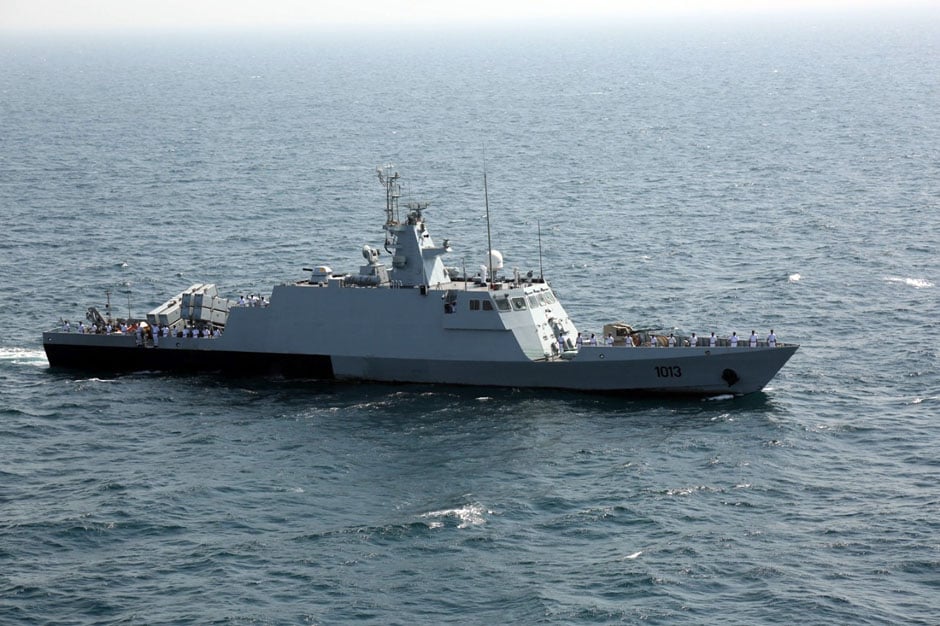
The Babur-class represents a heavily customized, substantially enlarged, and up-armed iteration of the Turkish Ada-class corvette. Displacing approximately 3,000 tons and measuring 108.8 meters in length, these multi-purpose, stealthy corvettes are explicitly designed from the keel up for network-centric warfare.10 The second ship of this class, PNS Khaibar (F282), commissioned with high distinction in December 2025, perfectly encapsulates the synthesis of foreign hardware, Turkish software, and indigenous Pakistani data links.18
The sensory and computational brain of the Babur-class is the HAVELSAN GENESIS ADVENT Combat Management System. ADVENT is a state-of-the-art, open-architecture CMS that fundamentally relies on constant network connectivity to function at its peak. It ingests massive amounts of raw data from the ship’s primary sensors, which include the advanced Aselsan SMART-S Mk2 S-Band 3D search radar, the ALPER Low Probability of Intercept (LPI) navigation radar, the AKREP (AKR-D Block B-1/2) fire-control radar, and the Meteksan YAKAMOS hull-mounted sonar.10
Once this sensor data is processed and categorized by the ADVENT CMS, it is fed simultaneously into two pathways: into the MilSOFT NIXS framework for strategic, long-haul broadcast to naval headquarters via RedLine, and into the Pakistan-developed Link Green terminal for immediate, low-latency tactical sharing with adjacent vessels in the task force.18 The kinetic armament of the Babur-class is formidable. It features a 12-cell vertical launch system (VLS) loaded with Albatross NG (CAMM-ER) surface-to-air missiles, dual triple-cell launchers for six P282 SMASH anti-ship missiles, an Aselsan GOKDENIZ 35 mm Close-In Weapon System (CIWS), dual STOP 25 mm remote weapon stations, and an Aselsan HIZIR torpedo-countermeasure system.10 Crucially, every single one of these weapon systems can be cued, targeted, and fired entirely based on remote data provided through NIXS or Link Green, enabling the Babur-class to remain electronically silent and hidden while engaging targets illuminated by a distant consort.
| Platform Integration | Combat Management System | Primary Sensors | Key Networked Armament / Effectors |
| Babur-class (PN MILGEM) | HAVELSAN GENESIS ADVENT | Aselsan SMART-S Mk2, ALPER LPI, YAKAMOS Sonar.10 | 12x CAMM-ER, 6x P282 SMASH ASCM, GOKDENIZ CIWS.10 |
| Jinnah-class Frigate | HAVELSAN GENESIS ADVENT | SMART-S Mk2 (3BAR), Thales MR-90 Front Dome.19 | Hypersonic P282 Ballistic Missiles, HHQ-16B SAM, Harbah Cruise Missiles.19 |
| Type-054A/P Frigate | Chinese Indigenous ZKJ-5 (Assumed) | SR2410C AESA Radar | 32-cell VLS (HQ-16 SAM), Anti-Ship Cruise Missiles.42 |
The Jinnah-Class Frigates and Type-054A/P Fleet
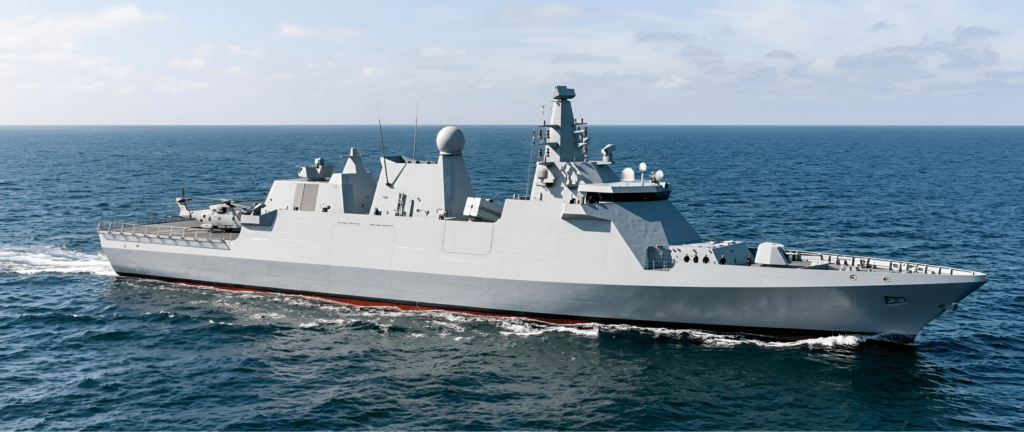
Building directly upon the technological success of the Babur-class, the Jinnah-class frigates represent the next, heavier evolution of Pakistan’s naval capabilities. Designed in close joint collaboration with Turkey’s ASFAT Inc., with full intellectual property rights notably transferred to Pakistan to ensure sovereign control, these warships boast an even more robust sensor and weapons suite.19
The Jinnah-class integrates the same GENESIS ADVENT CMS, SMART-S Mk2 radar, and YAKAMOS sonar as the Babur-class, but massively scales up the offensive, strategic capability. These ships are slated to be armed with the hypersonic P282 ship-launched anti-ship and land-attack ballistic missiles, a capability that serves as a major, tier-one strategic deterrent against India’s large naval presence in the Indian Ocean.19 The complex physics and precision required to target a moving Indian aircraft carrier with a ballistic missile at ranges exceeding hundreds of kilometers cannot be achieved by the ship’s organic radar alone. It necessitates the absolute integration of the entire C4I network. When a Jinnah-class frigate fires a P282 hypersonic missile, the initial target coordinates are likely generated by an overhead satellite, a forward-deployed submarine, or a Sea Sultan aircraft, shared via Link-17 to naval headquarters, routed through RedLine to the local NIXS network, and finally fed into the frigate’s ADVENT CMS for launch execution. Furthermore, the ship’s defensive suite, including the Chinese HHQ-16B medium-range air defense system, operates in a fully networked, cooperative engagement environment.19
Complementing these Turkish-origin designs are the four advanced Type-054A/P frigates acquired from China, such as the PNS Tughril. These multi-role warships bring improved radar systems, world-class stealth capability, and a 32-cell vertical launch system armed with HQ-16 surface-to-air missiles to the fleet, integrating into the broader joint-network alongside PAF assets.42
Aerial and Subsurface Nodes: The Eyes and Ears of the Network
The network extends far vertically and horizontally beyond surface ships. The Pakistan Navy’s modernization heavily features the acquisition of stealthy subsurface assets, specifically the eight Hangor-class diesel-electric submarines (derived from the Chinese Type 039B), four of which are being built domestically in Pakistan, which feature air-independent propulsion (AIP) for extended underwater endurance.3 These submarines, while primarily operating in acoustic stealth, function as critical, forward-deployed sensor nodes. By raising an electronic mast for a microsecond burst transmission, they can upload highly classified acoustic signatures and enemy fleet locations directly to the NIXS COP, instantly alerting the surface fleet to Indian carrier or submarine movements without betraying their own position.
Similarly, the newly inducted Sea Sultan Long-Range Maritime Patrol Aircraft (LRMPA) act as the far-reaching eyes of the fleet. Expected to utilize domestically designed sensor systems, such as EO/IR turrets or main search radars developed by Pakistani vendors like NRTC and NASTP, the Sea Sultan is explicitly configured to interface with the Link Green tactical data-link protocol.40 These aircraft aggressively patrol the vast, open expanses of the Arabian Sea, serving a dual purpose. They not only detect surface and subsurface threats utilizing advanced sonobuoys and radar, but they act as vital, high-altitude communication relays, extending the range of the Link Green MANET far beyond the physical radio horizon and ensuring that even geographically isolated naval task forces remain firmly tethered to the national command authority.
Cybernetic Resilience and Electromagnetic Spectrum Dominance
The wholesale transition to a network-centric architecture introduces a profound, systemic vulnerability: the entire warfighting apparatus of the Pakistan Navy is now inextricably dependent on the integrity, security, and constant availability of the electromagnetic spectrum and the underlying software code of its networks. Recognizing this existential threat, the adversaries of the Pakistan Navy continuously probe, attack, and attempt to compromise its digital defenses.
Cyber Espionage and Network Defense
The threat to Pakistan’s C4I infrastructure is not merely theoretical or academic. Leading cybersecurity threat intelligence reports, such as those meticulously published by the BlackBerry Research and Intelligence team, have documented highly sophisticated, ongoing cyber espionage campaigns specifically targeting the Pakistan Navy. Advanced Threat actors, most notably the suspected nation-state adversary group “SideWinder,” have aggressively and repeatedly targeted naval infrastructure, sync-schedulers, strategic commercial ports, and maritime facilities in the region utilizing highly advanced malware strains designed to exfiltrate classified data.25
Furthermore, international law enforcement and defense intelligence agencies (including the FBI and NCIS) have tracked the massive global proliferation of the “RedLine Infostealer.” While this malware is entirely unrelated to the Pakistan Navy’s “RedLine” communication infrastructure, it is heavily utilized by state-sponsored actors to compromise defense credentials, DoD accounts, and military networks globally, illustrating the exact type of severe digital threat environment in which Pakistan’s naval networks must operate.43
To actively safeguard mission-critical systems like NIXS, RedLine, and Link Green against these pervasive digital threats, the Pakistan military established and operates the highly classified Directorate of Cyber Warfare.34 This specialized directorate is officially tasked with the formulation, oversight, and stringent, zero-tolerance implementation of information security policies across all branches. Their mandate goes far beyond merely possessing a tactical data link; it comprehensively encompasses building the deep organizational infrastructure required to deploy, aggressively protect, and secure the link using cutting-edge, offensive and defensive cyber capabilities.34 Protective measures include utilizing strictly indigenous, national crypto systems for Link-M and Link Green, deploying hardware-based Synchronous Serial encryption devices, and ensuring that strategic command centers are logically, physically, and completely air-gapped from commercial internet infrastructure.14
Electronic Warfare and Spectrum Dominance
In the physical domain, the network must withstand intense, broad-spectrum electronic attack (EA). Indian naval and air forces possess highly sophisticated, multi-megawatt jamming capabilities explicitly designed to blind Pakistani search radars, overwhelm missile seekers, and completely sever tactical data links. To counter this blinding threat, Pakistan Navy platforms are equipped with highly capable Electronic Support Measures (ESM) and Electronic Attack (EA) systems integrated directly into the network.
The Aselsan ARES-2NC Radar ESM, heavily deployed across the new Babur and Jinnah classes, plays a pivotal, starring role in this defensive posture. The ARES-2NC utilizes advanced Digital Radio Frequency Memory (DRFM) technology, covering a remarkably broad frequency range from 7.5 to 18 GHz. DRFM allows the system to perfectly record incoming adversarial radar pulses, algorithmically alter their delay, phase, and Doppler signatures, and transmit them back at the enemy in microseconds, effectively creating dozens of false, highly realistic targets on the Indian radar screens.10
Crucially, these EW suites do not operate in isolation; they are deeply integrated into the data link networks. NIXS and Link Green facilitate explicit Electronic Warfare Control and Coordination across the fleet.28 This networked capability means that multiple Pakistani ships can coordinate their jamming efforts with mathematical precision, focusing highly concentrated RF energy against a specific adversarial AWACS or a leading Indian destroyer’s radar. This effectively blinds the enemy task force while simultaneously utilizing the highly directional, encrypted, and jam-resistant waveforms of Link-17 and Link Green to maintain perfect, uninterrupted friendly communications. Stingray Technologies explicitly engineers its communication and EW solutions with this exact goal: to allow Pakistani forces to “rule the electromagnetic spectrum” by rapidly identifying and neutralizing kinetic and non-kinetic threats across all frequencies, ensuring battlefield control.31
Conclusion
The Pakistan Navy’s aggressive, multi-faceted modernization program is a definitive testament to the modern military reality that maritime superiority is no longer forged in shipyards alone, but in the invisible, highly contested realm of the electromagnetic spectrum. Through the strategic, highly calculated implementation of the MilSOFT-developed Naval Information Exchange System (NIXS), the Navy has successfully achieved a sophisticated, unified Common Operational Picture capable of directing complex, networked weapons across the entirety of the fleet. The concurrent establishment of the RedLine terrestrial and maritime infrastructure ensures the highly secure, unjammable, country-wide transmission of this critical data, buffering the strategic command and control architecture against systemic, nation-state cyber shocks and kinetic decapitation strikes.
At the jagged tactical edge of the battlespace, the indigenous Link Green network provides the highly secure, self-healing, ad-hoc, and jam-resistant connectivity necessary for rapid, split-second ship-to-ship coordination and advanced missile defense, empowering highly lethal platforms like the Babur and Jinnah-class warships to strike unseen. Concurrently, the PAF-led Link-17 system completely shatters historical inter-service silos, bridging the massive communication gap between naval task forces, airborne early warning assets, and high-speed stealth strike fighters. This joint integration enables complex, multi-domain kill chains that have already proven highly lethal and strategically disruptive in modern combat scenarios like Operation Sindoor.
Together, these four foundational pillars, NIXS, RedLine, Link Green, and Link-17, constitute a remarkably resilient, deeply redundant, and highly lethal C4I ecosystem. By heavily and consistently investing in this complex network-centric architecture, the Pakistan Navy has not merely upgraded its radios and radar screens; it has fundamentally rewritten its entire operational doctrine. In the deeply contested, heavily armed, and volatile waters of the Indian Ocean, where split-second data processing determines the survival or destruction of a fleet, this integrated data-link network serves as the ultimate asymmetric equalizer. It ensures, unequivocally, that the Pakistan Navy remains a formidable, highly lethal, and deeply integrated component of the national strategic deterrent.
Works cited
- The Challenge of a Two-Front War: India’s China-Pakistan Dilemma – Stimson Center, accessed June 2, 2026, https://www.stimson.org/2021/the-challenge-of-a-two-front-war-indias-china-pakistan-dilemma/
- Reducing the Risk of Nuclear War in South Asia – Nonproliferation Policy Education Center, accessed June 2, 2026, https://npolicy.org/article_file/Reducing_the_Risk_of_Nuclear_War_in_South_Asia-FINAL_DRAFT.pdf
- Pakistan’s Homegrown Link-17 Kill Chain Helped Shoot Down India’s Rafale Fighter Jets, accessed June 2, 2026, http://www.riazhaq.com/2025/05/pakistans-homegrown-link-17-kill-chain.html
- Live Updates: Pakistan-India escalation – DAWN.COM, accessed June 2, 2026, https://www.dawn.com/live/pakistan-india-tensions
- Pakistan wants to bleed India by thousand cuts, new redlines drawn to combat terror: Gen Chauhan – Statetimes, accessed June 2, 2026, https://statetimes.in/pakistan-wants-to-bleed-india-by-thousand-cuts-new-redlines-drawn-to-combat-terror-gen-chauhan/
- Pakistan’s Homegrown Link-17 Kill Chain Helped Shoot Down India’s Rafale Fighter Jets, accessed June 2, 2026, http://www.pakalumni.com/profiles/blogs/pakistan-s-homegrown-link-17-kill-chain-helped-shoot-down-india-s
- Link-17 of the Pakistan Air Force – Global Defense News – gsdn.live, accessed June 2, 2026, https://gsdn.live/link-17-of-the-pakistan-air-force/
- Defence Turkey – MilSOFT, accessed June 2, 2026, https://www.milsoft.com.tr/wp-content/uploads/2020/11/defenceturkey.pdf
- Stingray Technologies, accessed June 2, 2026, https://www.stingray.com.pk/sea.html
- Babur-class corvette – Wikipedia, accessed June 2, 2026, https://en.wikipedia.org/wiki/Babur-class_corvette
- Center for Unconventional Weapons Studies (CUWS) Outreach Journal Issue 1293 – Department of War, accessed June 2, 2026, https://media.defense.gov/2019/Jul/22/2002160340/-1/-1/0/CUWS_OUTREACH1293.PDF
- Naval Information Exchange System – MilSOFT Software …, accessed June 2, 2026, https://www.milsoft.com.tr/index.php/portfolio/nixs-en/
- PRODUCTS – MilSOFT Software Technologies – Ankara, accessed June 2, 2026, https://www.milsoft.com.tr/index.php/products/
- MİLSOFT YAZILIM TEKNOLOJİLERİ A.Ş. – IDEF, accessed June 2, 2026, https://milsoft-yazilim-teknolojileri-as.idef.com.tr/
- Products – GIDS, accessed June 2, 2026, https://www.gids.com.pk/naval
- Milsoft Yazilim Teknolojileri A.S – Global Defence Mart, accessed June 2, 2026, https://globaldefencemart.com/companydetails/profile/milsoft-yazilim-teknolojileri-a.s
- _Jinnah_ -class frigate — Grokipedia, accessed June 2, 2026, https://grokipedia.com/page/Jinnah-class_frigate
- PNS Khaibar (2025) – Wikipedia, accessed June 2, 2026, https://en.wikipedia.org/wiki/PNS_Khaibar_(2025)
- [Pak Navy] JINNAH CLASS WARSHIP WILL HAVE P-282 MISSILES, accessed June 2, 2026, https://pdj.quora.com/Pak-Navy-JINNAH-CLASS-WARSHIP-WILL-HAVE-P-282-MISSILES
- MilSOFT Tactical Data Link Overview | PDF | Modem | Interoperability – Scribd, accessed June 2, 2026, https://www.scribd.com/document/707385964/1-DLP-TDL
- Mil-DLP – MilSOFT, accessed June 2, 2026, https://www.milsoft.com.tr/wp-content/uploads/2022/04/Mil-DLP_en.pdf
- Data Links & Messaging and Communication – MilSOFT Software Technologies, accessed June 2, 2026, https://www.milsoft.com.tr/index.php/portfolio/data-links/
- Link M – MilSOFT Software Technologies, accessed June 2, 2026, https://www.milsoft.com.tr/index.php/portfolio/linkm-en/
- Mil-LINK – MilSOFT Software Technologies, accessed June 2, 2026, https://www.milsoft.com.tr/index.php/portfolio/mil-link-en/
- Malpedia Library, accessed June 2, 2026, https://malpedia.caad.fkie.fraunhofer.de/library?search=BlackBerry%20Research%20and%20Intelligence%20team
- A Brief History of the NPS Field Experimentation Program: Spanning STAN, TNT, and JIFX – DTIC, accessed June 2, 2026, https://apps.dtic.mil/sti/tr/pdf/ADA613955.pdf
- Implementation of a Modular Fly away Kits (FLAK) for C4ISR in order to counter Asymmetric Threats in the Coalition Riverine and – DTIC, accessed June 2, 2026, https://apps.dtic.mil/sti/tr/pdf/ADA457565.pdf
- Tactical Data Link – Stingray.com.pk, accessed June 2, 2026, https://stingray.com.pk/datalink.html
- Stingray Tec, accessed June 2, 2026, https://stingraytec.com/
- StingrayTec Corporate Profile Digital | PDF | Intelligence … – Scribd, accessed June 2, 2026, https://www.scribd.com/document/1030939529/StingrayTec-Corporate-Profile-Digital
- Stingray Technologies, accessed June 2, 2026, https://stingray.com.pk/cew.html
- PAKISTAN’S INDIGENOUS DATA LINK SYSTEM – LINK 17 – Sino – Turkiye, accessed June 2, 2026, https://sinopakmilitaryforumzs.quora.com/PAKISTAN-S-INDIGENOUS-DATA-LINK-SYSTEM-LINK-17
- The Pakistan Air Force in 2024: A Powerful Transformation | by Amir Husain | Medium, accessed June 2, 2026, https://medium.com/@amirhusain_tx/the-pakistan-air-force-in-2024-a-powerful-transformation-a3344bab4ad4
- Inside Pakistan’s Indigenous Tactical Data Link – YouTube, accessed June 2, 2026, https://www.youtube.com/watch?v=geCzj3jQhWM
- Pakistan Navy Plans Modernization, Indigenization – South Asia Investor Review, accessed June 2, 2026, https://www.southasiainvestor.com/2025/02/pakistan-navy-plans-modernization.html
- INS _Kadmatt_ (P29) – Grokipedia, accessed June 2, 2026, https://grokipedia.com/page/INS_Kadmatt_(P29)
- LINK II MOD III Tactical Data Link System | Buy Online – Nexizo, accessed June 2, 2026, https://nexizo.ai/products/link-ii-mod-iii-tactical-data-link-system-963df026
- Boeing Receives 1st P-8I Indigenous Equipment From Bharat Electronics – Livefist, accessed June 2, 2026, https://www.livefistdefence.com/boeing-receives-1st-p-8i-indigenous/
- Indian-designed Data Link II delivered to Boeing – The Economic Times, accessed June 2, 2026, https://m.economictimes.com/industry/transportation/airlines-/-aviation/indian-designed-data-link-ii-delivered-to-boeing/articleshow/5921211.cms
- Karachi Shipyard to Get Boost From Pak Navy Modernization – South Asia Investor Review, accessed June 2, 2026, https://www.southasiainvestor.com/2015/06/karachi-shipyard-to-get-boost-from-pak.html
- Babur-class corvette | Military Wiki | Fandom, accessed June 2, 2026, https://military-history.fandom.com/wiki/Babur-class_corvette
- Pakistan Navy Plans Modernization, Indigenization – Haq’s Musings, accessed June 2, 2026, http://www.riazhaq.com/2025/02/pakistan-navy-plans-modernization.html
- Military Organizations in Pakistan Targeted With Sophisticated Espionage Tool, accessed June 2, 2026, https://www.securityweek.com/military-organizations-in-pakistan-targeted-with-sophisticated-espionage-tool/
Russian Indicted by US for Developing Redline Infostealer – BankInfoSecurity, accessed June 2, 2026, https://www.bankinfosecurity.com/russian-indicted-by-us-for-developing-redline-infostealer-a-26667