

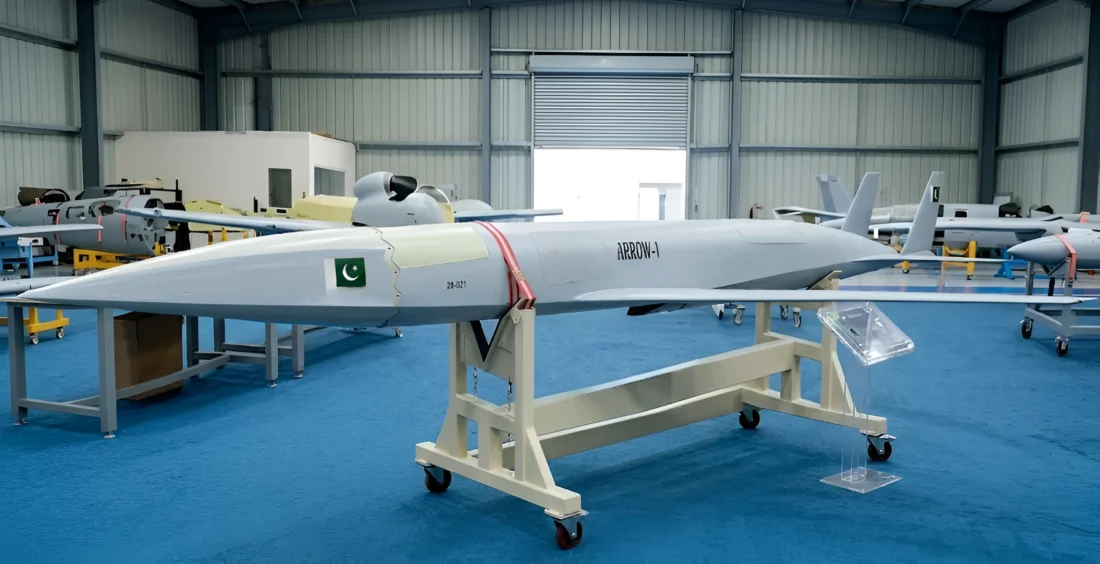

Pakistan’s National Aerospace Science and Technology Park (NASTP) has commenced serial production of the Arrow-1, a ground-launched, low-observable one-way attack drone developed for the Pakistan Air Force (PAF). The production line was publicly glimpsed in a video released by the PAF’s Directorate General Public Relations (DGPR) during the Chief of the Air Staff’s official visit to Uzbekistan. The footage carries significance well beyond its promotional value: it constitutes the first visual evidence that Arrow-1 has transitioned from a static display concept into an industrialised programme with an established manufacturing base.
Consistent with the PAF’s long-standing practice regarding emerging strike systems, Arrow-1’s technical parameters remain classified. No official data has been released on its range, cruise speed, warhead mass, guidance architecture or propulsion. Any credible assessment must therefore rest on observable design features, the platform’s place within NASTP’s wider product portfolio and the doctrinal trajectory evident across Pakistan’s emerging loitering munitions industry.
Design Characteristics and Programme Context
Arrow-1 was first presented in NASTP’s unmanned aircraft systems hall alongside the Lightning-I and Lightning-II. Within this grouping, Arrow-1 has been positioned as a low-observable strike drone, Lightning-I as an AI-enabled tactical loitering munition and Lightning-II as its extended-range derivative. The same exhibition space featured the combat-proven YIHA-III, an Anka unmanned combat aircraft display and modular cruise missile concepts, collectively presenting a spectrum of prospective missions.
The platform’s most consequential visible attribute is its airframe geometry. The majority of propeller-driven loitering munitions, the YIHA-III among them, employ conventional tubular fuselages optimised for low cost and ease of manufacture. Arrow-1 by contrast, adopts an angular faceted configuration that indicates a deliberate attempt to manage its radar cross-section. Its ground-launched architecture further implies runway independence and compatibility with mobile launch systems, a combination that enables dispersed deployment and shoot-and-scoot employment designed to deny an adversary reliable targeting of launch sites.
High-Subsonic Propulsion and Low-Observable Configuration
Visulas of Arrow-1 on the NASTP production floor offers clear indicators of its propulsion and performance class. A ventral air intake positioned beneath the mid-fuselage confirms an air-breathing jet engine, placing the platform firmly in the high-subsonic category rather than among the slower piston- or electric-powered loitering munitions that dominate the tactical segment. This propulsion arrangement affords substantially higher cruise and terminal speeds, sharply compressing the window between detection and impact available to an adversary’s air defences, while also supporting extended stand-off ranges from launch positions well behind the front line.
The airframe reinforces this assessment. Arrow-1 features a long, slender fuselage with a sharply pointed nose, chined and faceted surfaces, mid-mounted wings and outward-canted twin vertical stabilisers. Canted tail surfaces and careful planform alignment are established signature-reduction techniques intended to deflect radar energy away from emitting sensors, while the belly-mounted intake shields the engine face from frontal and ground-based radar illumination. Taken together, these features describe a purpose-built, high-subsonic, ground-launched low-observable attack drone engineered to penetrate defended airspace and prosecute high-value targets such as air-defence radars, command-and-control nodes and air bases. Its precise radar cross-section, range and warhead remain classified, but the design intent is unmistakable.
Pakistan’s Advancing Indigenous Aerospace and Defence Technology
Arrow-1 must be understood as one outcome of a broader and accelerating effort to build sovereign aerospace and defence-technological capacity. Over the past two decades, Pakistan has progressed from licensed assembly towards increasingly autonomous design, integration and production. The co-development and serial production of the JF-17 Thunder at the Pakistan Aeronautical Complex, Kamra, established the industrial foundation, engineering workforce and systems-integration experience upon which subsequent programmes have been built.
The establishment of NASTP marked a structural evolution in this trajectory. Functioning as the PAF’s in-house research, design and integration hub, NASTP has expanded into airborne and ground-based radar development, electronic warfare, avionics upgrades, unmanned systems and precision munitions. Its model of combining in-house research with joint ventures and transfer-of-technology arrangements, most visibly with Türkiye’s Baykar on the YIHA-III and with Chinese partners on systems such as the Dark Angle II, has enabled Pakistan to absorb critical know-how while progressively localising its supply chains.
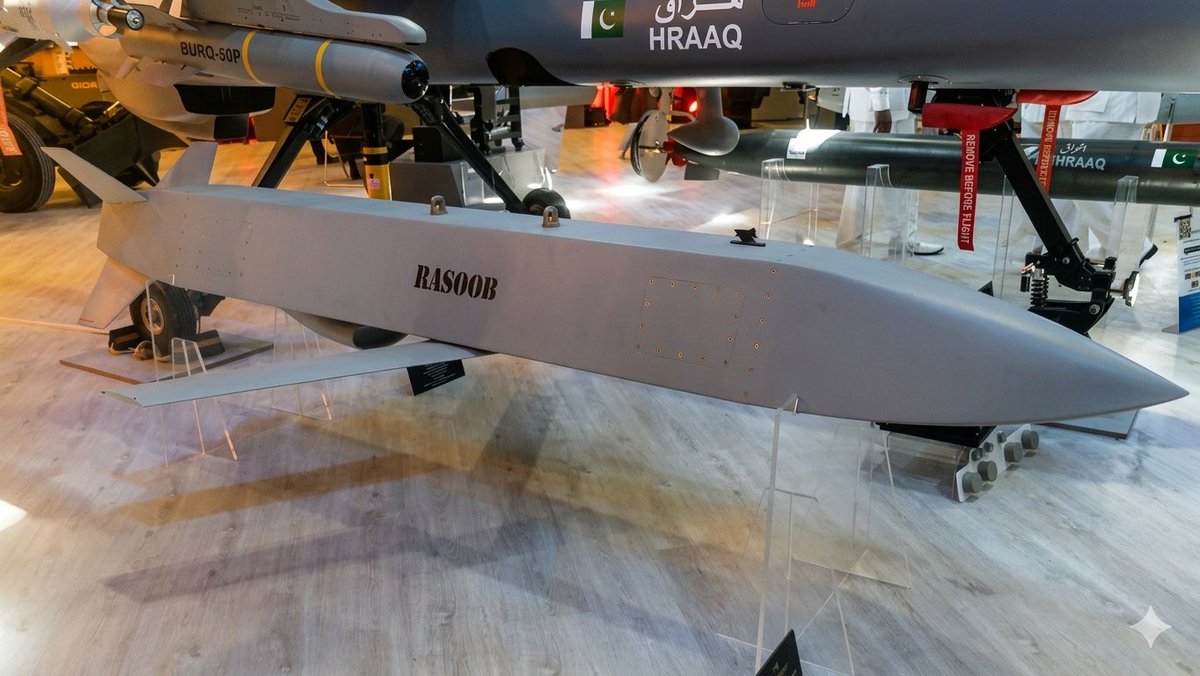
Parallel advances across the wider defence-industrial base reinforce this picture. Global Industrial and Defence Solutions (GIDS) has matured the Shahpar series of medium-altitude unmanned aircraft and a family of loitering munitions, while Heavy Industries Taxila has entered the long-range strategic loitering munition segment. A growing private sector, including Sysverve Aerospace, Woot-Tech Aerospace and Integrated Dynamics, now contributes rapid prototyping, AI-enabled targeting, fibre-optic guidance and swarming technologies. Stand-off precision weapons such as the Rasoob-250, together with battlefield networks such as PAKFIRE and Rehbar, demonstrate that Pakistan’s ambitions now extend beyond individual platforms to integrated, network-centric kill chains.
Against this background, Arrow-1’s entry into serial production carries particular weight. It joins the YIHA-III, KaGeM V3, HIT’s strategic loitering munition, SARFIROSH and the jet-powered Al-Murtajiz in a portfolio of expendable strike systems that offers multiple pathways to targets across varying ranges. Manned-unmanned teaming has been identified as a PAF priority, and Exercise Golden Eagle provides context for that direction. Whether Arrow-1 can be employed in concert with crewed fighters, AEW&C assets such as the KJ-500 and stand-off munitions nonetheless remains an open question of doctrine, interfaces and tested command relationships.
Strategic Implications for India
The May 2025 India–Pakistan conflict demonstrated that loitering munitions have become central instruments of precision strike, surveillance and air-defence suppression in the South Asian theatre. Arrow-1 introduces an additional layer of complexity into this contest. Should its shaping reduce radar detection ranges even marginally, Indian air-defence operators would face compressed timelines in which to detect, classify and engage incoming threats, eroding the reaction margins on which layered air defence depends.
The more significant challenge lies in employment concept rather than in any single platform. Pakistani doctrine increasingly treats loitering munitions as decoys, saturation weapons and force multipliers employed alongside cruise missiles, glide bombs and tactical ballistic missiles to probe and overwhelm integrated air-defence networks. Integrating a signature-managed effector into mixed salvos of less expensive propeller-driven munitions could compel Indian defenders to expend high-value interceptors and activate fire-control radars, thereby exposing those emitters to follow-on suppression strikes. Such an approach also imposes an unfavourable cost-exchange ratio, as mass-produced expendable systems are considerably cheaper than the surface-to-air missiles required to defeat them, threatening the depletion of interceptor inventories over a protracted campaign.
Arrow-1’s ground-launched, mobile character further complicates any Indian effort at pre-emption, since dispersed launchers are inherently difficult to locate and neutralise before an attack. Collectively, these factors are likely to compel New Delhi to accelerate investment in low-frequency surveillance radars, airborne early warning coverage, electronic warfare capabilities and dedicated counter-unmanned aircraft systems, as the burden of defence shifts from intercepting individual threats to managing sustained, multi-axis saturation.
Conclusion
The commencement of Arrow-1 serial production signals that NASTP has moved decisively from prototype demonstration to industrial-scale manufacturing. The platform’s exact mission set and the extent of its low-observable performance will remain uncertain until test data or operational employment provides confirmation. The broader strategic message, however, is unambiguous. Pakistan is methodically constructing a diversified portfolio of indigenous, expendable strike systems designed to complicate interception and stretch an adversary’s air defences, underpinned by a maturing aerospace-industrial base. For India, this development elevates the detection and defeat of low-observable and saturation threats from a technical consideration to a pressing strategic imperative.